

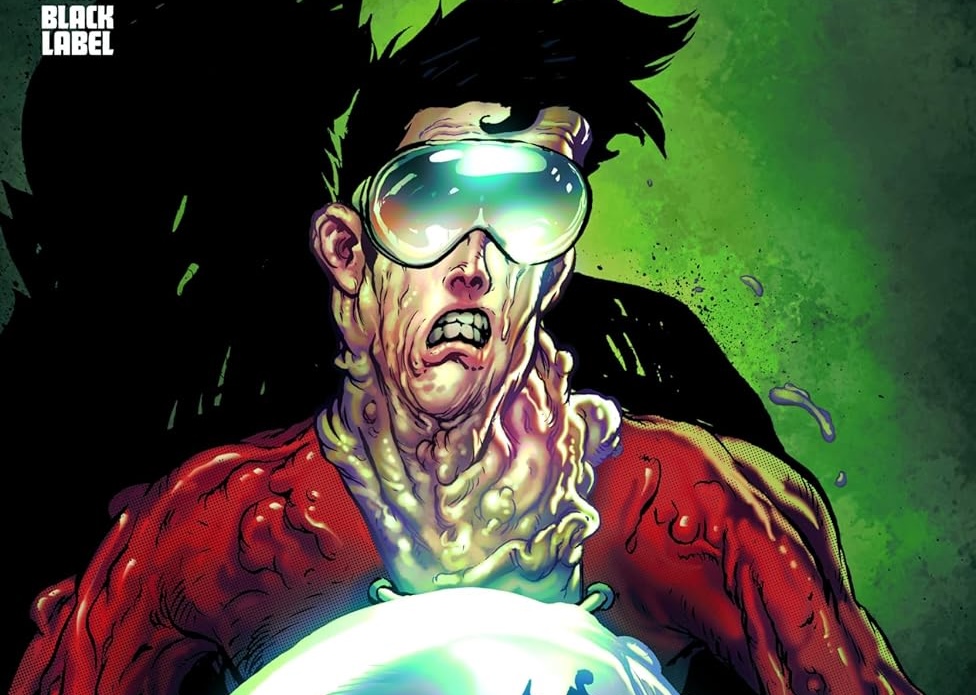

Nothing ever goes right for DC’s comic relief characters, but Plastic Man No More! #2 reveals just how devastating life can be for a character who is often accompanied by a laugh track. The sharp disassembling of Plastic Man’s character continues with the next stage of his slow-developing demise. Once again, Christopher Cantwell, Alex Lins, Jacob Edgar, Marcelo Maiolo, and Becca Carey put their all into developing a truly fascinating story and proving that Eel can be more than just a sitcom star.
In terms of artistic talent, Plastic Man No More! #2 picks off exactly where issue #1 left off. Even the most light-hearted scenes between Eel and his son are filled with a deep foreboding, thanks to the eerie colors and the misshapen penciling. Yet, as horrific as every flashback feels beneath the surface, the present-day scenes are just as jarring. Every jump makes Eel’s condition more devastating, and the comic never shies away from showing the horror of his descent into a puddle of goo. You know, a real heart-warming comic.
As amazing as the art is, however, it is hard to ignore the equally incredible writing. Cantwell expertly weaves the criminal element of Eel’s past into his more heroic present. Framing the book’s narrative around it helps tie Eel’s story to the classic trope of a criminal conducting one last grand heist.

DC Comics
Unsurprisingly for a Cantwell story, Plastic Man No More #2 draws heavily from the depths of DC’s lore. The book surprisingly reintroduces Uranium of the Metal Men, a character so obscure that he did not appear in the Prime Earth revival. The little-known character plays an essential role in Eel’s latest heist. It could help to make Uranium a far more memorable figure.
Other characters are also given a king’s treatment by Cantwell. Luke, an often overlooked and underrated character, gets moments of development and attention that he rarely receives otherwise. This is a man who was only introduced in 1999 and is generally just viewed as a forgettable member of the Terrifics. To give that character depth is an impressive accomplishment for Cantwell, especially as he builds Luke’s connection to other well-known DC heroes.
There are still some elements that need more elaboration, however. It would have been far more compelling to see Eel recruiting his allies, rather than having them appear beside him in his moment of need. Time spent formulating his plan could also have added to the sense of a gradual descent, rather than Eel leaping head-long into his scheme without actually stopping to consider what that scheme should be.
Additionally, the fight scene is difficult to parse. The fighting itself is limited to a few short panels, which lack much of a sense of flow. The strength of this book is in its characterization, plotting, and its fluid artwork. The fighting, meanwhile, features (literally) faceless hordes facing off against Eel’s barely-developed allies. It makes it difficult to care about the battle as anything more than a scene to check off on a template.

DC Comics
The coloring in Plastic Man No More #2 also takes a step back in several pages. There is no sense of depth to any of the Metal Men, nor do they actually appear to be metallic. The simplistic art style might work in other books, but a story so driven by body horror and realism does not complement it well. The bright colors might have contrasted well with more detailed art, as well.
That, at least, would be a suitable argument, if not for the transition back to complete darkness. Scenes with the Justice League remain simplistic and colorful, but the artists offer a stunning contrast each and every time the book reminds readers about Eel’s decaying body. The colors dull, the linework sharpens, and details creep into every spare mark in Eel’s face. Simplistic Justice League scenes, draped in comedy and classic art styles, are shattered in the face of a gritty tragedy.
The ending, too, is a grotesque display that needs to be witnessed without any spoilers whatsoever. The colors, the penciling, and even the silence is perfect for this story. If Eel is going to be reshaping himself — as plastic is so often molded — then that is the exact scene where this book can define itself.
Plastic Man No More! #1 set up the stakes, but Plastic Man No More! #2 showed off exactly why this concept has so much potential. With a consistently amazing quality of writing, artwork, and just about everything else, there is no reason not to pick up this book. It continues to excel at everything its creators dream of, and it will continue to thrill its readers.




You must be logged in to post a comment.