

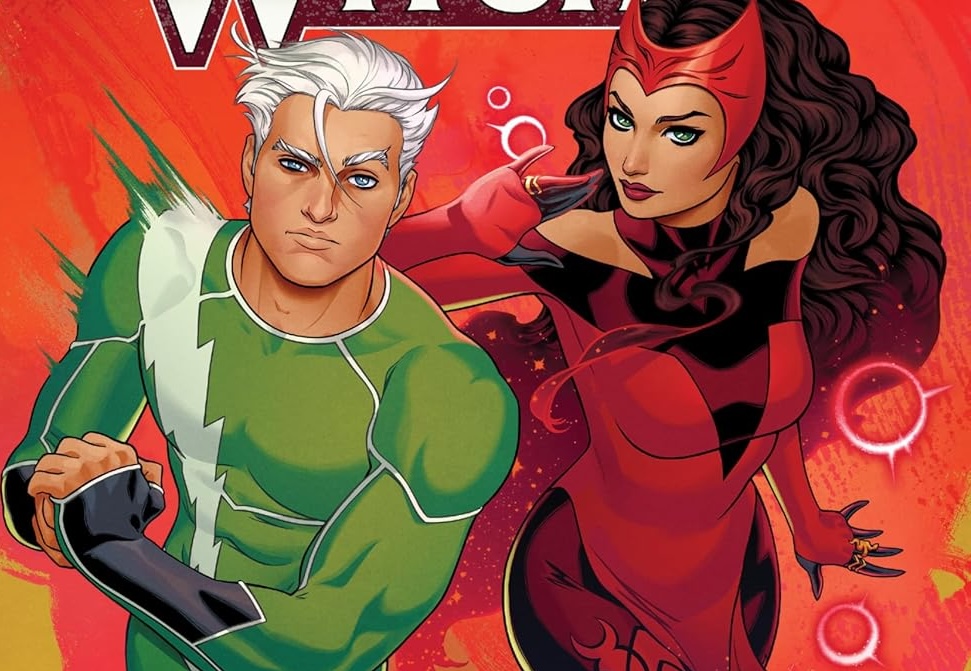

Scarlet Witch & Quicksilver is an odd little chapter of Steve Orlando and company’s Scarlet Witch epic, for various reasons. For one, the 2023 volume of the series ended after ten issues, got the four issues collected here as a uniquely titled miniseries, and then relaunched as a new, ongoing volume earlier this year. Despite a title change and rebooted numbering, this volume is still presented as Scarlet Witch Vol. 3 (with the new series slated to be collected in Vol. 4 in February).
Floppy collectors have an awkward situation in their alpha-numeric long box organization, but bookshelf collectors will have a nice, unbroken row of trades. Very confusing.

Marvel Comics
Why the strange interruption? Though the story seems to shake up the narrative foundations of the story by demolishing Wanda’s shop (and destroying her fantastic door), June’s Scarlet Witch #1 informed us that Wanda and Darcy still have their shop in Lotkill.
Perhaps the only reason for the narrative upset lies in the inclusion of Wanda’s family – not just Quicksilver (whose inclusion doesn’t seem large enough to necessitate the title swap), but also Wanda’s ex-husband Vision, magically-manifested son, Speed, and even a brief visitation from adopted father Magneto and Vision’s daughter, Viv.

Marvel Comics
The preceding Scarlet Witch title went to great lengths to revitalize Wanda, who has tragically spent most of her illustrious career as either a supporting character or a wildly destructive plot point. It’s been a long, uphill battle for Wanda to wash away the lingering trappings of the latter – she’s made a variety of reality-altering feats of atonement, most recently sacrificing herself to create a mutant afterlife. A starring role in a book that didn’t linger in her now twenty-year-old crimes was long overdue.
So perhaps Scarlet Witch & Quicksilver was only meant to open the doors of her upstate New York isolation and embrace the parts of Wanda’s past that aren’t inherently bloody and guilt-inducing, to return her to the parts of her life that she has denied herself. Even if Magneto has awful opinions about her relationship with her brother.
The conflict of the book – the Wizard, touched by an angel, sets out to eradicate the twins on the order of some omnipresent being – serves as a fitting canvas for these small reunions; never high stakes enough to overshadow Wanda’s more immediate concerns while managing to foreshadow some later Big Bad. This seems to be the Wizard’s sad lot: forever a minor villain, barely an inconvenience.
Lorenzo Tammetta, who takes over art duties from the first volume’s Sara Pichelli, captures all these villains and guest stars with an almost heartwarming humanity (yes, even the robots). Each of them carries their own personalities, their own energies, which is an impressive feat for any artist, let alone one juggling a pile of iconic Avengers characters. Even Speed, who rarely gets a better treatment than ‘little Quicksilver’ feels unique against his better-known uncle.

Marvel Comics
Whatever the taxonomic confusion inherent to Scarlet Witch and Quicksilver, the book does manage a nice diversion from Wanda’s quasi-domestic life, and it does so without sacrificing Wanda’s ongoing personal journey. It feels like a highlight reel of feel-good supporting cast, and continues Orlando’s trend of clearing the air around a long-beleaguered character.




You must be logged in to post a comment.