

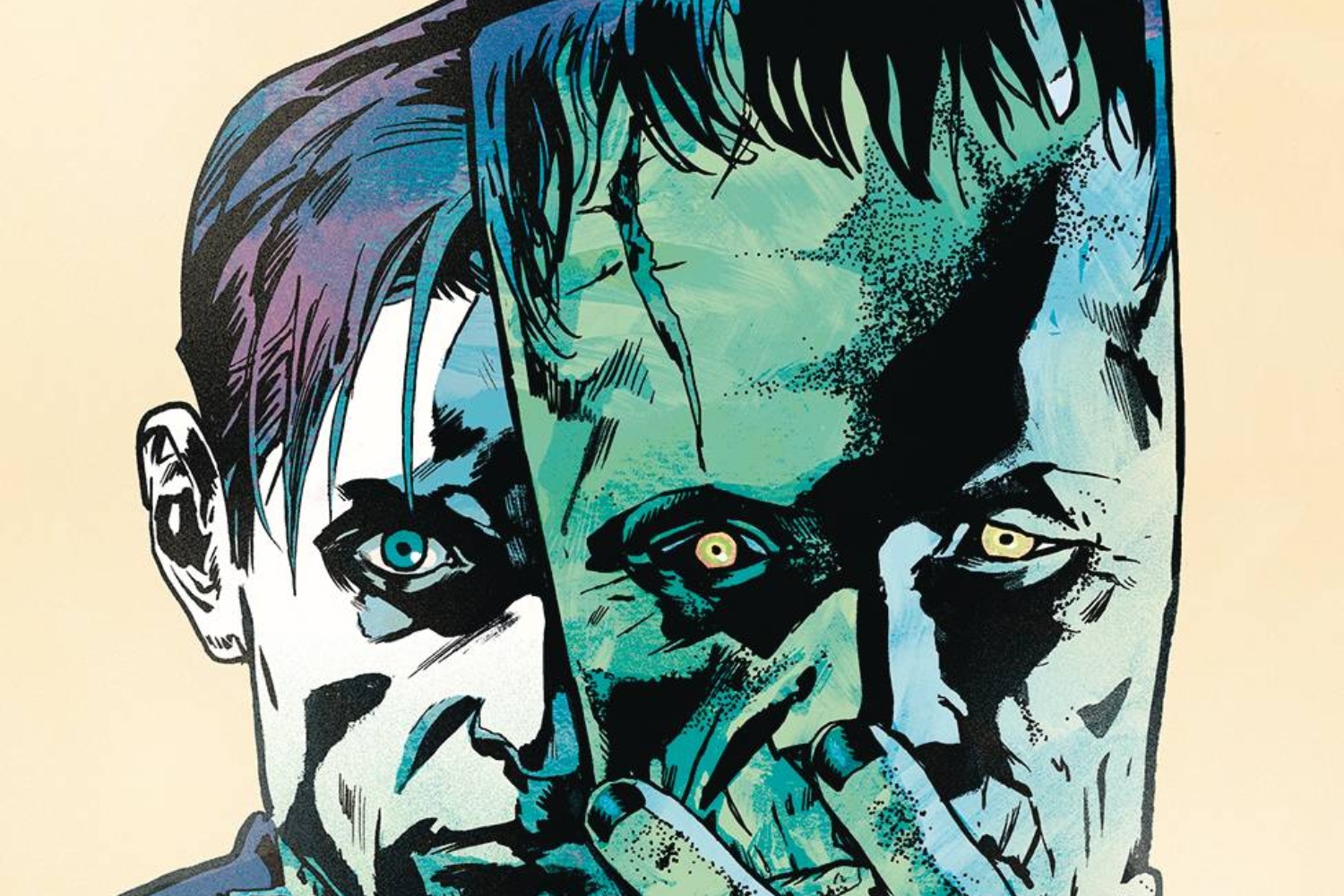

I’ve been a passionate fan of the Skybound’s various Universal Monster titles. Sure, not every offering has been equal (I loved Dracula over the Creature), but it’s been a feat to take these complicated creatures, distill their essence, add something new, and still tell a meaningful story.
Universal Monsters: Frankenstein has defined that dynamic to a tee — writer/artist Michael Walsh has opened up this story in a really novel and exciting way, adding new layers to get us thinking about the morality of man, our relationship to death, and even the nature of vengeance.

Variant cover by Jenny Frison. Courtesy of Image/Skybound.
But as we arrive to Frankenstein‘s fourth and final issue, Walsh (alongside colorist Toni-Marie Griffin and letterer Becca Carey) run right into the limitations of these adapted series, and the ending is both better and worse for that very process.
Because so far in Frankenstein, we’ve gotten just enough of the novel and 1931 film to feel connected to the “source material.” It’s been just enough basic structure, giving us that vital gravity and familiarity, even as the creative team had other goals in mind. That mostly meant the “infusion” of the young orphan, Paul, whose mission to understand the fate of his own father injected the standard Frankenstein story with even more humanity and emotionality. Sure, Paul wasn’t as robust a present across the first three issues as maybe he should’ve been, but that new wrinkle was huge in making this version of Frankenstein feel more vulnerable, and to dig deeper and more excitedly into its emotional core.
Perhaps some of those aforementioned issues were tied into this book’s interests in Dr. Henry Frankenstein. After coming off a little one-dimensional in the debut issue, Frankenstein’s battle between his obsession and his humanity became a central aspect in this story — perhaps just as vital as Paul’s own arc. What that left us with, then, was a kind of dueling narrative: the Dr. was too detached from his humanity, and struggled to reconcile, while Paul was very much the essence of humanity in a world where such “purity” maybe wasn’t so viable.
In the end, we ultimately got a really well-rounded narrative dissection of how is it is to loose your way morally/ethically, and how like the monster, we’re not made but rather forged by the fires of a complicated world. It felt like a profound realization of the story’s true heart and intellect, and it’s what made this adaptation so charming and refreshing.
Only, and this is where we truly, finally experience the limitations of adapting a complex novel into four mere issues, the ending lands a little…oddly. It feels like we sprint into the finale/climax at the burning mill, and that takes this powerful, expertly tailored moment and makes it feel slightly hollow. What should’ve been a more robust set piece is sadly a footnote of sorts.
Which isn’t to say that a little efficiency doesn’t go a long ways: the “scene” with the young drowned girl Maria happens brutally fast, but then that’s the point: we’re meant to feel like there’s a turning point for the monster, only for life to intervene and slash us suddenly, deeply to our core. Regardless, all of this seemingly had to be cut and/or streamlined to make way for this finale’s big moment: a “confrontation” between Dr. Frankenstein and Paul.
In another instance of using pacing or characterization to play with our perceptions, Paul’s oddly the adult in this convo. Without revealing too much, he’s the one “schooling” the good doctor about the true nature of grief and why we’re better left to suffer when we experience loss (as that’s the nature of our big, beautiful world).

Variant cover by Francesco Francavilla. Courtesy of Image/Skybound.
That dynamic certainly disarms, and it’s also a continuation of this book’s interest in exploring the simplicity of “life then death” as a counter to our own overt existentialism. Plus, it’s a way to show us that we know how to be when younger and we lose that in the shuffle of maturity and controlling a chaotic world.
Sure, Dr. Frankenstein comes off a little foolish (maybe the point?), and that’s only partially rewarding. But, again without spoiling too much, Paul actually gets a “happy” ending. He has a significant moment to bask in the beauty and complexity of his own grief, and while there’s no real sense of resolution, his painful but vital outlook on life and death is rewarded with one of the most directly beautiful moments in the book (visually and emotionally).
It’s a single instance that tells us that things will end and things will begin after we’re already worm food, but the real magic is getting to be a part of this cycle in the first place. The only thing to get out of this long, slow march is what you want to get from it, and in that sense, Paul is a firm bit of comfort in the dark. He is maybe the wisest of them all, and he shows us that life is not to be lived forever, but to be enjoyed, griefed over, and allowed to continue as deemed necessary by God/blind fate/etc.
He teaches Dr. Frankenstein and readers alike some big lessons, and it happens in such a sweet but sad way that we’re left to hover in that moment with him, contemplating what it all means and letting the weight of it all really hang in the air. And unlike other adaptations of this (especially the 1931 film, which has a slightly cutesy ending), this take on Frankenstein nails it where it matters most. Forget the rush across issue #4, or the half-cocked approach (at times) to the doctor (or that Elizabeth’s role basically doesn’t come to fruition despite some great chemistry with Paul).
Frankenstein is ultimately about endings (among other things) — specifically, what we do when we know they’re coming, and why the smartest, bravest of them all is a boy who just let his own ending come as it may. A boy who, despite not having any reason or training, knew instinctively to embrace the world’s imperfectness, knowing it’s better to have only memories as opposed to fighting a battle that’ll only get you tossed off a burning mill.
And the fact that Paul resonates so deeply here is proof of something vital about this Frankenstein: it’s been a way to explore Walsh as both a person and a creator. Do I think Paul’s a stand in for the author and his own views? It would make sense that he’d want to speak to us as someone new, and to try and give us something small but powerful to glob onto. It’s a sense furthered by other visuals in this issue: not only are there heaps of charming and tranquil scenes, but the horror is also amped up even further. (And across the first three issues, Walsh and company brought the old-school horror vibes with gusto.)

Variant cover by Maria Wolf and Mike Spicer. Courtesy of Image/Skybound.
Be it the terror experienced by the monster at the mill, a harrowing execution early in the book (that’s huge for setting up the doctor’s mental state leading into the finale), the aforementioned bits with Maria (seriously, that’ll gut you where you stand), and the unsettling undertones of the Paul-Dr. Frankenstein chat, this issue comes right for you amid some robust displays of beauty.
But why? To pick back up on the “presence” of Walsh, it’s about a conversation and fostering an experience. Here, someone has taken Frankenstein, remixed it in his own image and ideals, and presented this story anew. Maybe his “findings” aren’t totally novel (though the Paul stuff remains refreshing, obviously), but it matters not — we connect with the creator in such a profound, multifaceted way.
And in doing so, I think we’re experiencing the most effective “version” of this book. A journey that shows us not only to never fear death to the point it takes away from life, but that it’s in others that we are reminded of life’s blend of joy and heartache. That the connections we forge are both the best and worst parts of life, and only by having all of it can we truly have lived some halfway meaningful existence.
Frankenstein is clearly not an easy book, but Walsh has distilled its essence in such a powerful way (even if it meant leaving threads hanging, or having to move quickly when a slower crawl might’ve helped). The team more than stuck the landing, and that’s the thing that’ll stick with me longer than any other issues.
It’s the kind of spirited, deeply personal approach to an adaptation that connects with hearts and minds above all else. It’s also why this whole Universal line’s been such a success: it lets creators speak to us through our biggest fears/anxieties. At the end of Frankenstein #4, you may be less terrified and more overjoyed to walk through life as a patchwork creature made of love and memories.




You must be logged in to post a comment.