


The cosmic portion of the Marvel Universe has always been a place of wandering rogues, each compelling enough for their own stories but perpetually left in the background of other stories. It’s a part of the Universe largely undocumented beyond singular protagonists (and, more recently, a singular team).
That isn’t to say that it was sparsely populated – picking up nearly any issue of 1987’s The Silver Surfer will reveal any number of brief villains, from space pirate lizards to a whole retinue of ex-Heralds of Galactus. Had Surfer had any of the pull of then-contemporary X-Men books, there would have certainly been a host of miniseries diving into Reptyl, Firelord, or Pip the Troll.
But Surfer wasn’t a tentpole book, and the cosmic portion of the Universe has only received momentary spotlights through events like The Infinity Saga and the more recent Annihilations. This later produced a handful of those miniseries, though half those treated had already been endowed with solo titles at various points in their publishing history.

Marvel
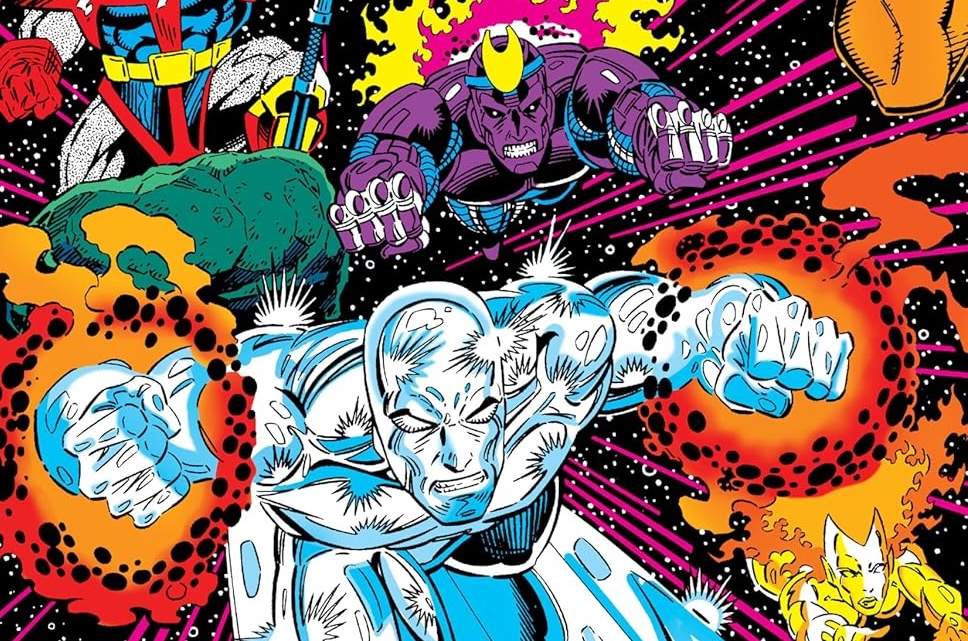
It was in the pages of solo books – Warlock stories, Surfer stories, and Nova stories – that space was populated and explored, in stories like those collected in The Herald Ordeal, which sees the aforementioned Heralds of Galactus pulled together to confront their God and his new employee, Morg.
Up to this point, these characters had only ever been singular foes of the Surfer and bit-antagonists in The Fantastic Four, and while creators always made them pop – there is no finer example of a one-off bronze age FF baddie than Terrax the Tamer – it was only in the pages of Silver Surfer that the characters were treated as semi-rounded individuals, given all the more depth through the Surfer’s empathetic nature and shared history. It was in this series, after all, that Thanos went from ‘spooky big bad’ to the Biggest Bad of the Marvel Universe.
The Herald Ordeal doesn’t do wonders in exploring, say, the inner-life of Air-Walker, but it does present some compelling evidence that these characters do have lives – and motivations – of their own.
After (the other) Nova begins to feel the burden of galactic-genocide guilt, Galactus exiles her in favor of the bloodthirsty executioner Morg; Nova now missing (and pissed that Morg is “unworthy” as a herald), the Surfer bops around space rounding up all the men/robots who took over his post after his own moral reawakening.

Marvel
It’s classic work by one of the preeminent creators of the Marvel Cosmic mythology, Ron Marz, the guy who examined the foundations laid by the earlier mastermind, Jim Starlin, and pushed to populate the corners of space with all these delightful weirdos. As the conflict with Morg and Galactus heats up, Marz slowly develops Nebula, a character who shone briefly in The Infinity Gauntlet and was left toothless and ill-defined. Here, she gets the signature bionic look that would go on to MCU stardom. Even the gross, weird little alien surgeon who performs this cosmic plastic surgery is a delightful character (who may very well have influenced Stan Lee’s sharp-as-hell barber in Thor: Ragnarok).

Marvel
Though The Herald Ordeal may not be the most memorable portion of this volume of Silver Surfer – it has nothing to do with Thanos, after all – it is nonetheless packed with Marz’s (and, near the end, Ron Lim’s) classic energy, a perfect spotlight on how sparse storytelling went on to populate a universe. And that’s not even going into the graphic novel and annual crossover the book starts with, both of which play with Silver Surfer’s more famous (and terrestrial-based) relationships to heartbreaking and hilarious effect.
Silver Surfer Epic Collection: The Herald Ordeal proves without a doubt that the quality of this volume of Silver Surfer never hinged on its participation in The Infinity Saga, and that every issue of Ron Marz’ long, long run provides depth and insight to the sparsely tread galactic stage.




You must be logged in to post a comment.