



We’re fast approaching a major mutant milestone – the golden anniversary of Giant-Size X-Men #1, which originally released in February of 1975. Created by writer Len Wein and artist Dave Cockrum, it’s hard to explain just how much Giant-Size X-Men #1 changed the franchise. So many of today’s most popular X-Men first appeared within this 68-page issue, including Storm, Nightcrawler and Colossus. Plus, it established Wolverine as a mutant, and put him on the team. It jump-started a title that had been dead for five years, and began the most important run in X-Men history, even if Chris Claremont didn’t take over writing duties until the next regular issue (X-Men #94).
But despite everything good about Giant-Size X-Men #1, the five-page, action-packed climax involves some of the worst physics I’ve ever read in a comic. I usually don’t complain about funky science in works of science fiction and fantasy, but this one deserves the attention.

Marvel Comics
In order to defeat the original, evil living island of Krakoa, the X-Men, new and old, form a mutant circuit, long before the recent Krakoan Era made mutant circuits popular. Storm electrically charges and amplifies Polaris’ magnetic powers, which are further augmented by blasts from Havok and Cyclops. Polaris finally releases the built-up energy in a powerful electromagnetic blast that somehow disconnects Krakoa from Earth’s gravitational field.
Free from Earth’s pull, Krakoa subsequently flies off into space, I assume through its own inertia – although Wein’s exposition says it’s due to “Earth-Forces” coming violently together. Rumor has it, this was all originally Claremont’s idea.
Okay, what’s so bad about that? Well, besides the fact I have no idea what Wein means by “Earth-Forces,” gravity has basically nothing to do with electromagnetism. They are different forces affecting two different aspects of matter. The only connection between electromagnetism and gravity found so far derives from Einstein’s general theory of relativity, which says gravity comes from the bending of spacetime by matter or energy. And since electromagnetic fields have energy, they create gravity — but not a lot. You’d need an unimaginably strong electromagnetic blast to create any kind of measurable gravitational effect.
And if Polaris’ electromagnetic blast were strong enough to do that, it would actually only strengthen the gravity around it, potentially being felt everywhere on Earth! There’s simply no way Polaris could sever the planet’s gravitational pull, let alone do so for one specific location and object.

Marvel Comics
If that weren’t enough, I can’t help but see more bad physics in Krakoa’s trajectory as it flies away from the Earth. Well, I suppose if it were shot away from the surface by “Earth-Forces” coming violently together, the trajectory could be straight-up, perpendicular to the surface. But if Krakoa really did fly away due to its own inertia after no longer being held by Earth’s gravity, it would actually move along a line tangential (that means parallel) to the surface.
You can demonstrate this at home. Tie something to the end of a string and spin it around in a circle parallel to the floor; for example, over your head. When you let go of the string, the object doesn’t fly off perpendicular to the rotation, but rather tangential to it. I did this once and created the stroboscope image below. In a similar way, in Giant-Size X-Men #1, Krakoa is the object on the string, and disconnecting Krakoa from Earth’s gravity is letting go of the string.
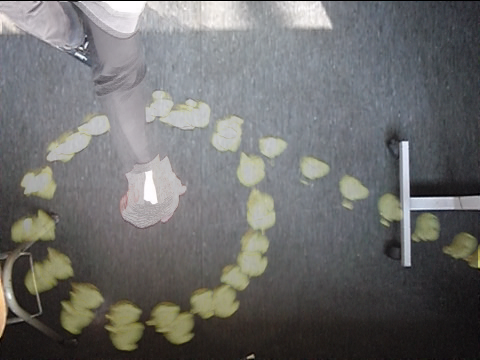
Photo by David Canham
Now, from the perspective of someone in the water nearby, it would probably at first look like Kraokoa is shooting straight up into the air, because you’re still rotating with the Earth, underneath the now-flying island. So, the left panel in the image up above isn’t all that bad.
But the next panel is drawn from a reference point in space and shows Krakoa shooting straight up, perpendicular to Earth’s surface. That’s either bad art, bad physics, or the fictional work of violent “Earth-Forces.”

Marvel Comics
It’s not all bad, though. I especially like the idea of electricity repowering Polaris, as well as her having electromagnetic powers rather than simply magnetic powers. About 200 years ago, physicists discovered the connection between electricity and magnetism, and about 160 years ago, Maxwell’s equations completely summarized the classical theory of electromagnetism. Later, using Einstein’s special theory of relativity, physicists could show that electric and magnetic fields are one and the same, just experienced in different reference frames. So, according to the laws of physics, every character with magnetic powers should also have electric powers (and vice versa).
In fact, the unification of electricity and magnetism was so successful, many physicists, including Einstein himself, spent years attempting to combine gravity and electromagnetism into some kind of Grand Unified Theory. Even though modern physicists continue to work on it, no Grand Unified Theory has been developed yet.

Marvel Comics
Then there’s Havok and Cyclops propelling Iceman’s ice-raft by blasting in the opposite direction –agreeing very well with the physics of rocket propulsion. And I also like the whirlpool forming in Krakoa’s wake, as that could definitely happen when the water rushed into that now-empty space.
Funky science or not, Giant-Size X-Men #1 is still one of the best comic books of all time. From Cockrum’s stellar art and character design, to the great writing and excitement of the action-packed story and the tension of the conflict, to the introduction of so many popular characters (not to mention the sheer historical impact), no one can deny how important this comic is. Despite the physics not passing even the Stan Lee sniff test.
AIPT Science is co-presented by AIPT and the New York City Skeptics.



You must be logged in to post a comment.