

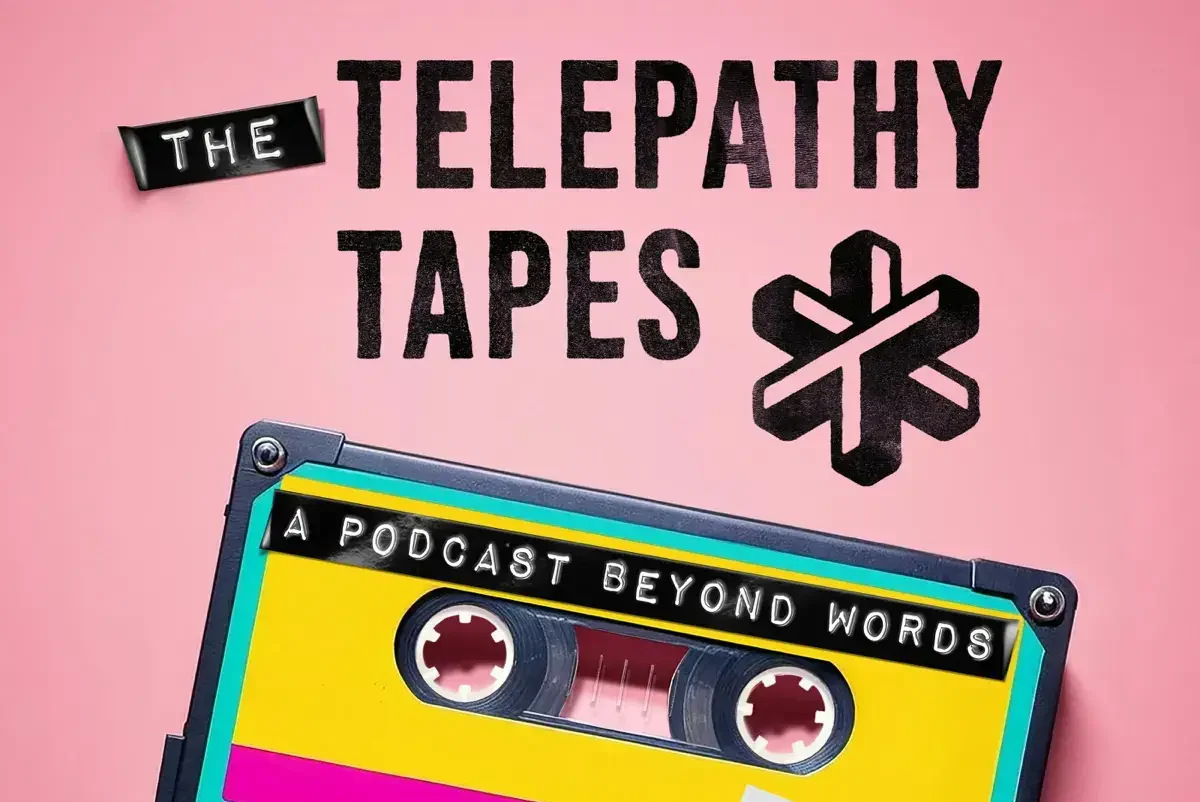

If you’re interested in learning about how telepathic abilities work in nonspeaking individuals with autism, then The Telepathy Tapes podcast is not for you. But if you’re interested in a thought experiment being conducted by researchers and reporters all over the world into what the inner lives of non-speaking autistic people might be like if they had the ability to telepathically communicate using a discredited technique called Facilitated Communication (FC), then Telepathy Tapes might be worth a listen. It’s important for people to understand why the claims being made in the podcast on behalf of individuals with autism should be taken with a large dose of skepticism.
FC is a spelling technique used on individuals with profound communication difficulties that relies on an assistant (facilitator) for physical and emotional support. The variant forms of FC basically break down into two main categories: traditional, touch-based FC and no-touch FC. In touch-based FC, a literate assistant known generally as a facilitator holds onto the wrist, elbow, shoulder, neck, or other body part to “support” the non-speaking person being facilitated. With no-touch FC, the facilitator holds a letter board in the air while the person being FCed points a finger toward it.
The problem with both forms of FC is that the facilitators (often inadvertently) aid in letter selection through visual, auditory, and physical cues. These cues can range from subtle changes in pressure while the facilitator touches the person, to changes in vocal inflection, or the use of hand signals that direct the FCed individual to targeted areas of the letter board. Often, the facilitator (unconsciously) moves the letter board in the air to signal where the person should touch the board. There are no reliably controlled tests that prove proponent claims of communication independence using FC.

If you think FC might have died out in the mid-1990s when PBS’ Frontline aired a documentary called “Prisoners of Silence” that exposed its dangers, it did not. In fact, like a virus, it’s mutated into variant forms known as Spelling to Communicate (S2C), Rapid Prompting Method (RPM), and Spellers Method. Instead of abandoning FC after reliably controlled tests repeatedly showed that facilitators, not those being subjected to the technique, were authoring the messages, proponents simply changed its name. There are over 20 pseudonyms for FC being used by proponents today, and the number keeps growing.
In The Telepathy Tapes, filmmaker Ky Dickens and neuropsychiatrist Diane Hennacy Powell set out to prove the telepathic abilities of nonspeaking individuals by setting up a series of tests. However, in every test featured on the podcast to date, Dickens and Powell show the facilitators the test stimuli (rather than blinding them from test stimuli, an essential part of a controlled trial) and then have them use FC with their children to spell out the answers. Not so amazingly, the children spell out answers the facilitator already knows — even when the FCed individuals are not looking at the letter board.
The claims made in The Telepathy Tapes don’t just stop with the FCed responses to simple tests. Instead Dickens, who claims to have been skeptical at the beginning of this bizarre journey, gets sucked further into the realm of credulity. Not only are these profoundly autistic children geniuses, they all have telepathic abilities or gifts from God that allow them to transcend their bodies.
Nonspeaking individuals are, for example, able to meet telepathically in a place called “The Hill,” to converse and learn from other nonspeaking individuals. They get their supernatural intellectual abilities, we’re told, by tapping into a cosmic library that contains all the knowledge of the world. Their capacity to dispense wisdom (including medical advice) far outshines the capabilities of mere neurotypicals who are—especially if you doubt their claims—incapable of expanding their minds and “thinking outside of the box.”
Dickens, and many of the parents and educators interviewed for The Telepathy Tapes, take a faith-based, “seeing is believing” approach to their investigation. FC works because people using FC say it works. But many of the “tests” Dickens sets up to prove telepathy are magic tricks that mentalists and conjurers use to fool and please their audiences.
A mother, for example, flips through a book (unseen to the child) and picks out a word, picture, or page number, and then facilitates the answer. In another test, a mother is shown an UNO card (again, unseen by the child) and then facilitates the answer. In yet another test, the child is blindfolded, then handed a series of colored popsicle sticks (e.g. red, green, blue) and is then asked to sort the sticks into the appropriate piles while the mother holds onto the child’s face. None of the “investigators” ever think to check what would happen if the facilitator wasn’t able to see the test stimuli and/or look at the letter board while the child pointed to it.
As The Telepathy Tapes wears on, Dickens and the facilitators want their listeners to think that these nonspeaking individuals are highly evolved and have psychic, prophetic, and telepathic powers that transcend the need for letter boards or words altogether. But of course, none of the claims being made on behalf of people being subjected to FC can be verified independently and without facilitator influence.
As a former facilitator who abandoned FC in the early 1990s after participating in blind testing, I find it painful to listen to how credulously Dickens and the other “experts” treat FC and the claims being made on behalf of nonspeaking individuals with profound autism. The later episodes in Season 1 of The Telepathy Tapes have an evangelistic tone (especially episode 10) that is, I believe, designed to recruit facilitators into using S2C/RPM.
But — and I’m stretching to find something good here — I think it would be worth sifting through the pseudoscientific nonsense and listening to what I believe are parents’ sincere and desperate pleas, written in the guise of FCed messages from their children, for better support systems both for their children and for them as caregivers.
Maybe one day, we as a society can provide people with profound communication difficulties (like those featured in the podcast) and their caregivers with the appropriate educational, medical, housing, and recreational supports they need, so that facilitators won’t have to rely on disproven techniques like FC/S2C/RPM to be heard.
For more information about FC/S2C/RPM, including controlled testing, systematic reviews, opposition statements and more, please visit http://www.facilitatedcommunication.org
Every February, to help celebrate Darwin Day, the Science section of AIPT cranks up the critical thinking for SKEPTICISM MONTH! Skepticism is an approach to evaluating claims that emphasizes evidence and applies the tools of science. All month we’ll be highlighting skepticism in pop culture, and skepticism *OF* pop culture. AIPT Science is co-presented by AIPT and the New York City Skeptics.


You must be logged in to post a comment.