

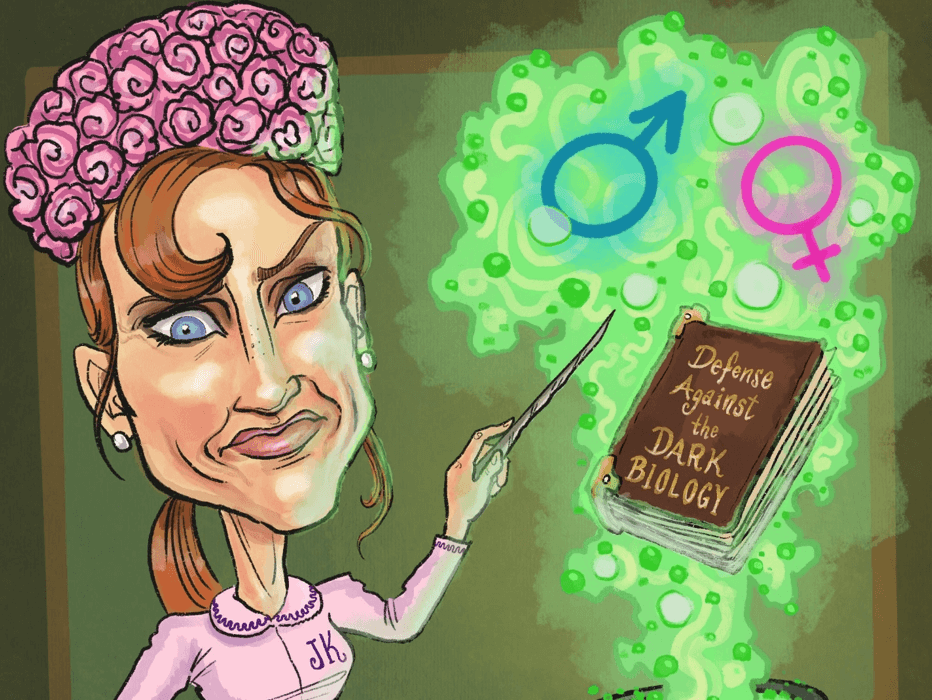

In the late ’90s, the Harry Potter series by British author J.K. Rowling became a pop culture phenomenon. Wildly popular among children, it was considered diabolical propaganda by Christian conservatives who were convinced tales of a school for witchcraft and wizardry were teaching kids to worship the Devil.
Ironically, nearly two decades after the book and subsequent film series concluded, Rowling has herself assumed the role of moral watchdog, spending an inordinate amount of time, particularly on the social media platform X (formerly Twitter), composing, sharing, and liking posts that are critical of gender pluralism, activity which has drawn criticism from fans of her work and the LGBTQ community in general.
Rowling and other critics of gender pluralism — the idea that gender identity and expression are more complicated than the binary of male or female — aren’t content to deny that trans and nonbinary people exist; they argue that the kinds of civil liberties and gender-affirming care which these people want is part of a larger, darker agenda. They think that innocent children are being brainwashed into believing themselves to be trans or nonbinary, prescribed hormone supplements like Estradiol and Androderm (what’s called Hormone Replacement Therapy, or HRT), and forced to undergo life-altering gender-affirming surgery.
On December 28, 2024, someone wrote on Rowling’s X account, “I wish you would use your immense powers for good. Your hateful focus on trans kids is hurtful and unnecessary”. In response, Rowling fired back:
“There are no trans kids. No child is ‘born in the wrong body.’ There are only adults like you, prepared to sacrifice the health of minors to bolster your belief in an ideology that will end up wreaking more harm than lobotomies and false memory syndrome combined.”
As both a trans woman and a scientific skeptic who’s quite familiar with false memories (as they relate to accusations of Satanic Ritual Abuse), I find Rowling’s comparison both hyperbolic and dangerously misleading. When you consider the true nature and scope of lobotomies and false memory syndrome, you can see why.

Lobotomy in “Pyschosurgery,” 1950
Medicine and misogyny
The first prefrontal leukotomy (more commonly known as a lobotomy) was performed by Portuguese neurologist António Caetano de Abreu Freire Egas Moniz in 1935. Moniz hypothesized that mental illness originated from a “fixation of synapses” in the brain which produced “predominant, obsessive ideas,” and believed these could be surgically corrected by severing the white matter fibers connecting the two frontal lobes.
While opponents of lobotomy denounced the practice as too invasive and speculative, many found the results too attractive to ignore — patients who previously suffered from depression, anxiety, paranoia, and even hallucinations and were treatment-resistant were suddenly calm and docile. Considering the alternative was institutionalization, lobotomies were cheap and easy, providing quick and effective outcomes.
At the height of their popularity, approximately 40,000 people in the United States were lobotomized. Despite the majority of psychiatric patients committed to sanitariums being men, the majority of lobotomies performed in the United States between 1949 and 1951 were on women, committed against their will by their fathers or husbands.
Lobotomies only had limited success in the short term, and the procedure came at a terrible cost — cognitive impairment and reduced intelligence, memory loss, reduced social skills, and behavioral changes such as aggression and irritability, or apathy and indifference. Thankfully, by the 1950s, lobotomies had fallen out of fashion, eclipsed by the invention of antipsychotic drugs like chlorpromazine.

Melvin Quinney (right) was exonerated from wrongful abuse claims, fueled by false memories, 30 years after being imprisoned. (Paul Flahive, Texas Public Radio)
Ah, memories
During the 1970s and ’80s, cultural attitudes toward sexual abuse and in particular, incest, began to change. Thanks in part to second-wave feminism, sexual violence against women became the focus of much research. In trying to understand the true prevalence of rape and incest in society, otherwise well-meaning therapists and psychiatrists began to believe that their patients (mostly women and children) were struggling with depression, anxiety, insomnia, relationship problems, etc., because of repressed memories that needed to be recovered in therapy.
What’s relevant with respect to Rowling is that after decades of research by psychologists like Elizabeth Loftus and Richard McNally, there’s compelling reasons to believe that most recovered memories of abuse (particularly the fantastic tales of Satanic Ritual Abuse) were iatrogenic — produced by or resulting from the intervention of a therapist. Memory is an inherently fallible and reconstructive process, a creative blending of fact and fantasy. Given the right circumstances and motivation, people who are especially susceptible to suggestion can develop false memories.
While there have been cases of people who retracted previous accusations of abuse and successful lawsuits brought against psychiatrists and hospitals for helping create false memories, as in the very public case of Bennett Braun, who personally settled out of court to the tune of $7.3 million, it’s difficult to estimate the true number of retractions due to the creation of false memories. In a 2023 study published in The European Journal of Psychology Applied to Legal Context, out of 56 respondents who’d retracted previous claims of recovered memories, “thirty-three participants considered their recovery of abuse-related memories to be caused during therapy.”
Wingardium odiosa
Rowling’s comparison of lobotomization and false memory syndrome to gender-affirming care misrepresents the nature and impact of the latter. We don’t know exactly how many children may have been lobotomized, but based on the high-profile accounts of some who were (e.g. Howard Dully, who was 12 at the time, or Ellinor Hamsun, who was only 6 years old), we know that children were subjected to lobotomy for reasons as varied as not reacting to punishment and “daydreaming,” to being “impossible to get into contact with.”
It simply isn’t true that children are being forcefully operated on, as was the case with lobotomies, or manipulated into believing themselves to be transgender, as was the case with false memory syndrome. As the Associated Press points out, it’s “very rare” for anyone under the age of 18 to receive gender affirming surgery, and those unique instances are decided on a case-by-case basis. Doctors and surgeons, as well as the institutions they represent, are beholden to ethical codes of conduct and aren’t going to risk their reputation by performing invasive surgical procedures on minors without the knowledge, involvement, and consent of a parent or guardian.
Do the numbers support Rowling’s contention that children are being forced towards HRT and gender-affirming surgery? According to a 2024 article published in the Journal of the American Medical Association (JAMA), of a sample of 22,827,194 insured minors taken from a national data set in 2019, the rate of minors ages 15-17 years undergoing gender-affirming surgery was 0.0021% or 81 minors; for those ages 13-14 years old the rate was 0.0001% or 3 minors. There is no record of any minors under the age of 12 having undergone gender-affirming surgery.
As an author and activist, Rowling has done demonstrable good in the world. This makes her use of her talent and the platform she’s built to spread such misinformation all the sadder. One of the recurrent themes throughout the books is how Harry Potter’s adoptive family, the Dursleys, mistreat him because of his latent magical powers; they fear and consequently resent him. Understandably, the reader is not supposed to like the Dursleys and their cruelty.
Every February, to help celebrate Darwin Day, the Science section of AIPT cranks up the critical thinking for SKEPTICISM MONTH! Skepticism is an approach to evaluating claims that emphasizes evidence and applies the tools of science. All month we’ll be highlighting skepticism in pop culture, and skepticism *OF* pop culture.
AIPT Science is co-presented by AIPT and the New York City Skeptics.



You must be logged in to post a comment.