

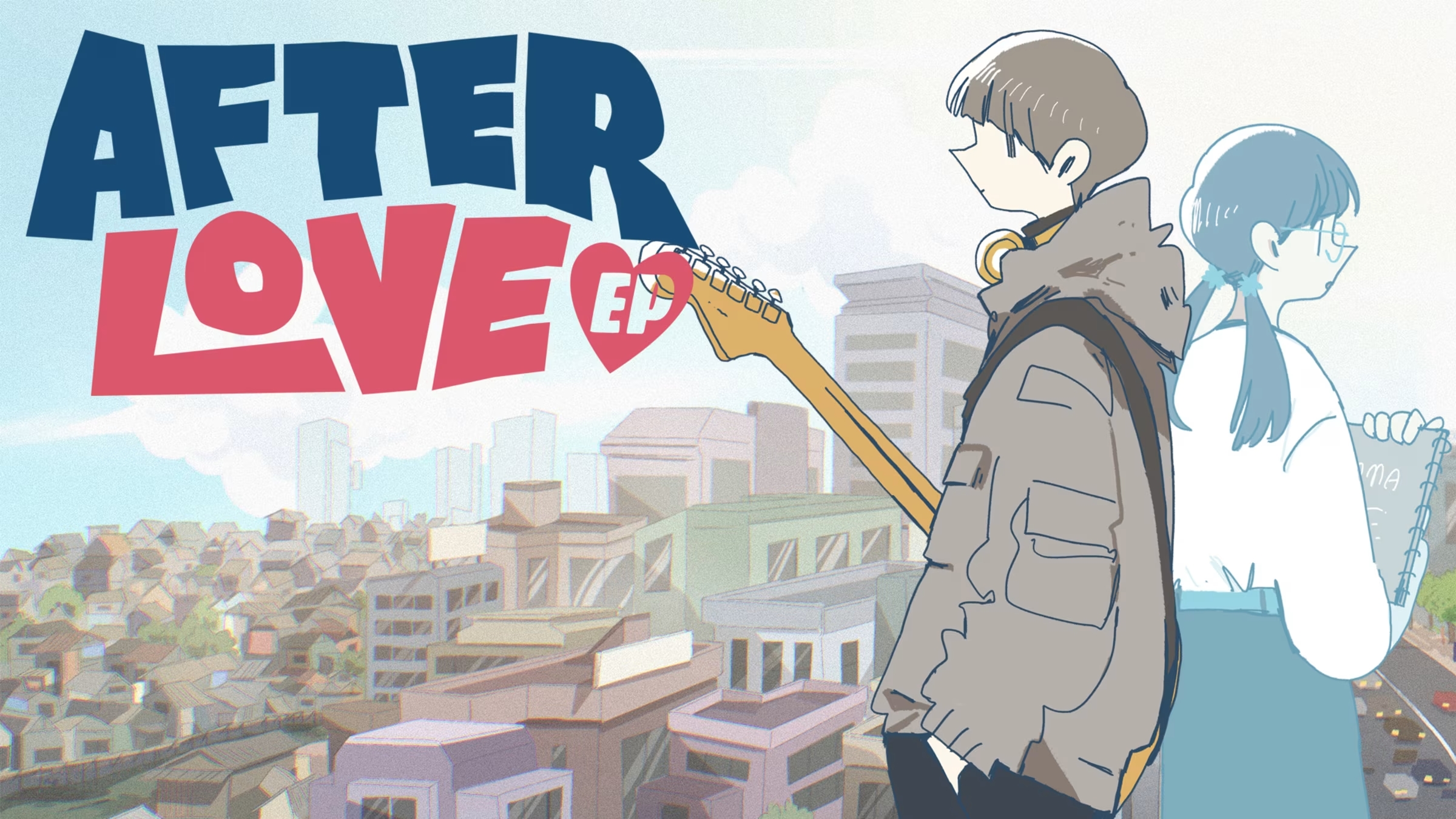

Rama’s trying to live again. A year after his partner Cinta passed, sending him into a malaise and splintering his on-the-cusp indie band Sigmund Feud, Rama goes to therapy. He starts meeting people who could be friends or lovers. But Cinta — a ghost or a figment of imagination — is never far from Rama’s thoughts. She wants the best for Rama, but she’s just as messy as he is. At the end of September, Sigmund Feud will play a make-or-break comeback show (indie rock band L’Alphalpha provides Sigmund Feud’s songs). Rama needs to step up — for bandmates Tasya and Adit, for the new friends (and maybe lovers) he comes to care about, for Cinta. For himself.
Afterlove EP is a visual novel, adventure game, rhythm game, and dating simulator. It’s stunning as a piece of audiovisual art. As a story, it’s wonderfully thorny and often quite moving. As a tribute to its late lead designer, Mohammad Fahmi (Coffee Talk, What Comes After), who died in 2022, it’s lovely. As a game, it bounces between enjoyable and frustrating.

Presentation-wise, Afterlove EP is gorgeous, thanks to lead artist Soyatu‘s clean, stylish, comic-inspired character art, L’Alphalpha’s catchy music, voice actor Risa Mei‘s striking turn as Cinta, and developer Pikselnesia’s deft depiction of Jakarta as a thriving city of ten million stories. Afterlove EP’s neighborhoods are filled with a distinct, memorable array of folks. Its streets feel like the places a musician in his mid-twenties would frequent — primarily an arts district with a well-loved record shop and an eminently hangoutable cafe.
Afterlove EP‘s story thrives on thorniness. Rama, Tasya, and Adit love and know each other well — well enough to recognize when one of them is hurting and to be impressively hurtful when things get heated. Cinta loves Rama and wants him to be happy, but she’s not an omniscient manic pixie. She doesn’t want Rama to grieve forever, but she’s uneasy about what his moving on would mean for them and her. Her being either a ghost or imaginary makes Rama reticent to talk about her, isolating them both. In one of Afterlove EP‘s best creative touches, Cinta has voice acting where every other character has a portrait. Thanks to a strong performance from Risa Mei, it’s a striking creative decision that helps set her apart from the rest of the cast.
Rama’s new friends and potential love interests Mira, Regina, and Satria are a similarly complex and dynamic bunch. Mira is a fellow creative whose passion is infectious. She’s also very similar to Cinta — enough to worry Rama that he’s attracted more to the resemblance than to her. Regina enjoys pushing Rama out of his comfort zone and being pushed out of her own. She also just broke up with Adit, who neither she nor Rama talks to about their burgeoning relationship. Satria’s the most together of the cast and introduces Rama to a host of cool folks. Pursuing him romantically means Rama figuring out his bisexuality in a city of both excellent folks and vicious bigots. All three are likable, dimensional characters. Whether or not Rama pursues them romantically, all of their stories intersect with Rama’s in interesting ways.

Nothing comes easy in Afterlove EP‘s story. Grief is a bear, and reweaving broken trust requires care and work. When Rama, Cinta, or their friends and loved ones screw up and lash out, it’s raw and ugly. When they build a bridge and cross to each other despite their struggles, it’s moving, sometimes even thrilling.
Structurally, Afterlove EP runs on time management. After an opening act that introduces the cast and the stakes, Rama has a month to spend as he will. Band practice is always on Friday evening, and there are a few fixed events, but the game plays out based on how you, the player, choose to use Rama’s time. Think of it as a cousin to modern Persona‘s calendar system. Band practice and certain story events manifest as a simple rhythm game. While neither elaborate nor challenging on the default difficulty, playing songs feels physically good and builds to a narratively cathartic final concert at Afterlove EP‘s climax.

Less successful is Afterlove EP‘s opaque romance system. Outside of a key moment where Rama decides to pursue a romantic relationship with one of his potential partners, there are no indicators of where he stands with them or what he needs to do to make things right when their courtships go sideways. During one of my playthroughs, Rama had a major falling out with his partner, which I worked to repair. By the end of gameplay, they seemed to be on good terms — only for the ending to reveal that they’d had a cataclysmic breakup and weren’t speaking. It was so out of left field that I’m not sure it wasn’t the result of a bug triggering the wrong ending. Afterlove EP‘s romances boast some of the game’s best writing, but they would benefit significantly from mechanical clarity.
On the review copy of the game I played on Switch, Afterlove EP is technically solid but beset by bugs in its late game. During the last day of the story, Rama and Cinta travel around Jakarta to get grounded and maybe rustle up some good luck before Sigmund Feud’s big show. Afterlove EP continuously crashed during this segment. I had to save whenever Afterlove EP let me during the rest of the sequence as it continued to crash throughout Rama’s city-wide journey, and the game’s autosave would load at the beginning of Rama’s trek. This needs to be patched urgently. Beyond being a visible and significant technical problem, it wrecks the narrative flow of a pivotal scene.
Frustrating as parts of Afterlove EP‘s gameplay can be, it’s a thoughtful, well-told story that treats grief and recovery with care without wallowing in the morose. Rama and company are dimensional, compelling characters. Soyatu’s art and L’Alphalpha’s music rule. I’m so glad the Pikselnesia team was able to finish Afterlove EP after Fahmi’s passing, and I’m looking forward to playing it again and seeing all the ways its story might go.



You must be logged in to post a comment.