

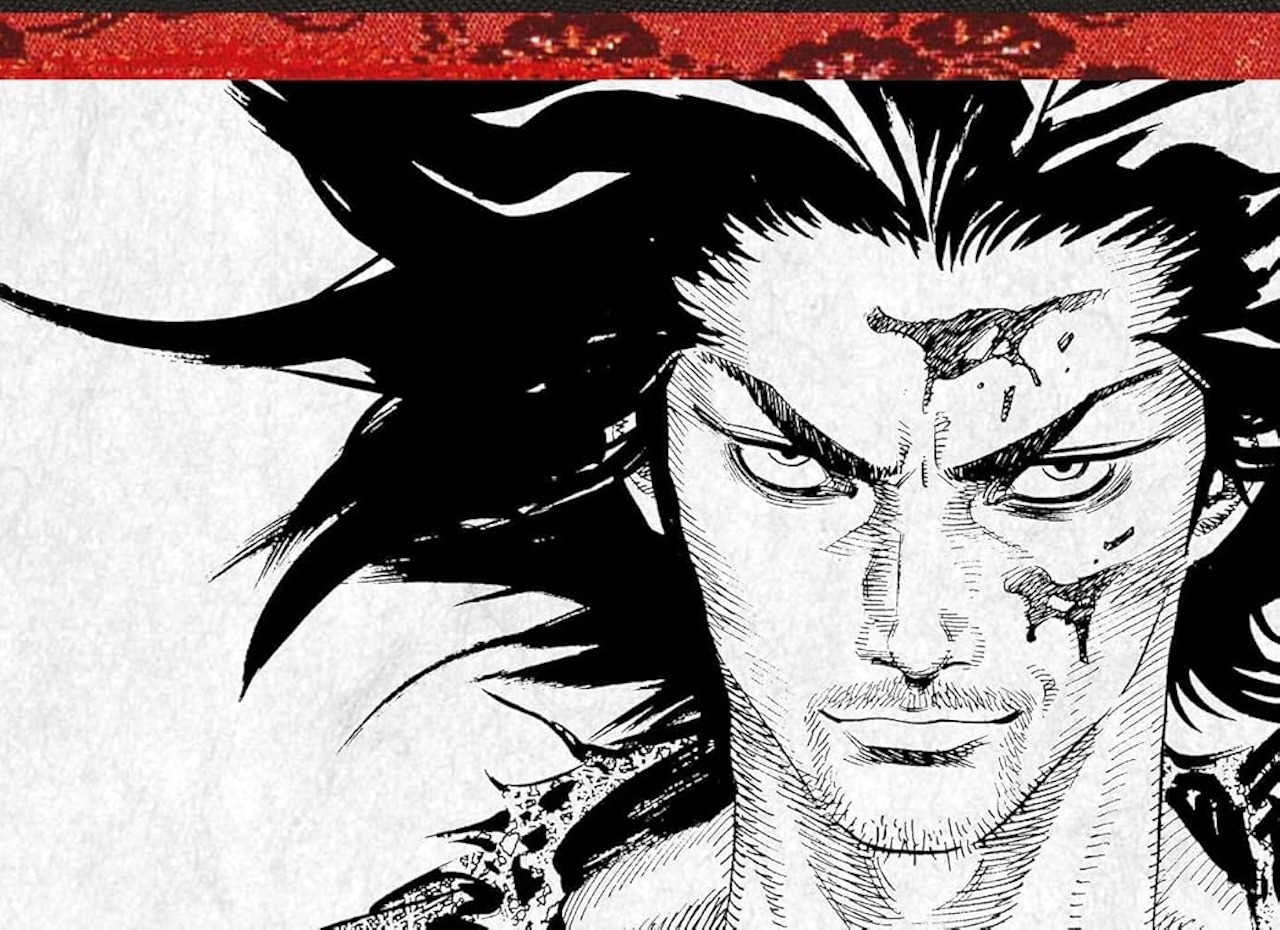

Let’s talk about Vagabond, one of the most critically renowned manga. Vagabond takes place during the Sengoku period, a time of warring states as a result of domain lords at the time. The manga was initially released in 1998 and has only been released in print. The story follows that of Shinmen Takezō -later called Miyamoto Musashi, a young man “seeking the way of the sword” with hopes of becoming “Invincible Under the Sun.” This story appears to be inspired by the novel Musashi by Eiji Yoshikawa. Mushashi is often considered to be almost wicked or evil by those who fear him because of his unrelenting fury during his many battles to grow stronger. Mangaka Takehiko Inoue once said that manga is his “arms and legs…a very natural way for me to express myself.” When looking at the beauty that is Vagabond: The Definitive Edition Volume 1, it’s clear that Inoue truly wanted this book to be an expression for readers to become invested in.

VIz Media
Shinmen Takezō, our protagonist, welcomes us to the world of Vagabond shortly after the Battle of Sekigahara, as a fugitive on the run with his lifelong friend, Matahachi Hon’iden. The pair find themselves rescued and soon go on their separate ways. Despite having been best friends for as long as they can remember, the pair couldn’t be more different. Takezō is a complex character: he’s arrogant, arguably depressed, and for all intents and purposes the most driven fighter ever. All he wants is to improve in the way of the sword- it’s all he can see for his future is that “[i]n the end, I’ll be cut down, too.” Meanwhile, Matahachi is the complete opposite – he’s without any sense of self-respect, he’s selfish, irresponsible, and very quickly irredeemable. For every moment Takezō appears cruel or brazen, it shows his own feelings towards himself; meanwhile, Matahachi continuously disregards the basic forms of decency that should be considered for others around him.

Viz Media
The latter half of the book includes a bit of a time jump, but all then takes place within the span of a day. Takezō, now called Miyamoto Musashi, has chosen to “live on and endure the shadows” by traveling to Kyoto to continue his quest to become “Invincible Under the Sun.
Inoue’s art style is, quite simply, brutally beautiful. It’s harsh, vivid, and absolutely stunning. The attention to detail brings every part of this book to life. And when in Kyoto, Musashi travels to one of the most infamous schools for training, where he hopes to fight the master of the school immediately. While things don’t go his way, and he continues to fight like a demon, it’s here where Inoue’s art comes to life to me. Sure, the first half is intricately drawn, as a majority of the book takes place outdoors. But it’s when the environment is sized down to that of a single room do things become expansive. Through this, I feel the story really begins to lift off and become more captivating.
As a Definitive Edition, Vagabond’s first volume is a well-rounded story that will likely hook the reader into the series as a whole. While the story handles intense and sometimes dark themes, it handles them as brutally honest as it could. There isn’t much skirting around the actions characters make, and while everyone is flawed in their own right, the strong polarization of characters’ actions forces the reader to confront these themes at face value. While that may be too much for some readers, others may find it an honest representation of the world; while some people are simply flawed, others are intentionally immoral. However, despite these themes, the story grows more and more captivating as we begin to understand more about Miyamoto Musashi. Moreover, idioms like, “[t]here is no light… for those who do not know darkness” encapsulate the book very well.




You must be logged in to post a comment.