

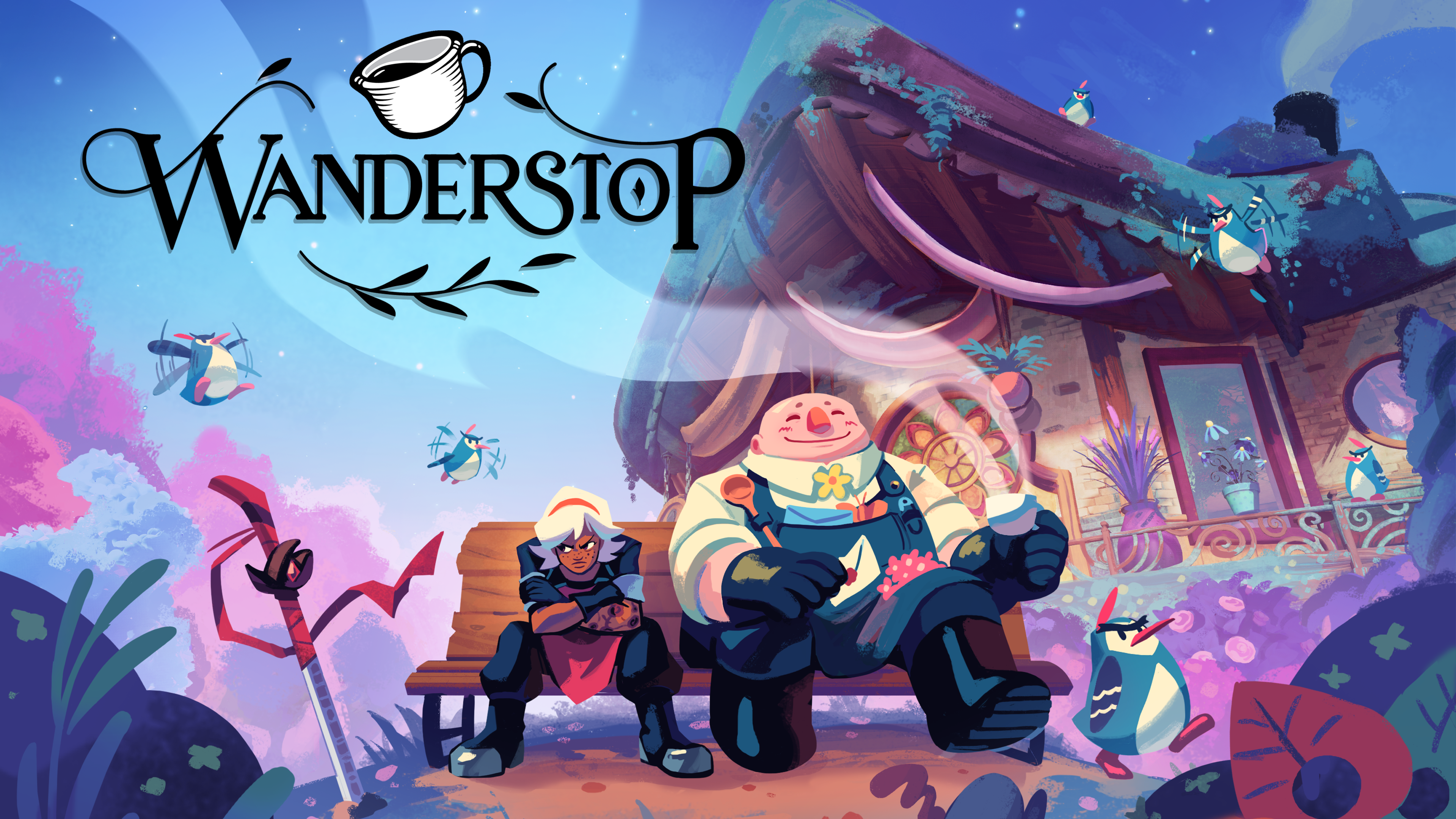

Three indistinguishable businessmen in brown suits (Jerry, Terry, and Larry) are wandering around Wanderstop, and they’re desperate for coffee before the presentation in the boardroom.
There is no boardroom at Wanderstop, nor is there coffee. This is a tea-exclusive haven in a small clearing at the center of some magical woods, and I suspect these businessmen all arrived here much the same way I did: as if deposited by some karmic force. They, like I, are the wanderers this place seems to “stop” (as in catch in a drain), people in need of kind, soothing reprieve in the middle of their epic, self-involved journeys.

I’ve met a half-dozen such wanderers at this point: a suburban dad turned questing knight, afflicted with an uncurable curse; a small bat-woman letting loose from an over-strict community and trying things for the first time. In the autumn, there was Ren, a fighter, who knew who I was – who was a fan of me – but who misunderstood who I was becoming. That seems to be going around.
In Wanderstop, you play as Alta, a woman who has been a sort of fantasy arena fighter all her life. She was the best of the best, undefeated, until she hit a wall – facing defeat after defeat, no matter how much and how hard she trained. A panic set it, a fear that she wasn’t working hard enough. Every loss was a crushing blow, not to her ego or her body, but to her work ethic.

Seemingly lost in those magic woods, Alta is the only one of the wanderers to be invited to stay by Boro, the warm proprietor of Wanderstop. Sensing that Alta is need of rest – something Alta refuses to believe – Boro teaches her how to make tea with Wanderstop’s overcomplicated mechanical heart.
There are tea leaves to be collected, fruity additives to be planted and harvested. The garden must be maintained – leaves swept up and ominously encroaching brambles to be cut back. Each visitor to Wanderstop has certain teas they require: something that gives them energy, something that reminds them of home. These teas are increasingly difficult to brew as some need fruits of different colors while one needs to be brewed with the pages of a hard-boiled detective novel.
But for all its cozy game trappings, Wanderstop isn’t a game of complicated and time-sucking mechanics. It doesn’t expect you to harvest crops to sell them, and it doesn’t expect you to develop Wanderstop into a thriving business. There is no money, and there are no time constraints. You aren’t expected to run across a massive map or to remember any NPC birthdays. There isn’t a task-limiting day and night cycle, and even though the game is concerned with Alta’s exhaustion, there is no stamina bar or bedrest. You don’t even have to tend to any graves or awaken any forest spirits.

That’s because Wanderstop isn’t a game about tea, not really – it’s a game about burnout, a narrative about seemingly insurmountable problems without definite solutions. You aren’t the only one with troubles in Wanderstop, and some seem more serious than others – whether they be a hokey miscommunication with one’s son or a recently amputated arm. None of these concerns are presented as more or less severe than any other – including Alta’s crushing fatigue. All concerns are valid at the Wanderstop, and all of them are dealt with in the same way: with tea, considerate questioning, and the realization that it’s not likely that every problem can be solved.
This game was developed by The Beginner’s Guide and The Stanley Parable developer Davey Wreden, you see, which might tip off fans that the game won’t be what it says on the tin. There are fewer narrative rug-pulls than one might expect from a developer whose games have mostly been about metanarrative and developer commentary, but Wreden’s general disregard for gaming conventions lies at the heart of Wanderstop, however cozily nestled it might be.

As the game slowly reveals itself – as Alta’s true narrative is slowly revealed – the game heightens a sense of subtle and toothless dread, but the game is mostly a game of humorous, Breath of the Wild-zany NPCs and simple, repetitive tasks. It’s a game that mirrors what recovery from burnout might look like: small rituals, reflection, but the always-present impulse to push forward in a way that might burn you out further. At one point, frustrated at her inability to fight, Alta decides that she’ll just have to become the best ever tea-brewer, and she commits to this with a firey intensity that isn’t healthy; the impulse to overwork isn’t so easily overcome. Thankfully, Boro is always around to remind her to slow down.
Playing with just enough of the cozy game workaholic mechanics and with just enough Wreden commentary, Wanderstop ends up being a compelling marriage of narrative and mechanics, of whimsy and message. It’s more cute than existentially alarming, and given that it relates the devloper’s own burnout, that balance is just as it should be.




You must be logged in to post a comment.