

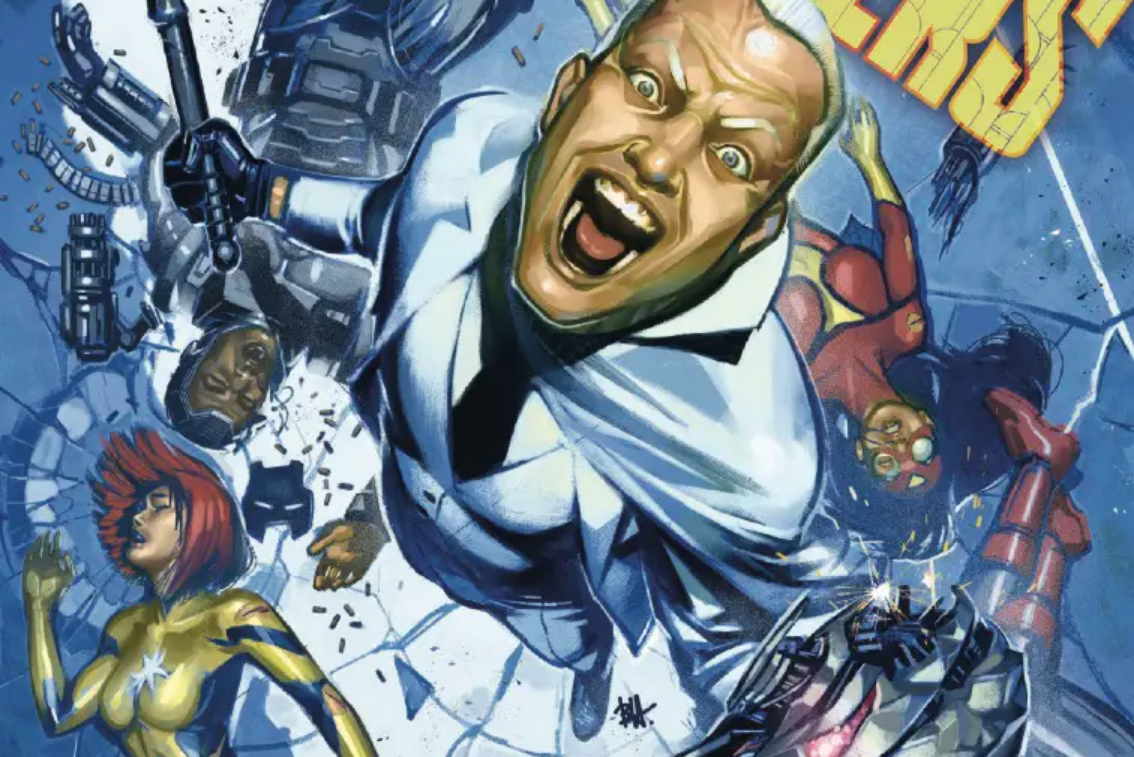

When Flag-Smasher attacks a nuclear weapons convoy, the West Coast Avengers are forced to put their many problems on the back burner to deal with the threat. Between Firestar’s PTSD, The One gaining more and more followers, and the primary Avengers’ growing concerns about Tony’s decision to make Ultron an official member, it’s only a matter of time before something gives.
If you’re keeping track, that’s four narrative threads — with a fifth introduced towards the end of the issue. That’s a lot for a 20-page comic to take on, and as a result, West Coast Avengers #5 suffers. There are a lot of fun ideas here, but it feels like the issue has too much on its plate. This is most noticeable in how the book handles Firestar.
In the previous issue, writer Gerry Duggan successfully highlighted Firestar’s past trauma, albeit mostly through observations from Blue Bolt. Firestar makes a big decision in the final pages of this issue — complete with a profound insight into her own character flaws — but the arc of this decision feels incredibly rushed.

Marvel
Firestar’s arc doesn’t feel earned because nothing about the story of West Coast Avengers #5 puts her through her paces. This wasn’t a Firestar-focused issue despite the book’s emotional climax hinging upon her. One could argue that she came to terms with her problems in the last issue — but that was a case of Blue Bolt pointing them out to her, not her confronting them.
If West Coast Avengers #5 focused more on the characters that make it special, it could’ve been a really poignant story about a traumatized woman coming to terms with the fact that she needs help. Instead, this is a book that is mostly about a fight between the West Coast Avengers and Flag-Smasher from nobody’s point of view in particular.
It’s a fun, lengthy brawl, littered with quippy dialogue and kinetic action panels, but it feels entirely incidental. Nobody on the team has a personal relationship to Flag-Smasher — least of all Firestar — and even though his actions here do appear to be a part of a larger scheme, it’s hard to justify the character having this much ‘page time’ given the relatively low emotional involvement this conflict inspires in the reader.

Marvel
The artwork is generally pretty good. Depictions of the primary Avengers team are where things look the best, and artist Danny Kim certainly doesn’t have any trouble making his characters feel expressive and alive. There are still some distracting problems, though. Hands and limbs can sometimes feel wildly out of proportion, and the lack of background details can make the book feel a little empty.
All the same, Blue Bolt’s decision to change his name is humorous, and the antagonistic, bantering relationship that he has with Tony is enjoyable. Given that one of the main purposes of the team is to rehab criminals like Blue Bolt, it’s nice to be reminded that this appears to be working. It would be nice to see Duggan push this aspect of the book harder, though. Right now, there’s simply too much going on, and it’s hard to see where any of this is going, or what the ultimate thematic point of the book might be.
If you’re looking for a low-stakes superhero punch-out, then this book is for you. While there’s nothing wrong with that, this issue had the potential to be something more emotionally resonant, but it squandered the opportunity. Duggan’s affection for the character of Firestar has served him well in the past, so it feels strange to have her big decision in this issue feel rushed. Overall, the book just isn’t telling a cohesive story or digging deep enough into these characters to produce anything truly satisfying.




You must be logged in to post a comment.