

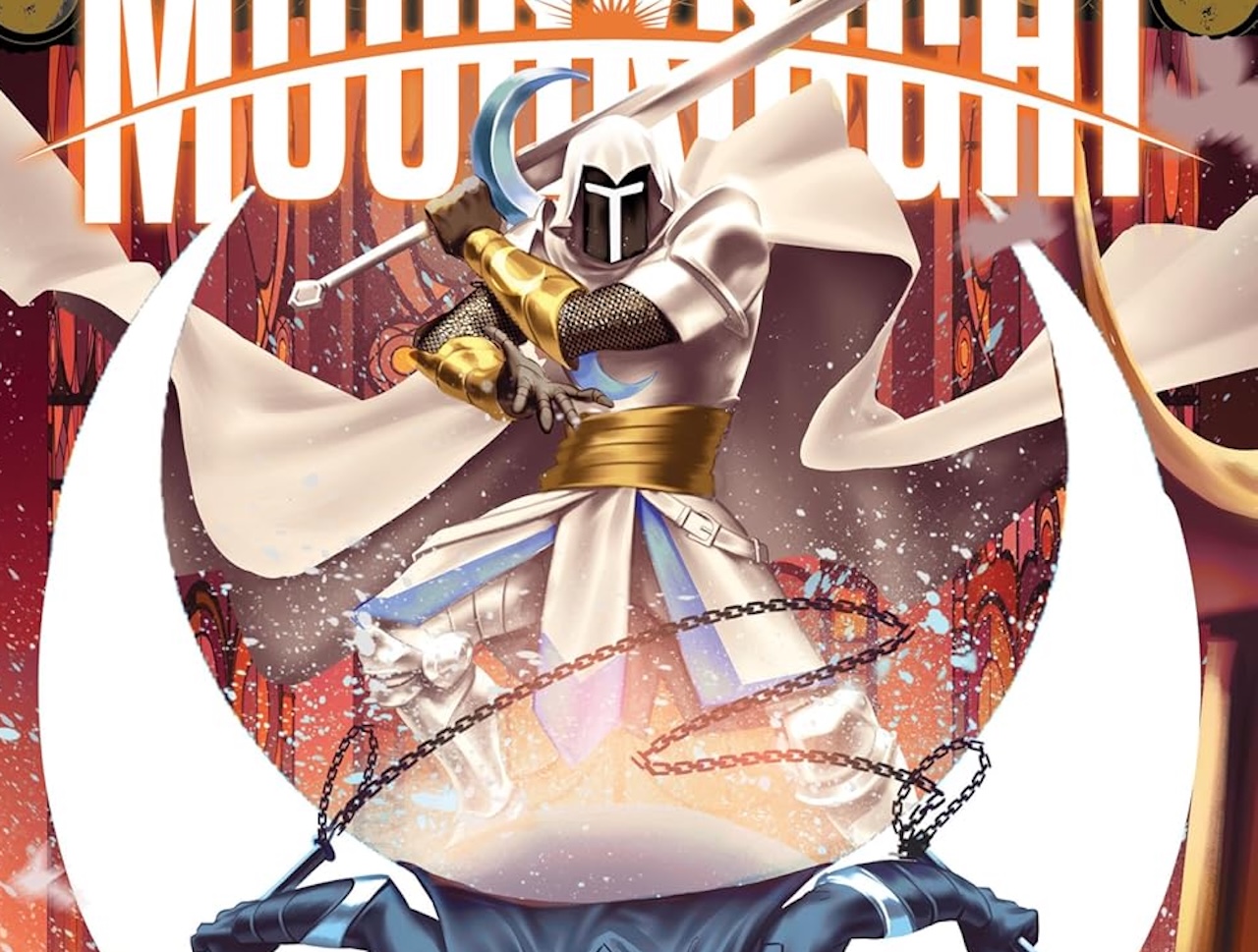

One of the most compelling – and least explored – aspects of Moon Knight is that of the character’s in-universe legacy. Writer Jed MacKay’s long-running contemporary take on the character has brushed up against this legacy with the introduction of Hunter’s Moon, a second priest of Khonshu much like Marc Spector himself. Both charged by the Egyptian moon god to be his instruments, the pairs’ varied purposes and vestments suggest a larger history, as well as hidden and varied motivations.
The role of the Moon Knight – and perhaps other priesthoods – has existed throughout the history of the Marvel Universe, however. Using an anthology format, Phases of the Moon Knight takes a peek at that legacy and speculations on it.

Marvel
Some stories, such as Benjamin Percy and Rod Reis’s “Crusader” from the first issue, explore Moon Knights of the past: a disenfranchised English knight abandons a thirteenth-century crusade, gets lost in the desert, and finds himself face to face with a Khonshu statue; becoming a Moon Knight, he goes up against the immortal Apocalypse.
Other stories, like Declan Shalvey, Eder Messias, and Yen Nitro’s “Ekleipsis” and “The Past is Present” by Justina Ireland, Daniel Bayliss, and Dee Cunniffe, present Moon Knights of potential futures. In the former, a Knight battles techno-cultists on the moon in the year 2846. In the latter, a young woman takes on the mantle in a not-too-distant Mad Max-like apocalyptic wasteland.

Marvel
In one story (“Moon Knight-Chan” by Yuji Kaku), the concept of the character is used as the loosest structure for a bizarre, gender-swapping Manga blur. The most disconnected from the potential past and future Moon Knights, this story projects the concept to a much broader canvas – Phases of the Moon Knight not as an exploration of the legacy of the character, but as an exploration of its furthest potential.
It’s a solid concept for an anthology, but as with any anthology, it varies greatly in quality. Not every Moon Knight is created equal, it seems, but that won’t stop readers from eagerly eating the book up – there’s a lot of compelling conceptual turns, here, and all these Knights — Spector included — are given wonderful attention.




You must be logged in to post a comment.