

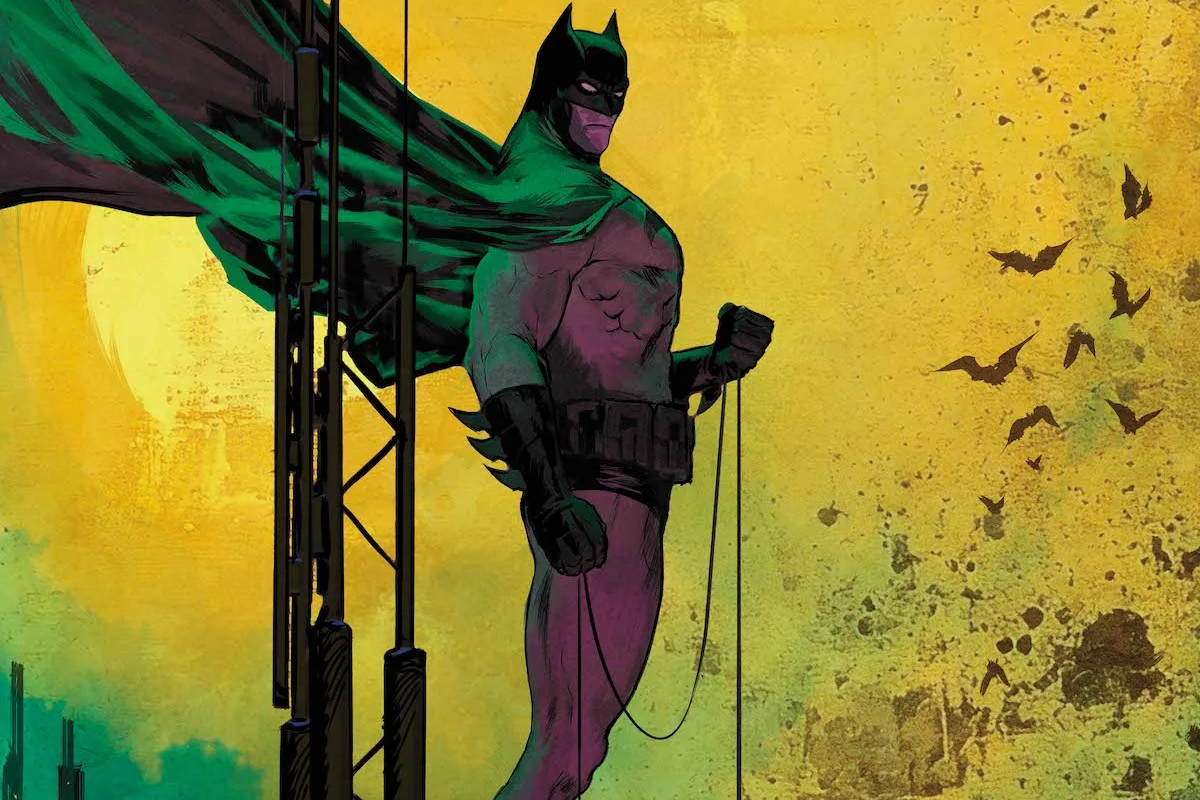

Despite stunning artwork from Mikel Janín, Tom Taylor’s first storyline in Detective Comics left a lot to be desired in terms of original ideas and thoughtful execution. This also left the book in a place of needing to leave a much stronger impression for its second story arc in order to maintain reader interest.
For Detective Comics #1097, Taylor alongside guest artist Lee Garbett continue the Elixir storyline. This time, however, the focus shifts to Harvey Bullock for a fresh perspective. This actually works, as going this route allows Taylor to tell a straight-forward noir story. That is especially true with Bullock having since become a private investigator after his termination from GCPD.

DC Comics
Though Bullock isn’t given many action sequences, Taylor and Garbett do explore a case from his time as a rookie police officer. This affords Bullock a rare moment of character depth, as readers get to experience the person he was prior to becoming the cynical detective fans know him as. As a rookie, Bullock is presented as more passionate about pursuing justice despite being highly inexperienced. This especially shows when he walks in on a murder in progress and naively believes the victim’s murderers were investigating his grisly torture.
Another way Taylor and Garbett build Bullock’s character in Detective Comics #1097 is by establishing his own network of informants independent of Batman’s. The most important of these is Bullock’s former mentor, Sully, who was himself a corrupt police officer. Apart from paying the younger Bullock to “forget” the murder he saw as a rookie, he had a number of other infractions that eventually got him terminated from the GCPD by internal affairs.
Bullock maintaining a distant relationship with his former mentor as a way of getting information establishes that Bullock is not beyond shady connections when convenient for progressing his cases. This helps maintain the noir tone of the story, which is augmented by Garbett’s artwork and Lee Loughridge’s colors.

DC Comics
Like Janín, Garbett’s artwork also presents realistic-looking characters. The use of warm and cool colors also convey a sense of mystery and danger throughout Detective Comics #1097. The noir tone is similarly maintained with the use of 1940s aesthics – not just in Bullock’s fashion choices, but even in the depiction of women to give off a femme fatale vibe. The fact that the story deals with a criminal organization known as Elixir and avoids Batman’s more iconic villains (except on the last page) allows it to stand out a bit more.
Though Taylor and Garbett work on establishing a longer history for Elixir beyond the organization’s involvement with Asema, very little is revealed about the motivations of its members. It’s likely that this will be further explored in future issues. But as of Detective Comics #1097, the organization’s actions (thus far) contradict those of the first story arc involving Asema. The first story arc established that the organization systematically murdered juvenile delinquents to create rejuvenating drugs for aging adults. Detective Comics #1097 depicts corrupt police officers dissecting a 112-year-old man alive, with no explanation given.
It’s likely that Taylor will later establish that the elderly victim was dissected as part of the “research” for the rejuvenating drug Elixir would later develop. For now, however, that remains a mystery. How well Taylor develops that mystery will depend on the next couple of issues, but it’s off to a decent start at the very least. If Taylor keeps the focus on Bullock with Batman having a very minimal role, this could result in a satisfying epilogue if it doesn’t tie into the second story arc that follows the celebratory issue #1110.




You must be logged in to post a comment.