

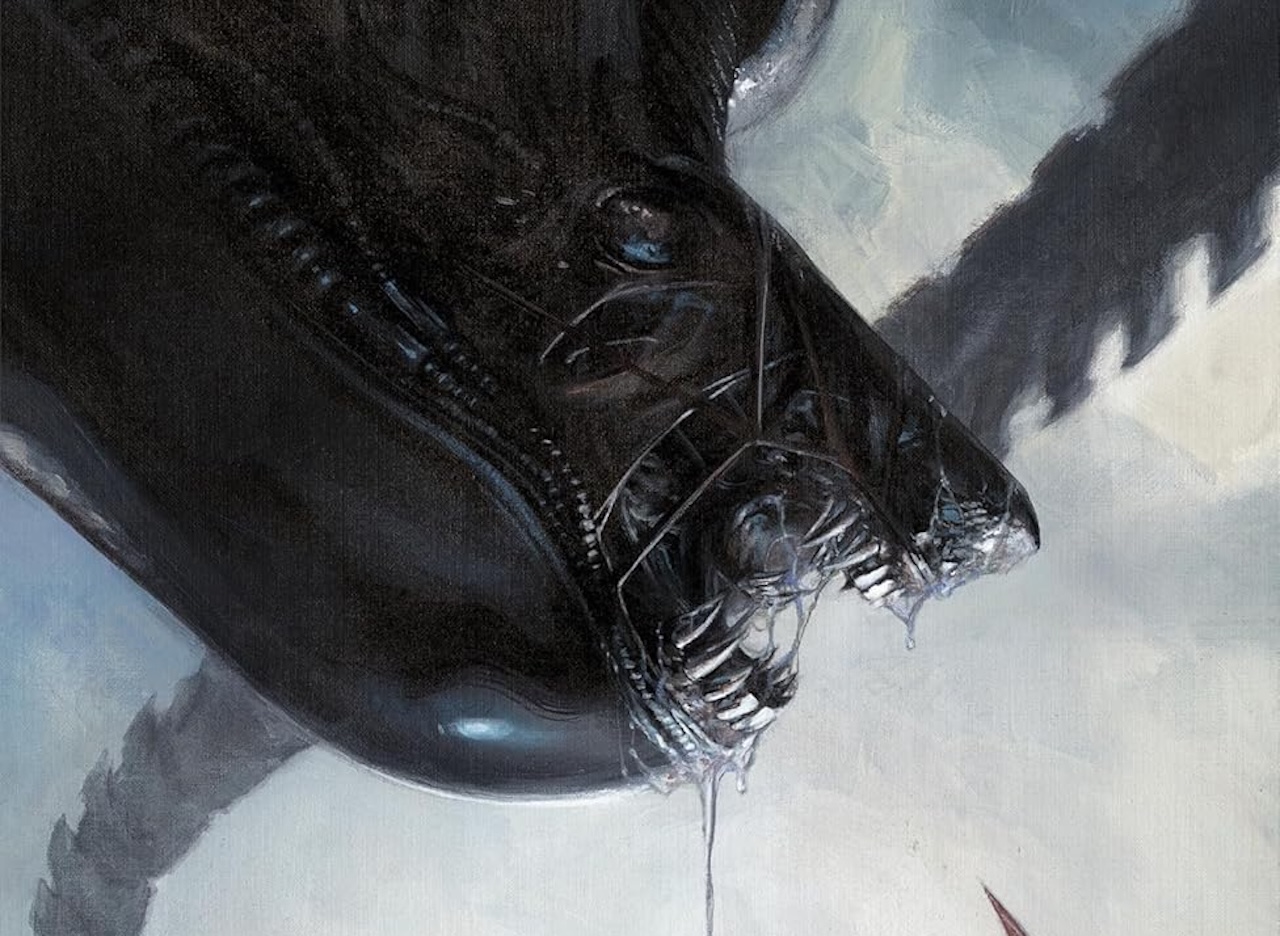

A great Alien story demands a very particular, difficult balance. On one side of the equation, the story must be inventive: it must take what is best from its predecessors (yes, even the widely despised, “bad” films) and use this as a foundation but not a crutch, and it must present fresh ideas. On the other side, the story must be restrictive; it must be effective, but it cannot be too descriptive or deliver too much exposition.
The former arm of the equation is, perhaps, obvious; the latter is more difficult to nail down. The concern is this: what’s best about Alien fiction – cinema, literature, comics, etc – lies in the unknown. 1979’s Alien is so nightmarish because there are no answers, no easy origin to the creature, no pat conclusion to Ripley’s horrific escape from the Nostromo. The xenomorph is an unknown, a creature that has lost some of its frightening otherness the more and more often it is shown on screen. When the action-forward Aliens came out in 1986, the more wasn’t necessarily the merrier (or more macabre); the swarm changed the dynamic but didn’t heighten the terror.

Marvel
The more we know, the less horrible the horror is. Just ask any strident hater of Prometheus.
Comics – a medium that depends distinctly on showing rather than alluding – seems like treacherous territory to strike the inventive/restrictive balance in, and creators have either succeeded stunningly or failed miserably since the late 1980s efforts published by Dark Horse.
The issues collected in Alien: Galaxy of Nightmares land in the ‘stunning’ category; the balance is struck by utilizing the aliens as a condition of the storytelling rather than the subject. There is little need for exposition on the origins of the creatures when the stories aren’t about them, per se. They exist to provide tension and action, but nobody seems particularly interested in doing anything more than surviving.
Writer Phillip Kennedy Johnson discovered that the key to the balance was not to spend too much time with the xenomorphs, but to develop the worlds into which he released them. Like any good horror film, the three stories collected here focus on character first, horror second. Personal stakes are established before infestation.

Marvel
This doesn’t mean the book doesn’t provide some insightful world-building: in lieu of tapping into the origins or habits of the xenomorphs, the stories in Galaxy of Nightmares tap into the larger socio-political world of the Aliens franchise. It seeds ideas – without over-explaining them – about the United Americas, about Weyland-Yutani, and about synthetics (the milk-powered androids which, by turns, betray or save Ripley throughout the film franchise).

Marvel
The artwork – first by Salvador Larroca and, in the third arc, by Julius Ohta – capitalizes on a ‘cinematic’ approach. Our human and synthetic characters are given near-photorealistic faces, impeccable expressions, and this gives us the feeling that we are witnessing truly adept performance. When the xenomorphs are on display – and, like Aliens, there are many, and they are fully on display – there is a grim, horrible foreboding. These are not artistically stylized versions of the monsters: this isn’t impressionistic. These creatures could be drawn from creature effect models, official renders, film stills. These comics have a visual fidelity that mirrors the best of the cinematic franchise.
Galaxy of Nightmares succeeds where a lot of Aliens media fails: it provides human stories, it builds the world without overexplaining it, and it provokes a genuine sense of dread. The creatures here are weaponized against the reader at their best: unknown, unbeatable, ever-present. These comics deserve a place on the shelf next to your elaborate, multi-disc 4K Blu-ray collection.




You must be logged in to post a comment.