

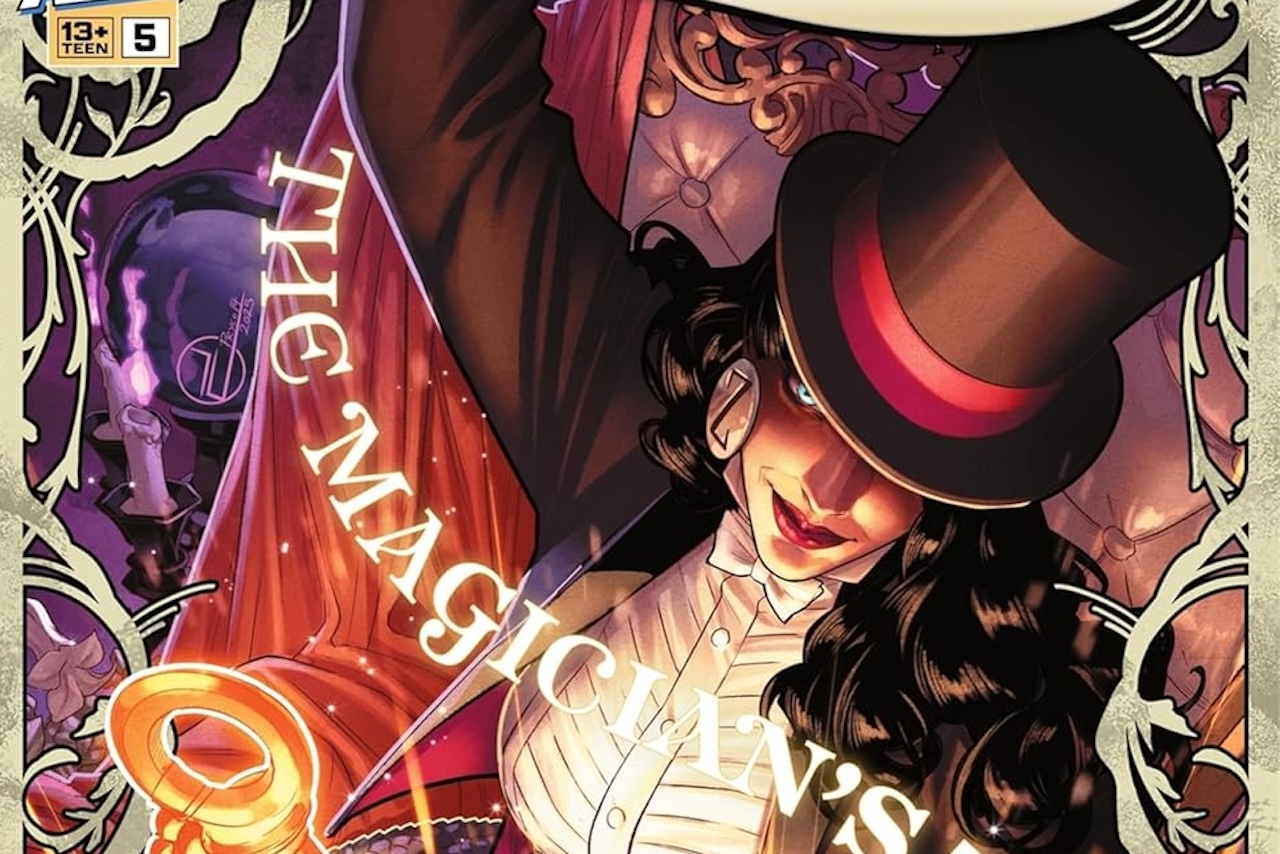

Zatanna stories are uniquely interested in language (her spells are words spoken backwards), and in a visual medium, that translates to lettering: the magic contained in reversed words, which must have felt mind-blowing to young readers back in the Silver Age, now paired with modern font flourishes and word-balloon colorization. Playing around with word balloons might be old hat to some readers now, but it’s a convention little used elsewhere in comics.
Zatanna #5 adds a unique new trick to the lettering game: in its intro, while a malevolent force rants at a bound and disembodied Zatanna, strategic letters of caption boxes have been replaced by stars – letters, it turns out, that Zatanna has slowly stolen from the villain. Having spent the series disconnected and damaged by spellcasting, Zatanna quietly steals the components for a spell in the form of singular vowels and consonants.

DC
It’s a clever trick, but it’s only one the issue dazzles with. This entire series has felt almost like a visual and conceptual assault on the reader as writer/artist Jamal Campbell escalates the magical insanity. We’ve had demon battles, sentient swords, new villains, and Clayface. Magical barriers and battles have been rendered in daring, panel-shattering arrays. The very metatext of comic books has been challenged: pages devolve into barely-constrained tableaus. At one point in this issue, Zatanna steps out of the comic book entirely, revealing the uninked blue-lined illustration boards she’s avoided participating in.

DC
For all that clever, creative trickery, the book is sometimes hard to wrap your head around. So many baddies, spells, and metalayers have been blended over these last five issues that it’s hard to keep track of what level of narrative we’re currently residing in: is this a dream? A vision? A flashback? Last issue featured a recap of the Blue Devil and followed it up with a nightmare with its own sleep demon before assaulting Zatanna with two monsterous versions of her friends; none of those things come into play in this issue. We’ve made a clean break, a jump into another handful of realities. When we do return to the site of last issue’s conflict, we’ve already taken diversionary paths to meet Zatanna’s mom and hear the origins of an Asgardian cursed blade.

DC
For all its confused and manic hubbub, it’s hard to fault the book or its creators: Campbell is giving Zatanna his all, which is more attention and effort than the character often receives. Outside last year’s brilliant Bring Down the House, she’s a character most often relegated to support and background B-plots. Hell, her origin is as a backup character, a guest-star that appeared in seven random issues in the 1960s; she didn’t have her own ground to stand on for decades. To have anyone as committed as Campbell work on the character is a gift to her fans; to have a book as beautiful and playful as this is a landmark.
Playing with lettering and the rules of Zatanna’s spellcasting is only a minor trick in a massive barrage of compelling ideas. What’s a little confusion when the payoff is so huge?




