


The Voynich Puzzle is a multi-mechanism board game seeking funding on Gamefound until 10:00 am eastern time this Thursday, although it’s already passed 700% of its initial goal. The game is based on a legendarily weird document from the 1400s, that is still legitimately mysterious today. Autumn Sword explains.
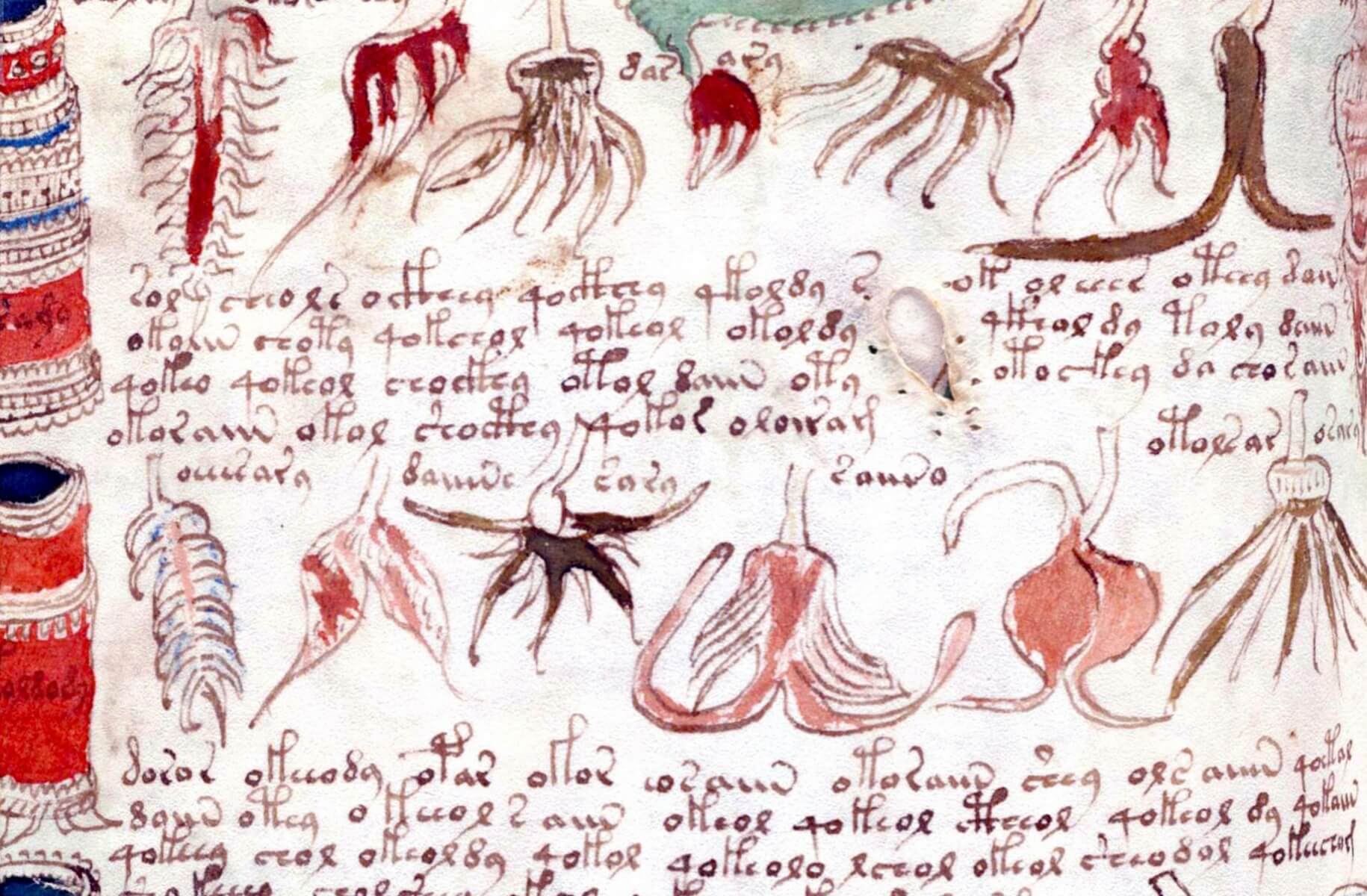
The Voynich manuscript, otherwise known as MS 408 of the Beinecke Rare Book and Manuscript Library of Yale University, is perhaps one of the most mysterious and baffling texts in the world. Carbon-dated to the 15th century, the vellum consists of around 240 pages, bound on one side, with some of the pages acting as foldouts. Within the manuscript is an indecipherable text and bizarre, hand-painted illustrations, including some of what appear to be plants and animals that don’t actually exist.
Based on the subject matter of the illustrations, scholars have taken to organizing the Voynich manuscript into six distinct sections: botanical and herbological, astronomical and astrological, biological and balneological (referring to the treatment of disease by bathing), cosmological, pharmaceutical, and the last containing various recipes. No one knows exactly what it was about or why it was created.
The bizarre nature of the Voynich manuscript’s contents and the text’s resistance to decryption have led to wild speculation on its origins. Some believe the text, conceptualized as its own language dubbed “Voynichese,” is the lost language of a civilization akin to the fabled Atlantis or Lemuria. Terence McKenna, ethnobotanist and countercultural icon, once called the Voynich manuscript “the limit text of Western occultism,” and speculated that it was non-human in origin. Siloe, a publishing house which produced a facsimile edition of the manuscript, even goes so far as to claim that, “One of the most popular myths about the Voynich Manuscript is that it was written by extraterrestrials.”

Tracing a mystery
The Voynich manuscript was first shown to the public in 1921 at the College of Physicians in Philadelphia, as part of the collection of Wilfrid Voynich, an antiquarian book dealer and the manuscript’s namesake, who acquired it in 1912 from the Jesuit Collegium Romanum library. The manuscript bears the ex libris — a bookplate denoting ownership — of Peter Beckx, Superior General of the Jesuit order from 1853 until his death in 1887. An alchemist from Prague, Georgius Barschius, is the earliest confirmed owner of the Voynich Manuscript, although there are several theories as to who ultimately authored the work.
When Voynich acquired the manuscript, it also contained a cover letter from Bohemian doctor, rector of the University of Prague, and official physician to the Holy Roman Emperor, Johannes Marcus Marci, addressed to Jesuit scholar Athanasius Kircher, which provides some clues to the Voynich manuscript’s provenance:
“Dr. Raphael, a tutor in the Bohemian language to Ferdinand III, then King of Bohemia, told me the said book belonged to the Emperor Rudolf and that he presented to the bearer who brought him the book 600 ducats. He believed the author was Roger Bacon [a Medieval philosopher and physician] …”
There’s no evidence to suggest Bacon was the author, though Voynich promoted the idea that Rudolf II had purchased the manuscript from English scientist and occultist John Dee, based on the fact that Dee was known to possess many of Bacon’s works. Dee was, however, a meticulous record-keeper and never mentioned the Voynich manuscript or said anything to suggest he was in possession of it.
Hidden language or hoax?
So what exactly is the Voynich manuscript? What was its purpose? Researchers consider several possibilities: the Voynich manuscript was written in a natural but unknown language; it was written in a natural language or a constructed language which may have been encrypted; or the Voynich manuscript was made to resemble a natural or constructed language, but it is in fact nonsense, i.e. a Medieval hoax. Despite decades of linguistic, cryptographic, and statistical analysis, there is no consensus as to which of these explanations is the most plausible.

Let’s consider the hypothesis that the Voynich manuscript is written in a language, whether a known natural language, an unknown natural language, or a constructed language. All languages obey certain principles, like vowel harmony and syllable frequency. Statistical and linguistic analysis of the text has suggested certain similarities to several known natural languages. It’s also been argued that the “word entropy” of the Voynich Manuscript — the degree of relative uncertainty with respect to what word will appear next in a sequence relative to the previous words — is consistent with what is found in either English or Latin.
Back in 2014, the late Stephen Bax, a professor of Applied Linguistics at Bedfordshire University, even announced that he had deciphered 10 words from the Voynich manuscript and that his research “shows conclusively that the manuscript is not a hoax, as some have claimed, and is probably a treatise on nature, perhaps in a Near Eastern or Asian language.”
However, Gordon Rugg, an academic with degrees in linguistics and French, argues there’s serious reason to doubt Bax’s claims, and that, “This is clearly not a language. It’s just too different from all the known languages of the world.” For example, if we consider the botanical pages, we can make reasonable assumptions about what the text for those pages may be trying to communicate — the names of plants, descriptions of their properties, and how they might be used medicinally. But Rugg points out there just isn’t “any pattern of particular words showing up mainly within particular sections of the manuscript, in the way that you’d expect if the plant pages really were about plants.”
Another oddity of the Voynich manuscript is the syllable frequency. Within a given text written in a specific language, if you make a scatter plot of the frequency of syllables, it will remain consistent throughout. Rugg shows, though, “if you plot the distributions of four frequently occurring Voynich manuscript syllables, their frequency varies dramatically across sections of the manuscript, often with very abrupt transitions.”
If the Voynich Manuscript actually is written in a natural or constructed language, it almost certainly has to have been encrypted. The problem there is that all other examples of Medieval ciphers have long since been decoded. Even the Vigenère cipher, invented in 1563 and once considered undecipherable, was cracked by German cryptographer and archeologist Friedrich Krasiski in 1863, without the aid of modern computational analysis. If the Voynich manuscript is an encrypted language written by a Medieval scribe, it would have to be a remarkable example of cryptography unlike any other of the time.
Which leaves us with the hypothesis that the Voynich Manuscript is a meaningless hoax. Can this account for all its peculiarities, including the seemingly nonrandom nature of the text and the statistical anomalies present?
Elements of Voynichese have been shown to be consistent with text produced by some form of automatic writing, rather than purely stochastic (i.e. random) means. Some researchers have even offered a means by which the text of the Voynich manuscript could have been produced, through a relatively simple process such as self-citation — in which the writer generates large parts of the text simply by copying and modifying characters previously appearing within the same section.

The Voynich Puzzle, by Salt & Pepper Games
The idea that the Voynich manuscript is a Medieval hoax is not as far-fetched as it may seem. At the time, books were all written and copied by hand, and therefore were incredibly expensive, costing as much as a modern home, so it’s easy to imagine why someone might create a fictional, mysterious manuscript. Books were works of art, usually lavishly decorated, and the possessions of the rich and powerful.
By contrast, the Voynich manuscript, according to philosopher Justin Sledge of the YouTube channel Esoterica, is “crude, even by Medieval standards.” The vellum of the Voynich Manuscript is of middling quality and unevenly cut. The inks and pigments used in the calligraphy and illustrations are also wholly unremarkable, containing neither rare nor expensive minerals or chemicals, while both the script and the illustrations themselves are rather plain and unimpressive compared to similar works of the time.
All this suggests that, while it certainly required a financial backer to afford the vellum (treated animal skin), cost evidently was cut where it could be, and if the expectation was to pass the Voynich manuscript off as a rare and unusual book, the expectation that it would sell for a very high price may have justified the initial cost to produce. If in fact the Voynich manuscript sold for 600 ducats in the 17th century, that would have been the equivalent of 2.1 kg of gold at the time, which today would be worth almost $150,000.
Ultimately, we must consider which is more likely: that the Voynich Manuscript was written in an unknown language unlike any other; that it’s written in a known language and encrypted to such a degree that it far surpasses all other ciphers of the Medieval era and even some modern ones; or that it’s ultimately a collection of meaningless symbols composed in such a way as to resemble a language, and exotic enough that people believe, even hundreds of years later, that it’s more profound and meaningful than it actually is?
AIPT Science is co-presented by AIPT and the New York City Skeptics.


You must be logged in to post a comment.