

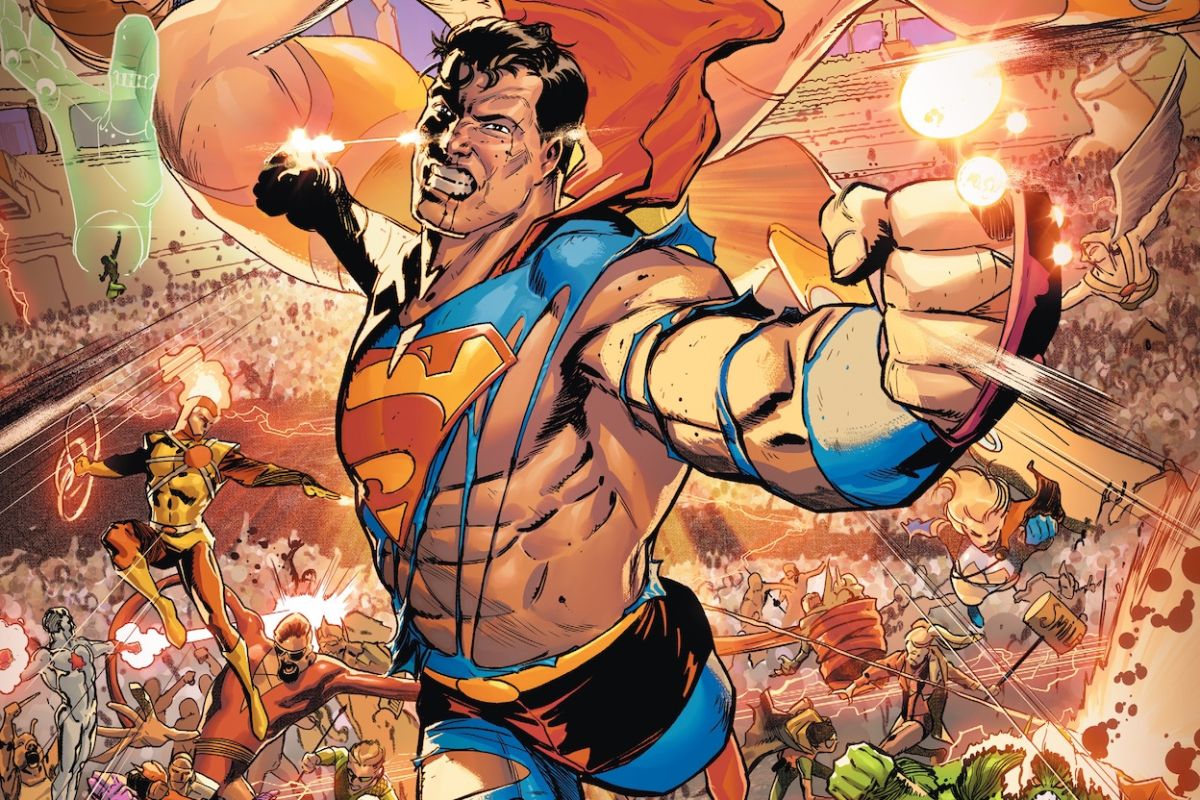

DC K.O. #1 by Scott Snyder and Javier Fernández is finally here, and it lives up to the hype in the sense that it delivers on the Battle Royale-style showdown between Prime Earth’s heroes. There are even some “hero deaths” very early on in this first issue. DC K.O. #1 even develops its storyline similar to an RPG, with Fernández even laying out some of the panels like the squares on a board game to guide the narration. In addition to delivering high-octane action, Snyder and Fernández also do good character work on the Justice League heroes, just before they go to war for their Earth’s future.
Snyder and Fernández also capture the hope and optimism that the Justice League heroes embody, which is a nice callback to the Bronze Age Justice League meetups. They also throw in some humorous meta commentary on DC’s Crisis events always being “Earth-shattering events,” where things will “never be the same again!” For good measure, DC K.O. #1 even humorously depicts Ambush Bug acknowledging that it’s always the obscure characters who rarely get used in stories that get killed off as canon fodder in these events.

DC Comics
Likewise, whether it’s the death of the multiverse or the end of time (or both), Snyder and Fernández acknowledge that constant continuity renewal has become a DC trope at this point that they just live it up. Ironically, this also spotlights the corner DC has written itself into over the course of a decade in terms of storytelling. More specifically, DC K.O. #1 shows that the DC Universe has not truly moved forward since the Flashpoint reboot of 2011, and has gridlocked itself into an endless cycle of “crisis” events and subsequent universe repairs. To that point, DC K.O. #1 does confirm that The New 52 timeline did happen, but as a tangent reality that DC’s post-Crisis timeline later reabsorbed.
The New 52 confirmation also effectively aligns DC K.O. with the timeline established in Mark Waid’s New History of the DC Universe. To be more precise, it explains why certain New 52 events like Geoff Johns’ and Jim Lee’s Justice League: Origin has now been moved to the team’s Silver Age. The other thing DC K.O. #1 spotlights with The New 52 callback is that the frequency of “crisis” events have rendered them inconsequential in the lives of the heroes. This is best shown with Mr. Terrific being optimistic that the heroes will once again pull through as they’ve always done in the past.

DC Comics
Weirdly enough, Mr. Terrific’s optimism does also spotlight a major weakness in DC K.O.‘s premise: the story will need to do something radically different to meaningfully raise the stakes and break the cycle of the world ending for the umpteenth time before the status quo is subsequently reset. Not only will doing so make DC K.O. standout from all the other “crisis” events of the past decade, but it will need to push the DC brand forward in a more meaningful capacity than both Dark Nights: Death Metal and Dark Crisis on Infinite Earths achieved.
To put it another way, DC K.O. needs to be the better version of Earth-2: World’s End and Convergence, in that the event needs to have meaningful repercussions for DC’s heroes. Even more so, since the Snyder and Fernández-fronted event already has many of the same story beats as those two 10-year-old events. Like Earth-2: World’s End, the story once more centers on Darkseid conquering an Earth in order to remake Apokolips, and the heroes have to come up with another deus ex machina to reverse Darkseid’s destruction. The story also has evacuation ships on the ready should the Justice League fail to save the Earth, like The New 52 Justice Society heroes did in the Earth-2 series.

DC Comics
Like Convergence, DC K.O. is another “contest among heroes,” in which every DC character must fight each other to the death for the survival of their world. This will seemingly involve interactions with their Absolute Universe doppelgängers, who are teased to make an appearance later on in the event. DC K.O. even introduces a concept that was the entire storyline of 2015’s Earth-2: Society: the idea of one hero acquiring the necessary god-like device or powers to remake the world in their own image. In the Earth-2 series, this took the form of the source vault, which contained the blueprint for recreating Earth-2. The Amazonian casket also served the same function in the story, with the Ultra-Humanite being the villain who recreated the old Earth-2.
In the case of DC K.O., one of Prime Earth’s heroes has to ascend into becoming an Omega Energy-infused entity in order to match Darkseid in power and defeat him. This same hero will also have the power to remake the universe in their own image, echoing both the Ultra-Humanite’s role in Earth-2: Society, and even Parallax’s in 1994’s Zero Hour. But this gets us back to the topic of DC K.O. needing to do something genuinely different to break the trend of inconsequential world-ending events that don’t spark meaningful new journeys for Prime Earth’s heroes.
At best, DC K.O. is off to a decent start in terms of setting up its main event, even if half of issue #1 is mostly an exposition dump with much of the action happening in the second half. But as mentioned, DC K.O. will need to be unpredictable in its storytelling and genuinely surprise people to avoid being “just another crisis event” that destroys reality for the billionth time, but nothing of consequence truly happens. If anything, the most surprising status quo change DC K.O. could end with would be having the Absolute Universe take over as the new primary DC continuity, with Prime Earth getting demoted to being a creator-driven universe, and end its continuity renewal crisis that way.




You must be logged in to post a comment.