


Many comics are purely aspirational – you read Superman or Captain America, for instance, to one day become a better person.
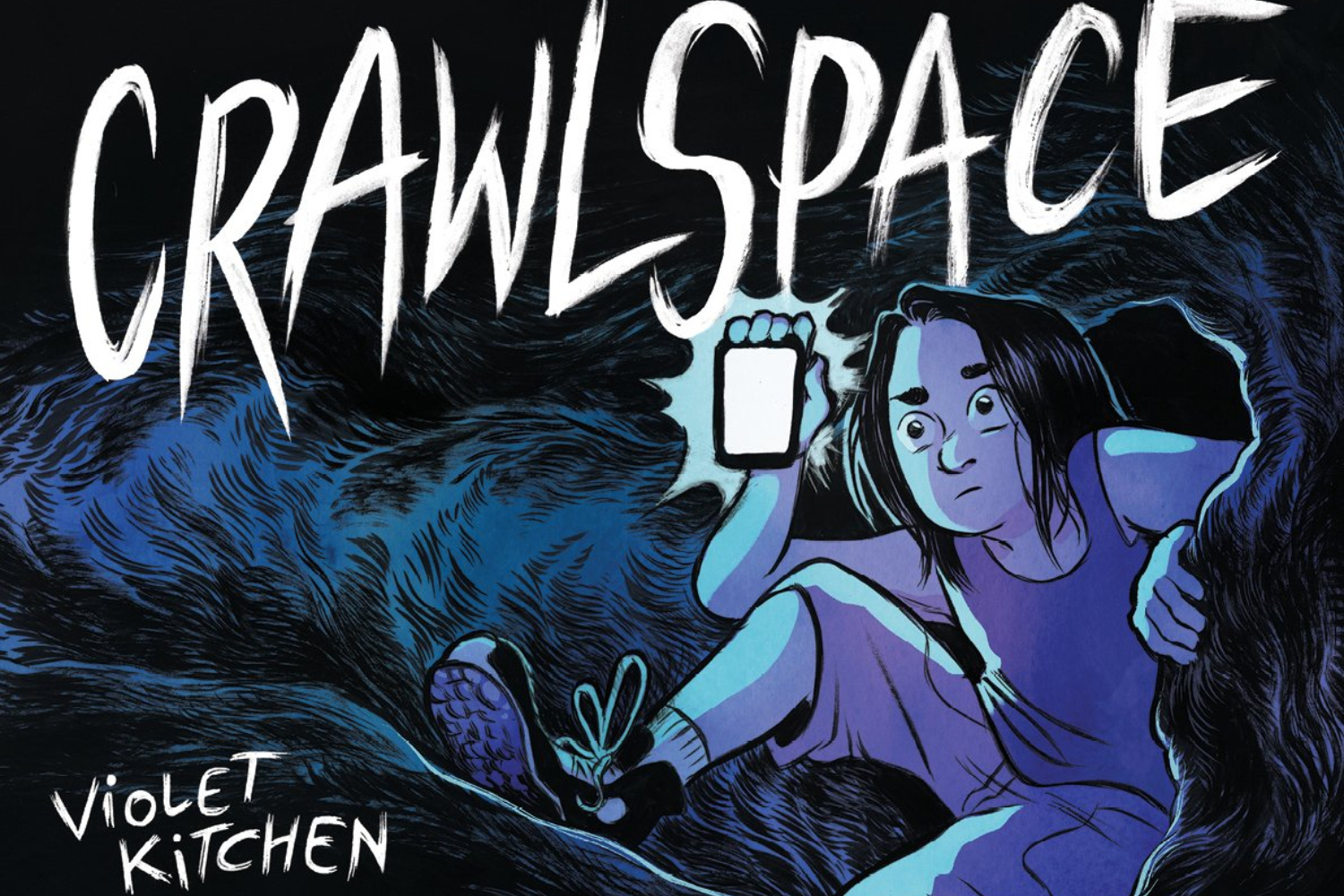
But in the case of Crawlspace, writer/artist Violet Kitchen basically captured my whole life in amber.
OK, not all of it per se, but something deeply, undeniably essential. Crawlspace follows Kel, a middle school student who isn’t very popular. Perhaps because rather than playing soccer or serving on the student council, they spend their time obsessing about, researching, and exploring various small spaces, seeking to “find out for themselves what kind of stuck they want to be.”
And that desire is utterly and undeniably familiar. Even to this day, on the very precipice of 40, I engage in an act I’ve come to call “Turtling,” where I hide under blankets to mentally deactivate or simply cope with life’s struggles. Add in a childhood obsession with tunnels, and building small towns of cardboard boxes that I could lord over, and Kel feels like this perfect avatar.
“I would definitely say that part of it is at least semi-autobiographical. I loved playing in big cardboard boxes,” said Kitchen, an Ignatz-award winning cartoonist (for Allodynia). “I loved being in my closet. There was something very protective about small spaces; they’re a very controlled environment.”
Kitchen has other stories about exploring these pockets. Like turning their loft bed into a space ship for escaping some “post-apocalyptic” moment they’d created. (Added Kitchen, “I’d have some snacks and some books. There’s something about that process, that ritualistic whittling down of things, that was very soothing for me.”) Or, building their own “enclosed little bubble world” out of building blocks. And, of course, the doodling of caves and cave systems.
Kitchen admits that there’s clearly overlap with Kel: They’re both seeking a level of distance and control (something I too sought out either unconsciously or unknowingly). As Kitchen put it, “I feel like this comic is about finding your place, but it’s OK if that’s a small place.”
Yet they also made sure to note that they “wanted this comic to be fictional,” and that Kel is absolutely their own person. And Crawlspace very much celebrates not just finding your own space, but being a person who has their own reasons for seeking and exploring these spaces at a time in their life when the world is very hard and strange, indeed.

Courtesy of Bulgilhan Press.
“I do think in many ways it’s a comic that’s a love letter to being a gross, mean kid in a way that I feel like I don’t see represented often enough,” Kitchen said. “There’s this experience of finding solace in stories that you can’t necessarily directly access in your own environment, or something about going to this other kind of place, maybe the smaller place.”
It’s an oddly novel approach: Trying to make a character who is very much not always lovable, or even seeking this sense of love. But instead they want the power to forge something for themselves. Kitchen said they often find that rather than letting these characters do the hard work of exploring individuality, other creators tend to try and reduce their experiences into trite cliches.
“I feel like often you see in these narratives…where it’s about this kid who is out of place at their school and being bullied or what have you,” Kitchen said. “It’s often people have this very black and white narrative around that. They want to get out this message that no one deserves to be bullied and they want to make that very clear.”
Added Kitchen, “But I think it often results in a flattening of these stories. Yeah, these kids are being mean to Kel, but Kel is also mean back and it’s murky and unclear like what started – if this is them acting in response to the way they’ve been treated or these kids are responding to a way that Kel has always been. We don’t get to know that as the reader, and I think that’s really important.”
There’s one standout moment in Crawlspace (which debuted at last weekend’s Massachusetts Independent Comics Expo) that really gets at this core idea. In trying to carve out their own little space, Kel discovers an important lesson about those that she’d otherwise rebel against back at school.
“There’s that moment where Kel goes all the way down in the cave and finds this graffiti of people who have been there before, and there’s this sense of recognition,” Kitchen said. “Like, ‘OK, I’m not the only person like down in this space. There’s this history I can rely on. I’m passing through something that is small, but it’s also larger than myself still.’”
Which is to say, Kel isn’t like your typical protagonist who is somehow magical or the “chosen one.” Instead, they’re just one kid with one interesting and relevant story to offer.
“I think part of what I was also trying to portray with this comic was, again, Kel also embodying some of the meanness that these other kids [experience] and in a way to highlight the performative nature of that meanness,” Kitchen said. “If you zoomed in on any of these other kids, they may not be having Kel’s experience exactly, but you know, everyone is trying to work through these questions and figure them out. But you’re in an environment where you have to perform something very different. I hope what I made was able to, in some way, embody that this sense isn’t something specific to this one situation.”
From there, that concept gets at an even bigger, bolder idea. Kel would easily assume that people at school don’t like her, but the honest truth is that folks just might have too much going on to be active or engaged.
“With the bullying and isolation, I think I was trying to capture the sense that it’s more about apathy than about cruelty – for the most part,” Kitchen said. “It’s not even so much that kids are being mean, but a lot of it really just is that the people around you do have their own problems and don’t really have time for you or just aren’t really going out of their way to perceive you, which I feel like is something that I experienced a lot growing up.”
Kitchen added, “It was also something I didn’t really see represented in a lot of bullying narratives. It’s about people going out of their way to make your life miserable. What if no one notices how miserable you already are because maybe they’re miserable, too?”

Courtesy of Bulgilhan Press.
And that gets us to an important motif not only in Crawlspace, but in Kitchen’s overarching career: empathy. Not just why we should have it for one another, but what it really takes to empathize with others.
“Empathy is a muscle. Empathy is a tool. Empathy is a skill,” Kitchen said.
Crawlspace, then, sees Kitchen further hone in on this idea of empathy being actualized. Yes, when Kel sees the graffiti in the cave, for instance, they can recognize that they’re never truly alone in their feelings. However, Kitchen is very much interested in why timing and intention really matter when we talk more meaningfully about empathy.
“I think a lot of my work is trying to explore this kind of transition from theoretical empathy to real empathy, or just trying to figure out how do you actually bring that forth into the world,” Kitchen said. “My 20s, in a lot of ways, is very much that lesson of learning how to do it and when to engage that muscle and when not to. How do I center myself in that way”
However, Crawlspace tends to take it even further still. The story is very much interested not just in distinguishing the “kinds” of empathy, but what happens when we get lost in the shuffle, as it were.
“Sometimes we mistake theoretical empathy for the real thing,” Kitchen said. “I think often we feel helpless enough that it feels like the best thing we can do is to go, ‘Oh, if I’m thinking about this thing a lot, then that’s enough.’ I think a lot of us remain trapped in that space. I don’t have any easy answers for knocking yourself out of that.”
Kitchen said that empathy can then become “this circular journey, where you end up spiraling further back inside of yourself.” You’re trapped (in a cave, if you will) and you’re now less capable of moving and engaging than ever before.
“You brought on these really enormous emotions that you don’t have the ability to regulate anymore or to control,” Kitchen said. “Rather than connecting you to the world, the connections that you’re trying to make can trap you… I think that is part of the lesson, too. Theoretical empathy isn’t, like, bad empathy. Sometimes you need to take yourself back into that place where you have a handle on things. You can imagine things without embodying them to the point where it’s incapacitating for you. Or it takes you out of your own body.”
That’s why these small spaces matter for Kel: It’s not just an escape from the lameness of middle school, but it’s a way to know and maintain some sense of themselves, and then using that knowledge to connect in a way that makes sense. It’s about knowing when empathy isn’t just some lofty goal, and how to fully apply it to your everyday life.
“I think those are things we move back and forth between a lot in different areas of our lives,” Kitchen said. “But I think learning to recognize that and being more intentional about when you’re able to actually bring that into your life. That’s a really important skill to learn.”
OK, let’s look at it through a decidedly less theoretical framework. After finding some graffiti, Kel eventually goes even deeper into one cave. There, they find what Kitchen calls the “heart of this story,” as they place their hands on some very old cave paintings.
“With the graffiti, I was trying to get that these were ancient cave paintings; like the handprints at Lascaux,” Kitchen said. “There’s this reverence and awe for the people that came before you – or, in this case, the people who may still be beside you right now. It’s a very spiritual feeling for me.”
Added Kitchen, “I feel like that’s been the center of a lot of my creative practices, the sense of trying to connect with people who aren’t physically there. And I think that’s also what Kel is trying to do…they’re really trying to imagine and embody their experiences.”

Courtesy of Bulgilhan Press.
Or, take even a slightly less poignant moment. In their research of caves and small spaces, Kel uncovers a story inspired in part by the Tham Luang cave rescue from summer 2018. It’s a moment where Kel’s obsession takes a turn for the terrifying. And even then there’s some deeply important lesson here: Being afraid isn’t bad when it’s also yet another aspect of this ongoing “journey” toward connection and empathy.
“I really like the sequence of them trying to fall asleep at night and being overwhelmed by this image of the drowned caver, especially with everything they’ve been saying before – they’re full of this bravado for the reader and really trying to talk about how they’re not afraid,” Kitchen said. “But having this moment of just being totally overwhelmed by this imagery in their head; I hope I was able to get across some of what they’re experiencing.”
The Thai diving incident isn’t the only way this book connects to the real world for its various goals. (Even as Kitchen said they didn’t reference anything directly as “that would date the comic in an almost artificial way.”) Even the cave itself isn’t just about isolation or disconnect. As Kel delves deeper into, she’s not just discovering people (both alive and long buried), but something even bigger still.
“I think part of the appeal of the cave specifically is being able to access deep time. To be able to access something really geologic beyond yourself,” Kitchen said. “There really is this sense of accessing a kind of time that you can’t on the surface. That’s why cave paintings are so well preserved; they’re really isolated in these very specific conditions. So there’s something about having this exist almost as a kind of time capsule. There’s a directness to that connection that in any other place archaeologically would be in much worse condition or worn away.”
Kitchen even found some inspiration and connection of their own in other archaeological studies and writings. Specifically, Underland by Robert MacFarlane, which Kitchen called “probably the most beautiful nonfiction books I’ve ever read. It’s this incredibly deep exploration of the underworld in the real world and also the mythological, and drawing connections between them and the ways in which we mythologize the underworld.”
But it wasn’t just cool pictures that drew in Kitchen. No, it was one cultural landmark that perfectly encapsulated Crawlspace‘s many interests in connecting people to one another, the outside world, and even time/reality itself. A compelling snapshot that shows us how connected it all is even if we can never truly realize the sheer depth.
“There’s one [underworld] he talks about in the introduction. I want to say it’s maybe Scandinavian folklore, possibly Finnish,” Kitchen said. “I remember specifically this image of the dead in the underworld walking in a way that’s like mirrored with the people living on land. It’s like as you’re walking across the Earth here, the dead are matching your footsteps underneath you. And I found that just an incredible and evocative image.”
Kitchen admits that some of these ideas and themes didn’t “directly make [their] way into the story, but I was thinking a lot about these kinds of stories and what caves in the underworld symbolize to us.” Kitchen went on to call them these “closed, locked away places. But there’s also a lot of potential there for things that maybe couldn’t exist on the surface. They’re like a place for secrets to be locked away.” And that makes them the perfect vehicle for exploring a certain sense of “coming out” or acceptance that’s embedded firmly within this book.

Courtesy of Bulgilhan Press.
“I think in many ways the undercurrent of the story is about the cave or the underworld being this kind of queerness that you can’t quite articulate about yourself yet that’s still locked away and underneath the surface,” Kitchen said. “I think there’s definitely something there. I think there’s a lot that I would have, if this were a longer narrative, I would have loved to dive into more, but it worked its way in there a little bit at least.”
And if you can’t identify with that exploration of queerness (but who can’t actually relate to feeling unduly weird?), Crawlspace has other tricks up its hiking boots. Across the book, Kel uses and connects with technology in a really interesting way. It both pushes her obsessive tendencies and reminds her of her own size and space in the world.
And Kitchen worked very hard to not make this function feel hokey or dated, but rather to speak to something shared and essential.
“I shied away from trying to guess what platform is used [by the kids]; I don’t know what 13 year olds are using right now,” Kitchen said. “I tried to capture more what the internet was for me at that time, which was less of a social platform and more of this very private and small space that I carved out for myself that I could go to that felt like it was the most curated and the most mine of anything up to that point in my life. It felt like the thing I had that was the most controlled and the most private. This is my magic portal. But it’s in either direction, right? It can be this pit that you’re falling into, but it can also be this entryway into another world.”
And by not passing judgment on technology, and looking at it so earnestly and freely, Kitchen was able to extend Crawlspace‘s interests in letting the story and its characters go where they needed to wind up. And through that freedom, they could tackle some truly big ideas about community, social disconnect, and even how technology is both a test and an opportunity like never before.
“I definitely don’t read this as a book about kids having phones being bad – even if there is a point in the narrative where Kel is fixating on this to an unhealthy level and really spiraling into this pit,” Kitchen said. “But at the same time, it is the first opportunity to get to explore these questions that are going completely unanswered in any other realm. And so it’s able to take them on this journey. So I really wanted to portray it as neutrally as possible. It’s just one more layer on which they’re getting to carve out some kind of agency for themselves.”
Without spoiling too much, Kel’s own such agency leads to a rather interesting ending. It’s one that, while you can discover the specifics on your own, certainly provides some extra important lessons and insights.
“I think they spent the entire narrative fixating on these historical figures that they can’t really know and fixating on an empathy that’s very theoretical,” Kitchen said. “And I think the ending is them coming around to realizing, ‘Actually, every person I know contains this.’ That was a big realization for me, too – you may not always be able to access it, but opening yourself to accessing it is probably the most revolutionary thing you can do as a person.”
Added Kitchen, “That, and having this ending where there’s no clear resolution to any of what’s been brought up, but there’s just a glimmer of light at the end of the tunnel. I’m not sure I could have ended it any way other than that…”

Courtesy of Bulgilhan Press.
It’s an ending that even has Kel’s creator feeling just a smidgen envious.
“I’m a little jealous of Kel because I think that they’ve started to figure that out a little more than I did,” Kitchen said. “And certainly maybe some people I know still in their 40s or 50s don’t really know the theoretical [empathy] between the practical. No one ages on this on the same timeline either, right?”
Because at the end of the day, Crawlspace is a book that Kitchen said “I needed to make for myself.” (The project began as their thesis when they graduated The Center for Cartoon Studies in 2023.) And even if they admit there’s “a version of the story that could have gone longer” (the whole thing is just 112 pages), they recognized a “tendency as a cartoonist to be overly explanatory. I always want to give the reader a lot of information lest I be misinterpreted in some way.” But Crawlspace allowed Kitchen to “rein myself back a bit and to not communicate everything directly.”
Instead, the book is merely “a vignette, a snapshot of this person’s life. There’s a lot of restraint in that that I wanted to honor.” Yes, Kitchen admits that they couldn’t know if everyone reading was a “very morbid child” obsessed with “caves or shipwrecks or rare diseases.” If you are, and you spent hours Turtling from the world into the reals of comics and astronomy books, then this book feels like coming home. But even if you weren’t just such a kid, there’s something deeply important to be found in exploring Crawlspace. Call it a map to somewhere we all should all hope to have for ourselves.
“I think with everything I make, I just have to trust that it will reach somebody and it’s not necessarily my business to know who,” Kitchen said. “Certainly everyone I know has been, at some point in their life, in some space that felt similar to this. And I can only hope I’ve done that experience justice in a way that people would respond to.”
Preorder your copy of Crawlspace right now via Bulgilhan Press. (Orders are due to be filled no later than January 2026.)



You must be logged in to post a comment.