

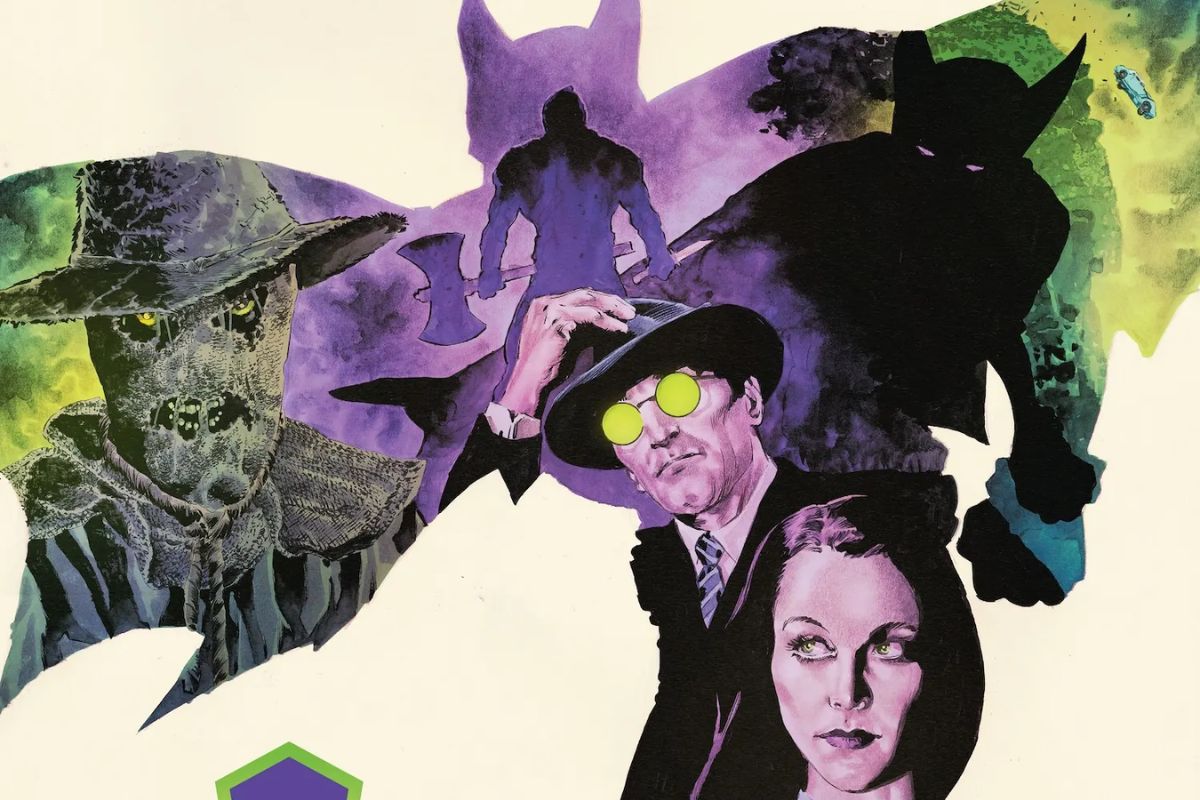

When Crisis on Infinite Earths erased the Golden Age Trinity from canon in favor of rebooting the Silver Age versions, a significant part of DC history was lost, and not for the better. The Bat-Man: First Knight showed why the Caped Crusader still works as a Golden Age hero, and how strong writing still makes him relatable. Likewise, its sequel, The Bat-Man: Second Knight, shows why the 1930s works perfectly to ground Bruce Wayne as an ordinary man fighting an impossible war against crime.
Without the convenience of 21st century technology and a large support system made up of powerful allies, Batman is effectively a more vulnerable hero. Not only is he more susceptible to significant injury in life-threatening situations, but he learns the hard way how his vigilante lifestyle negatively impacts both his own life and the lives of the people he loves, like Julie Madison. This vulnerability is spotlighted more clearly in The Bat-Man: Second Knight #2.

DC Comics
After nearly being stabbed to death by a hooded serial killer, Bruce barely makes it out alive and is hospitalized. Though Julie Madison covers for him (knowing his secret life as Batman), this fatal injury still puts a major dent in their still nascent relationship. What’s great about the way Dan Jurgens and Mike Perkins explores Bruce and Julie’s relationship is the unique perspective Julie brings to the table.
As an ordinary woman who makes her living as a film actor, Julie doesn’t have the built-in understanding that another woman like Selina Kyle (Catwoman) has. Julie doesn’t have a need to lead a dual life the way Bruce does, and doesn’t understand why he feels compelled to risk his life for a job he’s not even being paid to do – something Julie herself knows all too well as someone who gets paid to play different people on screen.
The other thing that’s great about how Jurgens and Perkins explore Julie’s role in Bruce’s life is how her presence actually complicates things for him. Bruce’s determination to investigate the hooded serial killer that sabotaged Julie’s motion picture premiere, and Julie’s natural concern for his well-being creates an organic conflict between them that hints at a future breakup – not because Julie doesn’t love Bruce, but because she doesn’t love Batman. Likewise, Bruce knows he won’t be able to give up Batman to give the life Julie clearly wants.

DC Comics
In addition to further fleshing out Bruce and Julie’s relationship, another thing that stands out about The Bat-Man: Second Knight is the origin story Jurgens and Perkins give Dr. Jonathan Crane, aka the Scarecrow. Though Jurgens and Perkins still preserve the Scarecrow as a psychiatrist who is obsessed with fear and developing fear gas, they add a fascinating twist to his origin story: he was responsible for weaponizing gas during World War I.
This actually makes sense, since tying his obsession with fear to the first world war helps inform Scarecrow’s present motivations. If he was fired for failing to see the inhumanity of weaponizing gas for warfare, it’s easy to understand why he would continue his research without US government supervision, and why he’s interested in selling his fear gas to Adolf Hitler as his highest bidder. This also makes Scarecrow a more terrifyingly grounded villain in a way he’s rarely afforded in the main DC canon.
Of course, the last best thing that happens in The Bat-Man: Second Knight is the introduction of the Golden Age Superman. Not only is it refreshing to see Clark Kent in a fedora again and change in a telephone booth, but it’s fun seeing him interact with Lois Lane, who is not yet aware that he is Superman. He even wears the suit that he wore in the Fleischer cartoons of the 1940s. Clark’s arrival also leads to an exciting cliffhanger where he meets Batman for the first time, with the latter being skeptical of the idea that a man can fly.

DC Comics
There’s a lot to love about the way Jurgens and Perkins capture the spirit of the Golden Age Superman that is both modern, yet respectful of his origins. To start with, both writer and artist make it clear that this is a Superman who is still early in his career and is not yet the polished Man of Steel we know him as. Though Jurgens and Perkins do not present the Golden Age Superman as being “punch first, ask questions later,” nor threatens to kill people, he still uses his reputation as an intimidation tactic. Not only do military personnel in Gotham take him seriously, but so does Batman when he sees that he is actually bulletproof.
Art-wise, Perkins succeeds at presenting Superman in ways that homage both his Golden Age comic appearances and the Fleischer cartoons. He even gives Clark Kent a face that resembles Superman serials actor, Kirk Alyn, both in and out of costume. This helps sell the humble reporter Clark likes to present himself as in the late 1930s, and allows Superman to still retain his gentleness when he uses his imagery to intimidate criminals. Throw in the fact that Perkins excels at capturing 1940s imagery, and the tone of film noir with heavy use of shadow and Mike Spicer’s colors, and the Golden Age feel is complete.
All in all, The Bat-Man: Second Knight continues to exceed expectations. It’s a bit of a painful reminder of the rich Golden Age lore DC lost when it flushed the first 50 years of its publication history down the bog with Crisis on Infinite Earths, which continues to be the publisher’s biggest enduring mistake. At the same time, The Bat-Man: Second Knight offers some refuge for fans of this era by telling new stories with these versions of the characters through a more modern lens.




You must be logged in to post a comment.