



(Editor’s Note: Minor spoilers ahead for Ultimate Endgame #1)

Deniz Camp is truly in the thick of it all.
Over the last couple of years, Camp (alongside artist Juan Frigeri) has helmed The Ultimates for Marvel. Spinning directly out of Jonathan Hickman and Stefano Caselli’s Ultimate Universe #1, the book has been expertly building this massive story featuring new takes on familiar heroes (and foes to boot). The TL;DR is that a rag-tag group of Ultimate heroes – Iron Lad (Anthony/Tony Stark), Captain America, Doom (Reed Richards), Thor, and Sif – have been righting the wrongs of the Maker (also Reed Richards) by restoring heroes’ powers and thus their place in this brave new universe. It’s quite lofty to say the absolute least.
“It’s so impossible for me to say what the reception was for a book that I wrote,” Camp said during a recent Zoom call. “All I see are the things that people tag me in – some people tag you in terrible things, but for the most part, people are really nice.”
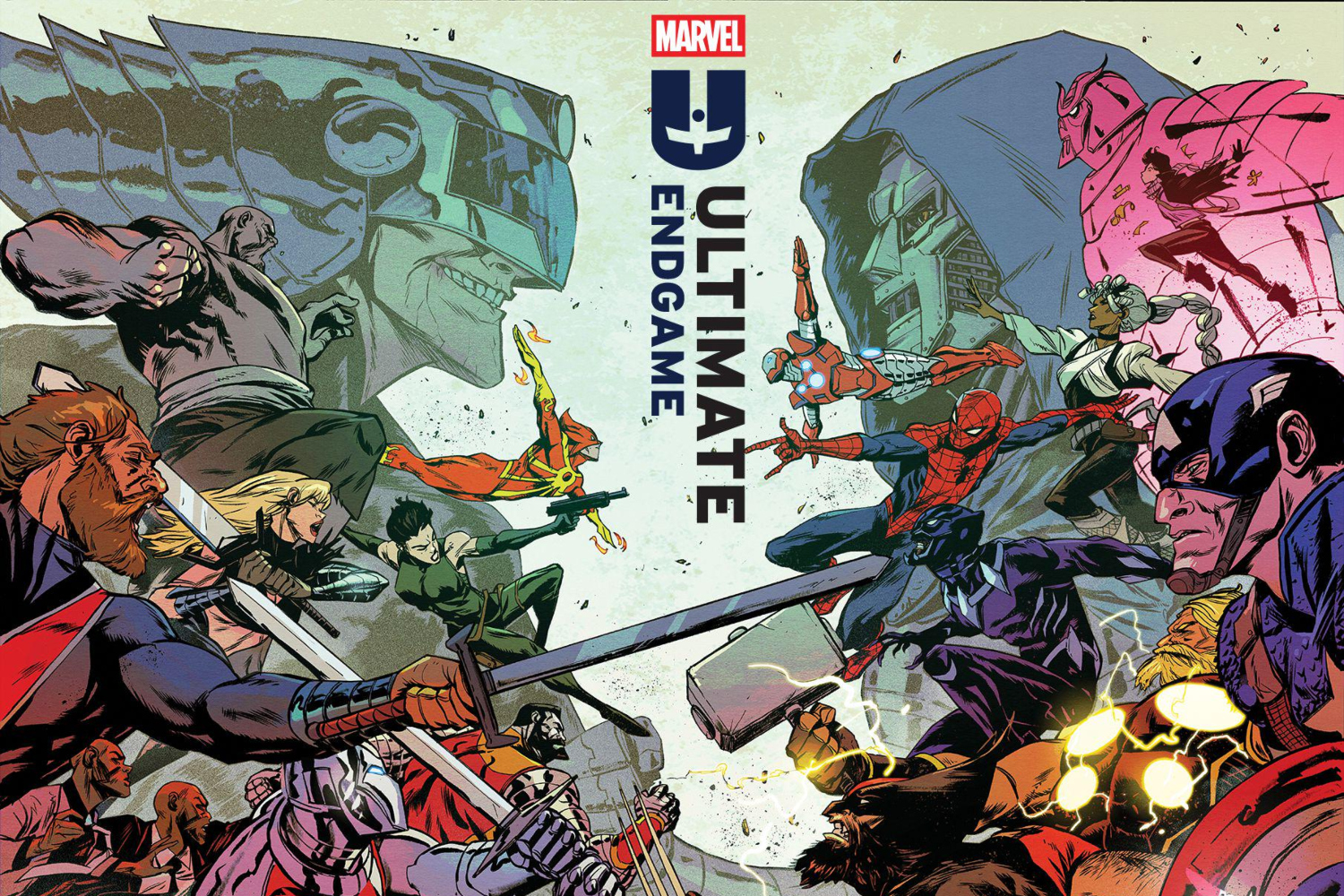
But clearly Camp has done well enough with this book, as he (alongside artists Terry Dodson and Jonas Scharf) has been tapped for Ultimate Endgame, which effectively closes the book on the universe (at least for the time being…) with one final, brain-smashing hurrah. Admittedly, Camp is a smidgen nervous – but not necessarily for the reasons that you might’ve expected.
“I felt very confident about my ability to tell the stories for my characters,” Camp said. “But I was a little worried about the others. I hope I’ve done my job. I know too much anyway, so it’s fun.”
And by others, of course, he means the various creative teams and their respective books: Ultimate Spider-Man (Jonathan Hickman and Marco Checchetto); Ultimate X-Men (Peach Momoko); Ultimate Black Panther (Bryan Edward Hill and Stefano Caselli); and Ultimate Wolverine (Christopher Condon and Alessandro Cappuccio). It’s Camp who will actually have the final word, as it were, as Spider-Man, X-Men, and Black Panther each end with their respective 24th issues in January and February. (Ultimate Wolverine has been extended to issue #16 in spring 2026.)

Variant cover by Ryan Stegman. Courtesy of Marvel.
“I feel a sense of responsibility to the characters and to the story that we’ve been telling…to end this in a way that is satisfying, true, and respectful, and that reflects how it makes them feel things and reflects the world as I see it or I experience it,” Camp said. “And so trying to do all of that, all the different things I introduced, but then also for all the characters that John and Peach and Brian and Chris have spent so much time deepening and creating, it was very daunting.”
So, how exactly will Camp best maneuver through this wonderful mess that he’s co-developed and master-minded? It helps, of course, that he and The Ultimates team have “a big mega story that [we’ve] been telling from the very beginning.”
Camp added, “And then there’s the big mega story that John was telling from [2023’s] Ultimate Invasion. So the spine of the series, of Endgame, are those two things.”
For part of that “formula,” Endgame spins directly out of Ultimates. In that series, Tony and the team have spent two years preparing, as the Maker has spent a simulated 2,000 years in his technologically-advanced City (likely preparing and not just, say, catching up on episodes of Black Books). Endgame, then, finally sees the clock strike zero as they must enter the City to see what literal millennia have done to further augment both the Maker and his especially formidable Children of Tomorrow.
“It’s fun figuring out an interesting way of taking characters like the Maker and Spider-Man and X-Men and Black Panther, and doing interesting new things with them that honor what came before,” Camp said. “One of great things about pop music is that you get to mine the past and take the thing that you like and do your spin on them. I love a challenge – that’s the point of being a creator.”
Admittedly, Camp doesn’t have a “giant whiteboard” to track this massive story. (He does, however, use ample notebooks.) Mostly, though, its been about being “really diligent about the plan,” and sticking to it as fervently as humanly possible.

Stonehouse Homage variant. Courtesy of Marvel.
“It was just about pacing it out,” Camp said. “After it was decided that this would happen, and we were really going to end it, I just ran down where the characters would be at the end of the books. I knew where Spider-Man was going to be when, and so, logistically, I just needed to know, ‘OK, what happened at the end? What’s the setup? What do I have to play with?”
Camp added that he kept asking himself one central question: “How could I take those ideas and themes and continue them forward just a little bit? I wanted whatever came after to feel organic with what came before.”
To an extent, that process meant, as we’ve touched on already, fully respecting what the other creators were going through in ending their own dearly-beloved stories. That meant making sure that “everybody gets to end their story in whatever way they want, and whichever way is best for them. And I think that’s what’s going to make those stand the test of time.”
It was also a matter of trying to innovate where he could (to let readers “get something new that’s going to be, I hope, respectful and feels right”). And what we end up with is a lot of small touches that ultimately (pun certainly intended) feel extra significant. It’s the “same” story but advanced, and the Endgame team have been strategic in making something that feels like a genuine fruition of the potential of each character and title.
For instance, several times during our chat, Camp brought up Spider-Man. If you’re unaware, this Ultimate Peter Parker is a family man, who in his mid-ish 40s, is thrust with the responsibility of becoming Spider-Man (in a world where there’s not a lot of guidance for the cape-and-tights crowd). Camp’s take on Spidey, then, feels deeply familiar with just a little bit o’flourish.
“Spider-Man is in the first issue,” Camp said. “That book was so focused on family, and so family plays a big part…what he thinks about when he goes into the City and all those things.”

Courtesy of Marvel.
Parker’s “interest” in family is one novel element of the overarching Ultimate “saga.” Which brings us to another interesting component of this Ultimate Universe: its overall immaturity. Which is to say, compared to the “mainstream” Marvel universe, there’s not as much history surrounding Peter Parker of Earth-6160 (which explains, at least in part, the family “angle”). As it turns out, that immaturity can be both a blessing and a curse for the creators.
“It’s a little bit different when you’re dealing with characters with 60 years of continuity or more; that’s a bigger task,” Camp said. “But there’s another thing where those characters are pretty malleable because they’re fairly new. This Spider-Man has only really been written by John. This X-Men has only been really written by Peach. And so you really have to work to get it right as best you can.”
But in keeping with what’s basically become his his mantra at this point (stick to the plan, be consistent), Spidey’s “family first” arc is neatly extended as he basically gets a new “family” as the team prepares to enter the City. OK, it’s really just a little bonding between Peter and Tony, but it’s close enough, yeah?
“It should be that Peter’s the father and Tony’s the son – that’s not their relationship,” Camp said. “Peter is sillier than Tony, but he’s also more mature than Tony, right? So it’s like they both kind of bring something to the table.”
If you’re looking for a more direct moment with the Parkers, of course, you still get that in Endgame #1. I won’t spoil it directly (it’s been touched on, at least in part, across the preview materials), but it does involve a genuinely touching moment between Peter, Richard, and May that hums with true thematic resonance.
“One of the better moments is stuff with Peter’s family – that was really important to me,” Camp said. “We give Spider-Man an emotional moment that I’m really, really proud of, and I think really works. And I think Terry just nailed it. This moment came organically about – if I were a father, what would I do in a situation like that?”

Courtesy of Marvel.
As much as Camp had an affinity for Spider-Man, you can’t deny that his true ride-or-die across Ultimates: Tony Stark. The son of technocrat Howard Stark (that universe’s Iron Man), the super-duper genius Iron Lad has “really gone through it throughout the run, to say the least,” as Camp noted. As is the case with the rest of the book and its many characters, Camp just wanted to push it even further with our favorite brainy hero.
“He’s lost some of himself along the way, literally and figuratively, but he’s also expanded his thinking to grander and grander designs,” Camp said. “[Hickman] set up all these things, and I don’t want to ruin anything that hasn’t happened yet, but there’s all these different things that his father’s done. It’s all still floating in the air about how they all relate to each other.”
And, yes, part of Tony’s arc in Ultimate Endgame will involve a little more struggling and even some outright suffering.
“Tony is coming in thinking like, ‘OK, we’ve been through a lot, but I can see everything. I’m a time god. We’re going to fix the world,” Camp said. “He comes in with a pretty strong plan; he knows how difficult this is going to be and also a plan that he thinks is going to work. And as so often in the case, he quickly gets humbled. That’s in terms of something much worse, and he’s not ready for it.”
But, in keeping with his affinity for the character, Camp isn’t just punishing this lad for the sake of it. No, there’s still lessons to be learned, and Endgame provides the best opportunities for such personal development.
“When you’re the child of alcoholics, I find you can go in either direction,” Camp said. “Either you’re a teetotaler who is extremely earnest, and that’s Tony. Or you can go the exact opposite way.”
Camp added, “I love all of the characters when I’m writing them. When they lose, it’s not like, ‘Ha, Tony, overestimated himself and that was dumb.’ He wants to help people, and that’s beautiful.”
(At one point, I asked Camp to blink if Tony made it out of Endgame alive – only to be met with a stone-cold stare. When I then asked if he might simply suffer instead, Camp replied, “Depends on your definition of pain. Oh, and alive in what form?”)

Courtesy of Marvel.
But some people in this universe would rather see it all burn – cue the Maker. Camp said that while the Maker is “clearly at the center of everything,” he’s “never appeared in any of my books in real-time. You see him a little bit during flashbacks.” So, how does he plan to contend with the Maker’s shadow that’s “long been over my entire book”? Why, a little transformation that seems well-earned after 2,000 years spent locked up.
“So I knew that it had to feel big. Years have passed in the City, and so it had to be a big transformation of the Maker and of the City,” Camp said. “I felt it had to be an escalation. I really wanted to play with things that I hadn’t yet played with. And I wanted the threat to be worthy of [Ultimates], and worthy of the rather large universe that we all created.”
And other heroes in Endgame also undergo their own transformation. Some of them aren’t nearly as dramatic as the Maker’s big reveal toward issue #1’s end, but each such change does have its own significance.
“I wanted all of the characters in Endgame to feel like they evolved into something,” Camp said. “So you see Doom has new armor and something happens with Spider-Man where he’s a little bit different and maybe a little more powerful. Because this is real – everything is real now. This is the big leagues. This is what we’ve all been building for. It’s a scrappy group of people going against the Devil, essentially. Or God. I wanted that to be present in the way they were drawn.”
The resulting clash is part of what makes Endgame so dang effective and generally entertaining. At least the start is exactly what Camp has promised here: A thoughtful, dedicated continuation of this larger narrative’s interests in what makes heroes interesting, how they really tick, and why we need them now more than ever before. Endgame realizes the sheer significance of everything that’s come before, and the story tries to appease and reconcile as much as possible to tell a vivid story about never accepting defeat and fighting back where/how you can. “Scrappy” is certainly a solid keyword for this rollicking adventure.
Oh, and in case you need even more, there’s some other important developments and corresponding goodies. Camp said that “the opening scene of the book is a mission statement for everything. There’s a lot there that is very intentional. Every piece of it is very intentional, those first two pages. One of the themes of Endgame is encapsulated right there.”
And what exactly might be the theme? Well, here’s a slightly cryptic lil’ teaser instead.
“I think it’s more interesting when you can see what they’re playing at,” Camp said. “And it’s all these different people that are after the same thing – they all have a vision of the world, and they’re competing visions of the world.”

Variant cover by Chip Zdarsky. Courtesy of Marvel.
As for something a little more direct, Ultimate Endgame #2 (coming February 4) offers up “a lot about the history of the City and what’s been happening these last 2,000 years.”
But more than that, the very essence of Ultimate Endgame has been churning at the center of this big, lively universe for some two years. (That certainly keeps with Camp’s M.O. of what’s basically “Yes, and…”) It’s something that “[Hickman] put in there, and I really amplified it because I really feel it and a lot of my friends and family really feel it and a lot of the younger people I talked to really feel it.” And that’s a simple but devastating truth: we’ve clearly lost something along the way.
“That, and that the future was not what it was supposed to be,” Camp said. “It was not what we were promised. We set up some questions in the first issue about, and really throughout, asking, ‘Is it possible to fix the world? Or, is it broken forever? Is there something in between those things?'”
If you’re worried that you’re ill-equipped to tackle such massive existential questions, fret not. Camp said that “you don’t need to know the lead up to Ultimates #18” to be well read enough to tackle Endgame. What you need to know is basically right there in the opening salvo of issue #1.
“I explain to you what’s going on: an uprising has been declared,” Camp said, with much of the Ultimate Earth engaged in what’s effectively World War III. “And so you don’t need to know how it happened to enjoy the fact that it seems like a lot of young people are rising up against a superpowered dictatorship. I can explain that in a caption, and you can just enjoy what I think are new visuals to that and a new part of that story.”
It’s an extension of Camp’s approach to all of his books: The story should always be accessible above everything else.
“I always do everything to try and make it understandable as it could be somebody’s first issue,” Camp said. “Especially if it’s a #1 or something. If you pick up an issue, #7 or #10 or whatever, just enjoy that story for what it was. Ultimately, Endgame is the same. You don’t need to pick up more things.”

Variant cover by Peach Momoko. Courtesy of Marvel.
Of course, more adventurous readers will also be handsomely rewarded. (If they can manage that reading pile, of course.)
“But if you’re just reading [Endgame], and that’s all you read, I think you’re going to get a cool book that gives you a sense of something bigger has been going on and that something bigger is going on,” Camp said. “Then you can pick up The Ultimates if you want to get the full dimension of that story. And you can pick up everything that came before if you want to get the totally full dimension of every layer of the story.”
Because, at the end of the day, Camp is concerned with lots of things. Respecting the work of his collaborators/fellow creators; creating a massive event that is still decidedly approachable; letting characters resolve their arcs the way they need to; and even balancing some razzle dazzle with substance, and geeky world-building with timeless storytelling. But mostly, the only thing to be concerned about is that this story, from its foundational opening to its reality-busting ends, hits as hard as possible.
For even more Ultimate action, check out our recent interviews with Jonathan Hickman and Chris Condon.
“This is the end for the Ultimate Universe, and so you’re going to see a bunch of surprising endings that will hopefully feel natural,” Camp said. “But we are not bound by what comes after. We are bound by what is most appropriate and what’s most true to these characters and the story that we’re telling. So I hope it’s going to be really satisfying for people and it’ll be really surprising for people. That’s what we’re going for.”
Ultimate Endgame #1 is out this week (December 31).



You must be logged in to post a comment.