

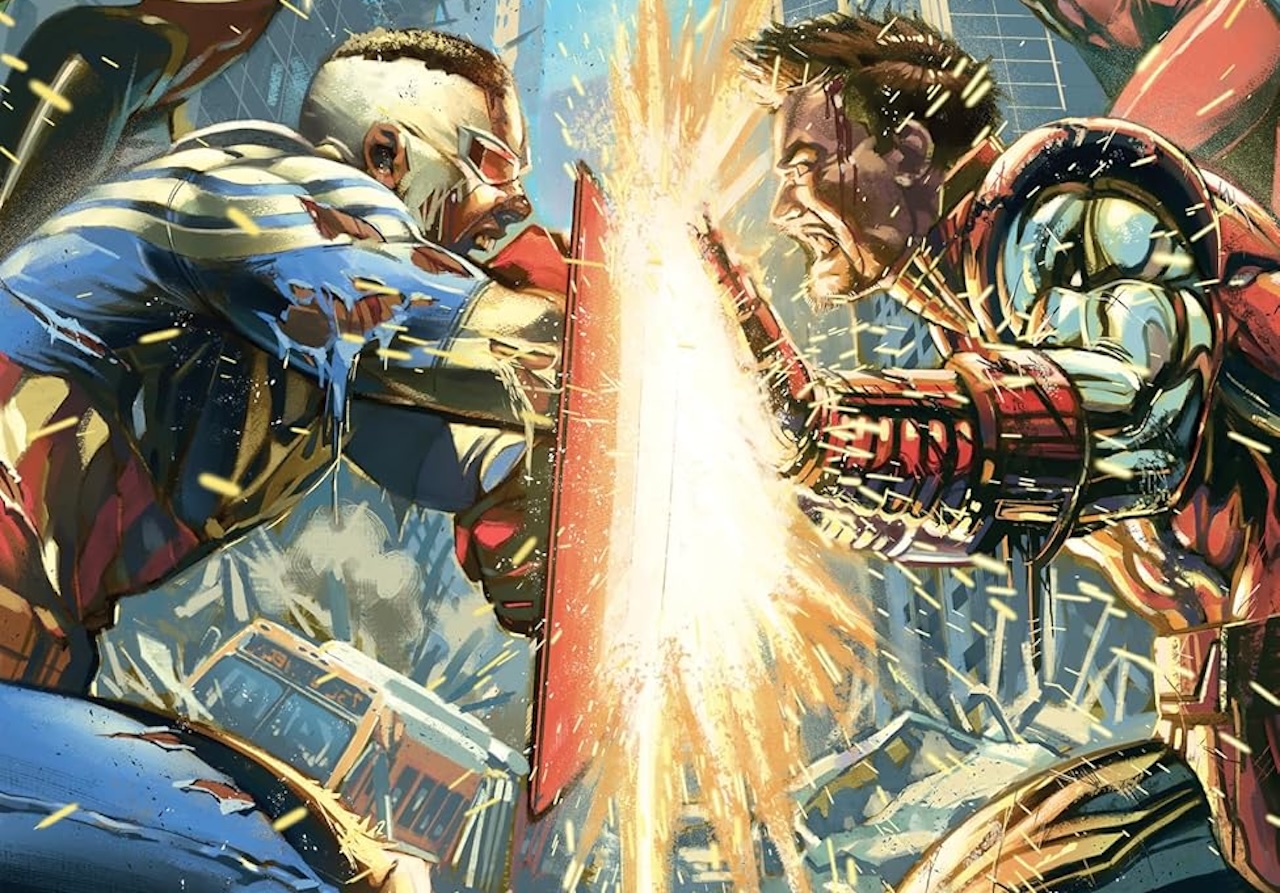

People love an underdog, and the West Coast Avengers are a historically underdog driven-team. For most of its history, the team’s roster has consisted of both heroes and former villains trying to make a name for themselves. Whether they were shuffled to the West Coast team due to an over-saturation of East Coast members, or hand-picked to show they were rehabilitated in the eyes of both their peers and the public, a through-line is the idea of overcoming their own faults and rising up to the occasion.
Such is the case in the second arc of West Coast Avengers, collected in War of Ultron, with perhaps its biggest challenge yet: proving that Ultron, the maladjusted creation of Hank Pym, has truly changed his ways. A problem like Ultron’s public perception isn’t easily fixed, as previously shown in the first arc, The Gospel of Ultron. With both the leader of the Church of Ultron (called “The One”) and a version of Ultron who flew into the Sun (“Ultron the Scorched”) causing trouble, it seems Tony Stark and James Rhodes team of rehabilitated Avengers have their work cut out for them.
With the preemptive ending of the series at #10, so much of the story feels rushed and reduced to a barebones finish, with several lingering questions that are ultimately unanswered by limitations of space and time. The series concludes with Avenger Ultron doing the big heroic sacrifice in trapping himself and the other two versions of Ultron together in a massive, metal slab.

Marvel
It’s clear certain aspects of the series were given more time to conclude than others. Likely, those were story threads that were meant to end in the second arc and others that felt more unpolished were meant to have a longer development period. One particular plot point I wished had had more room for exploration was the dynamic between Blue Bolt and Wonder Man, especially with the reveal that Blue Bolt’s abusive father is a longtime Simon Williams fan.
It’s no secret, and even joked about in universe about the tenuous relationship most Avengers have and/or had with their own fathers. Whether intentionally or not, with Vision and the Avengers arriving to demand Tony answer for Ultron’s inclusion in the West Coast Avengers, Blue Bolt’s reveal on why he chose the new name ‘Wonder Man’ and Avengers Ultron’s attempts to separate himself from Hank Pym, fathers and sons and the question of: can someone truly change?
Even with the sandbox nature of comics, it still seemed odd with the continued rehabilitation of Ultron without a conversation between Tony and Janet about the parallels between Ultron’s struggle for an identity paralleling a certain creator of Ultron and founding Avenger. It felt as if some characters were under-utilized for deus ex machina moments that had no true pay-off, while other characters than the average comic reader wouldn’t know received far more page-time.

Marvel
In that same vein, the tone of War of Ultron changes from page to page, if not somewhat meandering in tone and pace to final page reveals. The book was strongest when it focused on the horrors of the different Ultrons and what each version mention for Ultron as a complete figure. The knowledge that ‘Avenger’ Ultron keeps every memory of his past as a reminder, combined with the other two versions that were, up until the end, running around professing their own version of what it meant to be Ultron could have worked in a story that knew was it was.
For every darker page, there were an equal number of jokes filling the page, and while it’s never easy to find a balance between humor and horror, War of Ultron severely missed the mark.
War of Ultron, while in some ways a misfire, still had incredible page spreads by both Ton Lima and Danny Kim, who shines in action-driven work. The series ending on #10 isn’t too shocking, but more a frustrating side-effect of the state of the industry. West Coast Avengers sadly never quite seemed to find its narrative legs.




You must be logged in to post a comment.