

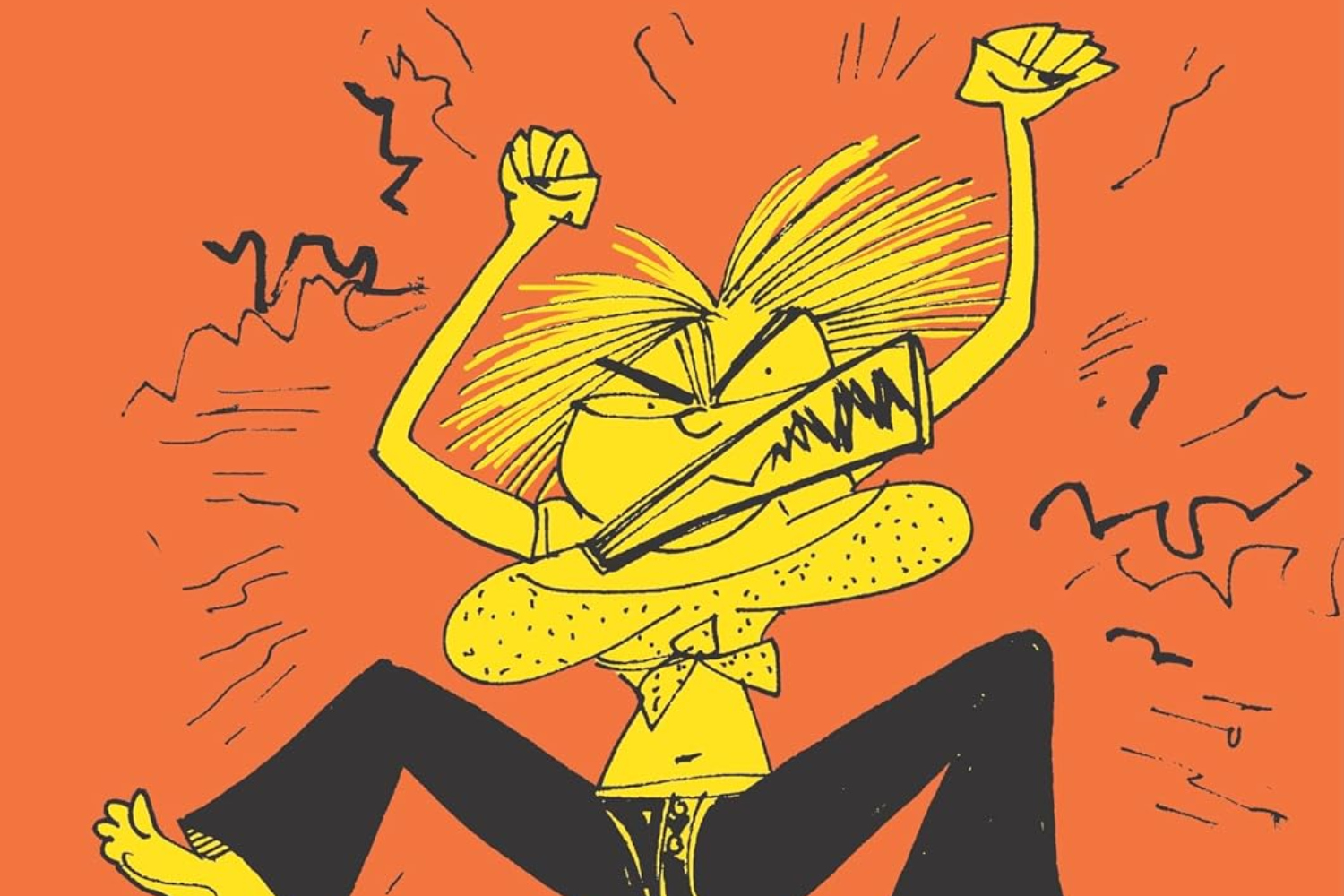

From 1991 to 2004, the world got plenty of face time with Midge McCracken. The creation of cartoonist Roberta Gregory, Midge was the surly, cantankerous star of Naughty Bits (which ran for a record-breaking 40 issues from Fantagraphics). Described as the “most unlikable character you’ll ever love,” Midge was the “shockingly nasty, hateful and even racist…office sourpuss” who won our hearts as she begrudgingly grew up and evolved (sorta) across the unwaveringly earnest pages of Naughty Bits.
Now, for the first time ever, Midge’s unsettling life has been placed in full chronological order in Bitchy!: The Exasperating Existence of Midge McCracken. Here, we get the “witty, irreverent, and unvarnished stories that comprise Midge’s troubled and troubling life” as they “coalesce into a lively narrative that will captivate new and old readers alike.” With a new intro from Gregory, and an insightful afterword by comics critic Helen Chazen, Bitchy! is a snapshot of essential, female-centric comics.
Here’s an excerpt from Chazen’s afterword that further touches on the true importance of Bitchy!:
“The weighty tome in your hand tells the story of Bitchy Bitch’s life so far as we know it, an unending cavalcade of frustrations from youth to womanhood. But this collected life story of Bitchy Bitch was never told in the pages of Naughty Bits — we are reading it for the first time now… Not only through arrangement but the very act of compilation, the story of Midge McCracken is changed forever, simply because it is, in fact, a story. It’s a story of a girl who grows up to be a woman, challenged from the start by the violent sexual and social contradictions of heteronormative life… This is Bitchy’s life, and now, in this collected form, it is Bitchy’s life story.”
With Bitchy! in stores next week (July 21), we recently caught up with Gregory via email to discuss the “weighty tome.” That includes how she feels about revisiting Midge after two-plus decades, the larger goals and “messaging” within Bitchy!, what went into developing each storyline, the significance of being the longest-running solo comic title by a woman creator, and even the possibility of future Midge-starring stories.

Courtesy of Fantagraphics.
AIPT: How does it feel to look back on Naughty Bits after some two decades of distance? Do you feel like you accomplished whatever it is you intended to accomplish?
Roberta Gregory: Back in those pre-digital days, I wanted to create the comic book that I, myself, would eagerly look forward to reading every few months (it came out on a sorta-quarterly schedule). Something with the spirit of the Underground Comix I read in the early 1970s, but from a woman’s point of view, and stories that get right into some touchy subject matter, but with lots of humor and plenty of “aha moments” and everything else that makes it fun to read: commentary, letters from readers, “guest comics” from my friends and colleagues, my autobiographical comics, and the continuing saga of a challenging character who’s not always easy to feel sympathy for.
Back then I had no idea it would run for 40 issues, so, yes, I think that’s quite an accomplishment for someone whose creative endeavors are all over the map when it comes to subject matter! (I did have a lot of stories in print during the later Underground era, late 1970s into the ‘80s, but nothing to this extent.)
AIPT: How has your relationship/connection with Midge changed/shifted at all over the years?
RG: Midge started out as an unpleasant throwaway character I had absolutely no love for at all. In the first issue, I subjected her to a “date from hell” with excruciatingly graphic bad sex, [and] then figured I’d seen the last of her. When Fantagraphics said they’d like to publish a second issue, I reconsidered Midge and began to dream up a workplace, family, and some life history and I guess my inner novelist took over. Now I feel pretty empathetic towards her as she tries to overcome her lifelong negative conditioning while lacking the overall self-awareness to understand why her life sucks. I do let her make some progress along these lines, so if there’s hope for her, there’s hope for almost everyone, I suppose.

Courtesy of Fantagraphics.
AIPT: Do you feel like the overarching story or its general focus might play out differently if you tried to tell these same tales in 2026?
RG: I decided that Midge was about one year older than I am, and I really had fun recreating the often-clueless world of the 1960s and 1970s. Younger readers have said they find this all rather enlightening. I would have no experience of what goes on in an office today…nor one in the 1990s, for that matter. The closest I came was working in the production department of trade magazines during the 1980s, in which I spent most of my time in a darkroom or at a drafting table. Someone once asked me what they actually do in Midge’s office, and all I could do was shrug.
AIPT: How did you decide would make for a good story? Was there criteria or a formula that made certain life moments or feelings worthy of being immortalized somehow?
RG: Nothing was really planned. The first two childhood stories appeared in issues #3 and #4 as I wondered what kind of family would produce someone like Midge, and her high school days followed in the next few. Then I sent “present day” Midge on vacation (and its aftermath) for five issues, [and] then sent her to college in the year 1970 for three issues, then back to the present. Then another childhood story in issue #21, followed by a post-college adventure, then back to the present…I even squeezed in a “Medieval Midge” tale in issue #27 that unfortunately didn’t fit into the concept of this collection, but it’s hilarious nonetheless.
The very last Midge story was drawn in 2004, with thirtysomething Midge in the early ’80s. My creative process at the beginning was based entirely around the comic industry direct market system, in which a new title is solicited by distributors three months ahead of publication date, and the number of orders from retailers determines the press run. I’d suggest a topic to Fantagraphics for an upcoming issue (“Uhhhh, how about ‘Midge goes on vacation'”) then occasionally jot down some ideas that surfaced, or an appropriate scene, while working on some other big project or my day job. And then about a month or so before everything was due, I would sit down and scribble out the storyline and dialogue in several hours, almost like I was channeling it from some remote corner of my brain where it had been quietly brewing away. Then, I churned out all the artwork in a few weeks of some very late hours. The creative process is a wondrous thing.

Courtesy of Fantagraphics.
AIPT: This is the first time things have been organized chronologically. Does reading it this way reveal anything new or insightful you hadn’t picked up on before?
RG: I’m amazed how well the stories fit together with intriguing little details that tie in to one another and so forth. During the 1990s, Naughty Bits was more of an intermittent side project, my “Fantagraphics comic book.” I was much more creatively engrossed in my smutty mini-series, Artistic Licentiousness, and with finishing the lengthy graphic novel I’d begun in the 1980s, Winging It. Now the first title is out of print, and I’m not very happy with my artwork in the second, but I continue to love my Bitchy stories.
AIPT: I feel like the tone and style of your stories paved the way for indie comics over the 21st century. What is it that you think people resonated with exactly?
RG: I absolutely had lots of fun with these Midge stories, the art and writing. Some of my other projects were filled with rather tedious artwork I fussed over constantly. I think of myself as a writer who happens to draw (and really not all that well sometimes), but there’s no way to draw Midge “wrong.” And there’s really nothing you “can’t” write about in storytelling.
AIPT: This book has the honor of being the longest-running solo comic title by a woman creator. How much does that accolade mean to you right now?
RG: Well, I’m happy to hear this, but I always wonder if this is official, and who’s kept track and how is “long running” defined? I think of all Donna Barr’s The Desert Peach pages, or Colleen Doran’s A Distant Soil epic, both of which began before Naughty Bits. I published my Dynamite Damsels comic book 50 years ago in 1976 and that was called “the first solo self-published comic book by a woman.” But, really, the late Mary Wings published her small press Come Out Comix before that, and there may have been more, as part of the feminist publishing wave of the early 1970s.

Courtesy of Fantagraphics.
AIPT: I feel like your comic is kind of a response to Cathy – a more realistic and open take on some of the “female empowerment” threads of the ’90s. Is there any truth to that – is there some story the project is a response to instead?
RG: As I said, this comic is mostly what I wanted to read, that nobody else was doing… which has pretty much been the story of my life when it comes to creative output. I never really connected much with Cathy….or with much popular culture at all, at least to the extent that most Americans seem to be involved with it. However, the very first story in the very first issue of Naughty Bits (“Crazy Bitches”) was a response to something…(Spoiler alert: Robert Crumb) Fantagraphics is reprinting and reissuing that very issue this summer, so everyone can read about it very soon!
AIPT: Is there anything about these stories that you’d do differently somehow?
RG: I really don’t know. If I had carefully plotted out Midge’s life story with all the “rules” and “trajectories” people expect these days from fiction, would it be superior to this happily slapdash collection of stories? Perhaps I might have toned down some of the more in-your-face images and more brutal dialogue if I’d known the early 2000s would be the dawning of a social media era where one image can be singled out, given an inflammatory caption, and then sent out to enrage millions of individuals. But Naughty Bits was a comic book, sold mostly in comic shops, many with life-sized cutouts of Spider-Man and Batman in the front windows, reaching a readership of 3,000 or 4,000 comics fans at most. So, as they say, it is what it is.
AIPT: Could we ever see even more of Midge’s wonderful misadventures? Or is her story mostly done and wrapped up by now?
RG: I was developing a storyline in the last several issues where Midge obsesses incessantly over a perceived lump in her breast and, predictably, bemoans her lousy insurance while imagining horribly lurid mutilation fantasies without taking any steps toward actually doing anything about it from a medical standpoint… and then Fantagraphics decided the series should end with issue #40.
I’d written the first 20-some pages of a script about Midge dealing with breast cancer and was trying to decide if the storyline should have it turn out to be a massive false alarm, or should I use this as an excuse to kill her off… so that’s kind of where it stands at the moment. I guess I could continue Midge stories as long I have breath in my body, but now the question is: would this be Midge’s world [from] twenty-some years ago, or our current digital age.

Courtesy of Fantagraphics.
AIPT: Do you have a standout issue, storyline, moment, etc. from the book? Something that speaks to the heart of what you were trying to do perhaps?
RG: Well, I was rather pleasantly surprised by my “Chuckie” storyline, where Midge thinks she’s found Mister “I’ll-settle-for-this-guy-I-suppose” before she realizes she has to Do The Right Thing (and does) while Marcie loses touch with reality, all during the days of The Millennium Threat. Despite being a period piece from an era everybody’s now forgotten about, it also sorta wrote itself, but as a lengthy, cohesive story with some twists and turns that even surprised me. Creativity is such a weird and wonderful experience sometimes.
AIPT: Is there anything else we should know about Bitchy!, Midge, your work, comics in general, etc.?
RG: The comics world is such a dazzlingly vast universe now compared to the mid-1970s when my first stories showed up in Wimmen’s Comix. I was delighted and inspired in 1972 to see an entire 32-page black-and-white comic book with stories by women (having grown up believing that women comic creators were almost nonexistent), and now there seems to be no limit to what graphic storytelling can be. And I’m very pleased to be able to add my own quirky contributions to the fabulous party mix.
I hope to stay well enough to finish my current works in progress, and perhaps even tackle some new ones…and a recent major move was an eye-opener as far as the staggering amount of words and pictures I’ve committed to paper over the past six decades or so! I’m happy that some other folks might enjoy it as much as I do.

Courtesy of Fantagraphics.



You must be logged in to post a comment.