

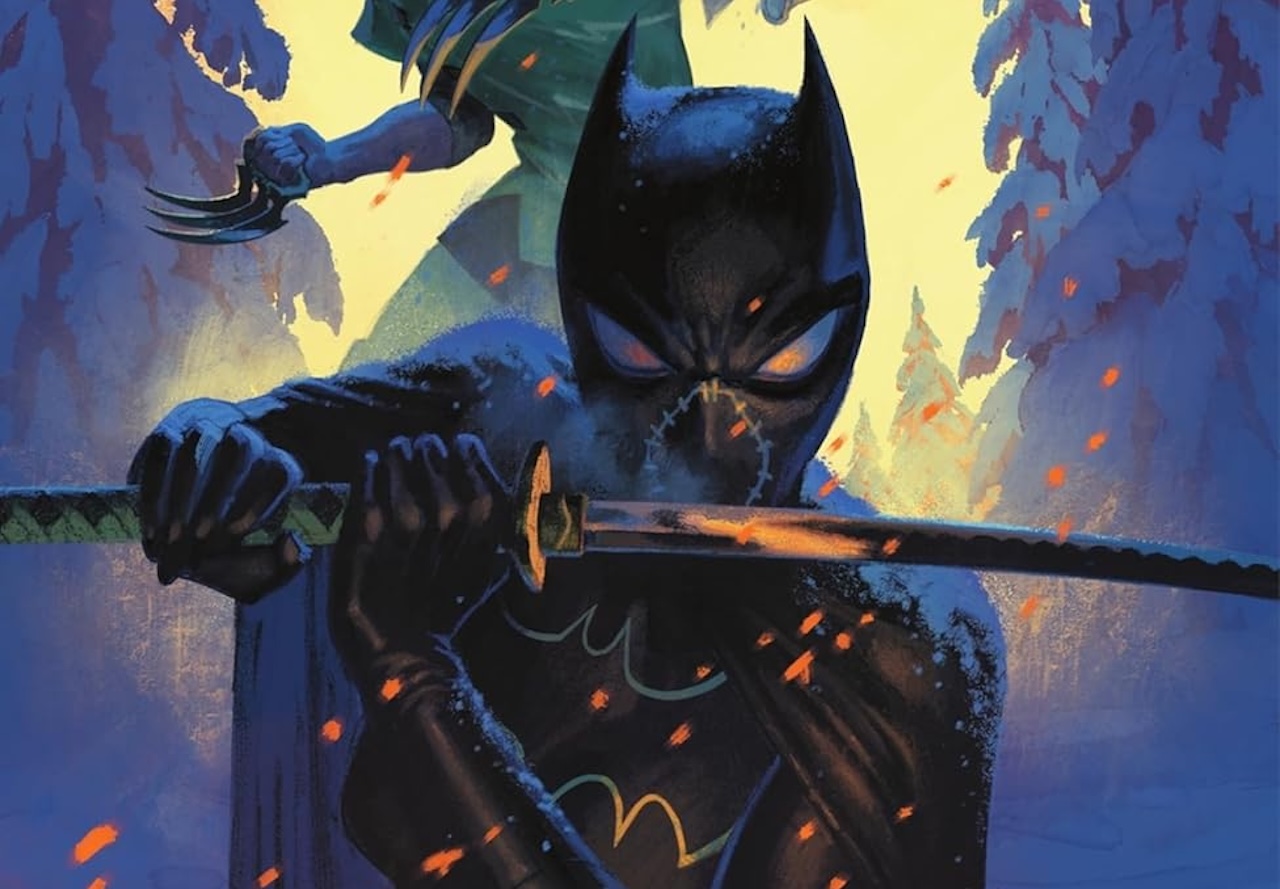

The final installment of Batgirl’s War of Shadows is out today, completing a fun if slightly drawn out arc against Nyssa al Ghul, the Unburied and Cassandra Cain’s own conflicting feelings in the death of her mother, Lady Shiva. This issue ends Cass’ time in Samsara and reminds her who she is at her core, headed home to Gotham with a clearer mind and a heavier heart.
Takeshi Miyazawa’s crafting of each page, between the paneling and the fluid movements of Batgirl, feels like a return to form. Batgirl has felt its most true when it focuses on Cass and her ability to read people, to understand a situation before it happens. This separates her from other street-level fighters and draws the reader naturally to the action sequences, watching with a careful eye in how Batgirl handles herself as one of the best hand-to-hand combat fighters in-universe.

DC
Batgirl #16 opens cleverly deceptive, with Cass seemingly alone in front of a fire, finishing her report for Oracle, aka Barbara Gordon.
Since the death of Lady Shiva, Cass has struggled to understand who she is and her own fears she is nothing but an extension of her mother and Shiva’s own obsession with retribution. In a clear parallel, Nyssa al Ghul repeats her own father’s mistakes, all the while declaring herself above comparison. Though Nyssa falls into the same traps of Ra’s al Ghul, it isn’t until Cass forces her to feel her suppressed and avoided feelings that anything true is said by Nyssa. If Batgirl suberts everyone’s expectations of her, Nyssa falls right into the usual traps of her father’s own hubris.
Her own denial of her actions and perpetuated behaviors cause her to break down, not too dissimilar to Cass’ own realization she is hiding from herself in a younger, more violent version of herself. Cass is shown to be capable of breaking away from her past and expectations of her, even as she sees illusions of her younger self, her mother and David Cain, each trying to dissuade her from her changed point of view. The justice she seeks is unattainable and instead of spiraling with the mistakes of her past, she chooses to instead think of the future.
Tragedy is subverted in Batgirl’s decision to save Tenji instead of leaping into fight, a decision shown throughout the issue. While Batgirl does fight defensively, any moment she may have leapt into a fight is either diverted by another or she side-steps the struggle entirely. The message from Jaya is reflected back by the issue itself: “more violence cannot stop a bleeding wound.”

DC
The end of Batgirl #16 feels like a clean slate for the series, pushing past an arc that could have used some generous editorial work.
While Batgirl and presumably Tenji are returning to Gotham, there still remain unanswered questions: who is Jaya? What waits for Cass back in Gotham? Is she truly as at peace with her mother’s death as she seems? Will the visions that have haunted her in Samsara follow her to Gotham, or have those ghosts been laid to rest with the planting of the last blue poppy?
A series with an initially strong start falling into a far slower sophomore arc isn’t new, but it is a bit disappointing. Writing a character like Cassandra Cain in somewhere other than Gotham was initially so intriguing, knowing how much of herself is tied to that city. Ultimately, I believe the arc was just extended out too long and would have otherwise had a satisfactory conclusion that didn’t make this reviewer far too happy to be returning to Gotham.




You must be logged in to post a comment.