

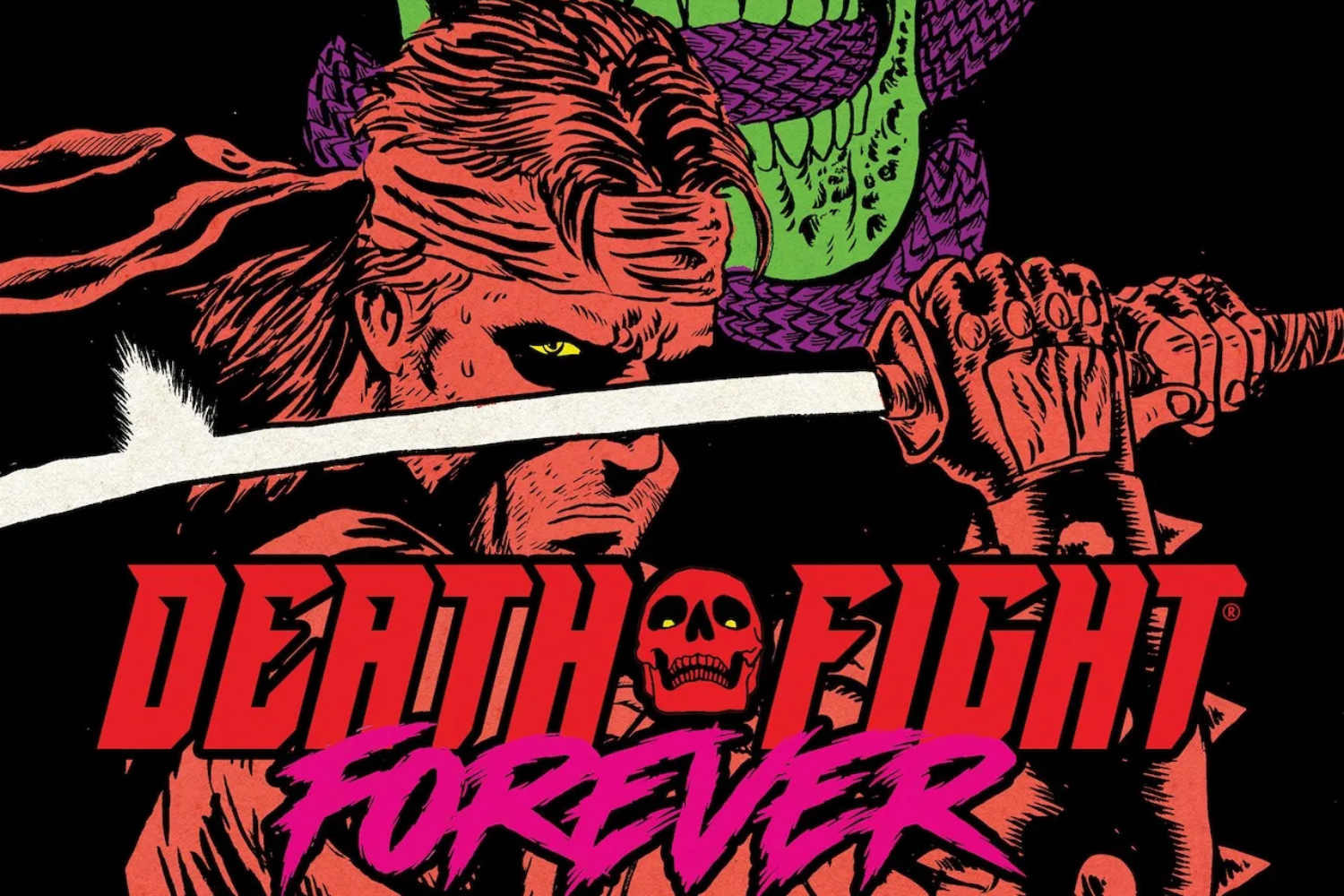

Earlier this year, Andrew MacLean announced plans to celebrate the 10-year anniversary of Head Lopper with a brand-new #1. But if you still require even more over-the-top action from MacLean, he’s teamed up with artist Alexis Ziritt (Space Riders) for the equally bonkers Death Fight Forever.
Inspired by quirky action flicks of the late-ish ’80s, Death Fight Forever follows Crash and Bash Biggle, two “super-thief bruiser brothers” who do battle with the “inter-dimensional crime boss, Lord Slyther.” However, the Biggle brothers’ lives are forever changed after they confront Marla Mendoza, the “leader of the COPZ gang and Slyther’s most formidable loyalist.” Think G.I. Joe but on really good acid, basically.
And that very much defines the rest of Death Fight Forever. Ziritt’s art (as backed by the sharp wit and pristine weirdness supplied by MacLean) is a proper fever dream of mythical proportions. It’s the black light poster dripping in intense colors and ungodly visuals that will stoke all your nostalgic interests. But don’t forget that, despite this kooky majesty, Death Fight Forever is still a story about two brothers kicking ass.
Death Fight Forever #1 is due out this week (February 18) via Image Comics. To prepare your brains for the coming onslaught, we caught up with MacLean recently via email. There, we discussed the book’s rotating lineup of artists (issue #3 features Al Gofa), how he approaches exploring and furthering nostalgia, the book’s visual identity (and how that relates to his own identity as an artist), and standout moments from the five-issue project, among other topics and tidbits.

Main cover by Andrew MacLean. Courtesy of Image Comics.
AIPT: This book feels like the most wonderfully bonkers video game from 1991 that I never played. What about this kind of “nostalgic exploration” interests you?
Andrew MacLean: Nostalgia is having a great love for something from your past. I feel like all of my comics have been love letters to things or times I’m nostalgic for. Nostalgia feels good, it’s often a remembering of simpler times, or just being completely engrossed in something you enjoy. If I love something, I want to be a part of it. Making these comic book love letters is how I get closer to things I love.
AIPT: Was there some larger goal/objective of working with different artists for issues #3-5?
AM: Not initially, no. It’s something that we pivoted to along the way. The original plan was to have Ziritt draw the whole book. When he could no longer fit it in his schedule, we decided to bring in other artists. I felt that if you’re going to change artists out mid-series, you might as well lean into it, bring in multiple artists, and really embrace the change. So, I tried to make it an opportunity to showcase some of my favorite artists and was grateful that the place where Ziritt left off was the perfect place to make the shift to a new art style.
AIPT: In the vein of that last question, you’ve got such a singular identity/look as an artist.What’s it like working with the other artists to translate your vision and develop this story? Is that collaboration sometimes hard for you?
AM: More often than not, I’m the writer and the artist on my books, and while I did do a cover for each issue of Death Fight Forever, I didn’t draw any of the story art. So, that’s obviously a very different process, but also, not my first time doing it.

Courtesy of Image Comics.
I write myself very detailed scripts when I work alone, so the transition to working with others is pretty easy in that regard. From there, if there is something an artist doesn’t understand, it’s usually pretty easy to find a solution.
Occasionally, artists go off-script altogether and change events and characters. That wreaks havoc on building a story; it’s that cause and effect, right? You change something and it breaks the chain. But honestly, I didn’t have any problems like that on Death Fight Forever.
AIPT: I hope this doesn’t come off insulting, but how much does plot really matter to you? I get the sense from your work that it’s about the larger experience and being immersed in this world over “traditional” storytelling (and that’s hugely exciting).
AM: This is a bit difficult to answer…
I think of plot as the series events in a story that are governed by cause and effect. By that definition, my stories definitely have plots. I think a comic without plot is probably an art book. HAHA.
But maybe what you’re cluing in on is that I’m not huge on themes. I’ve explored themes like war, power, and family dynamics, but it’s always secondary. My primary goal is to entertain, create a sense of adventure, or just generally have readers go on an emotional journey with these characters — the ups and the downs.

Courtesy of Image Comics.
I want readers to have fun, get excited, laugh, and just forget about all the crazy shit on their phones. Or, forget they have phones altogether. I want them to go somewhere else for a little while and enjoy it enough to want to come back.
That said, if it’s not a lack of theme that you’re cluing in on, then I just don’t know. If something happens that feels out of nowhere, well, then you’ll just have to wait to see where the story goes. Nothing happens without reason — but I can’t say I know when I’m being traditional and when I’m not. I’m just trying to make fun stuff and enjoy the time spent doing it.
AIPT: I’d love to get a sense of where you get your ideas and inspirations for a story like this. Do you have a vision board or a Pinterest page of just the absolute weirdest, wildest things to cull/pull from?
AM: I think about the types of things that would be fun to draw, but a story always starts with a character for me. If I create a character that is fun enough to draw, [and] that I want to draw it over and over, then I start wondering what kind of world they would live in and what kinds of things would they do there. String together a few cool things for a character to do and you’re halfway to a story.
But I don’t start collecting reference and inspiration until I’ve created a world. Once I have a sense of a world, I can start collecting things that I think would fit in it.

Courtesy of Image Comics.
AIPT: You balance action and comedy really well here. What’s the “formula” for making things funny but still exciting, and is action and comedy a lot closer than we’d expect?
AM: I don’t usually set out to write a script with jokes already in mind, but they come to me as I figure out what happens moment to moment. If an idea makes me chuckle a little, I’ll include it. In terms of balance though, a well-timed joke after a scene that was very serious, emotional, or just information-heavy can be a great way to segue to a new scene, lighten the mood, or just take the wind out of something that feels overly serious.
AIPT: Who’s your favorite Biggle brother, and why?
AM: Definitely Bash. Crash is kind of flawless, which is something Bash struggles with, but it also makes for a rather uninteresting character. Bash’s flaws are what make him special.
AIPT: Do you see any spiritual, thematic, etc. connections between this and Head Lopper? (I only ask ‘cause we’re at the 10th anniversary of that most wondrous book.)
AM: The only thing I would say they have in common is that they are both love letters to things I adore. Otherwise, no connection.

Courtesy of Image Comics.
AIPT: Do you have a favorite moment from issue #1? Maybe something that speaks to the experience you’re really trying to foster?
AM: My favorite moment in issue #1 is a joke where Commander ThunderFang is trying to give Bash a giant ’90s cell phone and a promise to be there for him in his time of need. Bash is overly hung up on the size of the thing and where he can even keep something so big. But all the while, in the background, Crash is actually trying to make a difference and save someone who is bleeding out. Blood is squirting everywhere, and Crash needs help, but ThunderFang and Bash are too wrapped up in their pointless conversation to notice. I find that style of dark absurdity really funny.
AIPT: What teasers and tidbits can we expect from issue #2-5?
AM: I think at the end of issue #1, people will probably think the series will focus heavily on the Biggle Brothers. However, Sergeant Marla Mendoza plays an equally big role. In fact, the way that issue #1 really sets up the rest of the story for the Biggles (it’s a bit of an origin tale), issue #2 sets up the rest of the story for Marla. And I gotta say, Marla is easily the coolest character in the series. She’s my favorite and she was all the artists’ favorite too. Keep an eye on Marla!

Courtesy of Image Comics.
AIPT: Andrew MacLean, this is perhaps the most important question I’ll ask this whole interview: What’s the best ’90s beat ’em up game released and why?
AM: I didn’t have a ton of games growing up, but I played the hell out of the ones I had. My favorite beat ’em up was probably Double Dragons II. It’s what inspired the Biggle Brothers. I created Bash first and immediately felt he needed a brother.
AIPT: Is there anything else we should know about Death Fight Forever, comics, the Biggle Brothers, kung fu fighting, video games, etc.?
AM: Death Fight Forever #1 hits comic store shelves on February 18, and keep an eye out for new Head Lopper starting on April 22! Both from Image Comics.



You must be logged in to post a comment.