

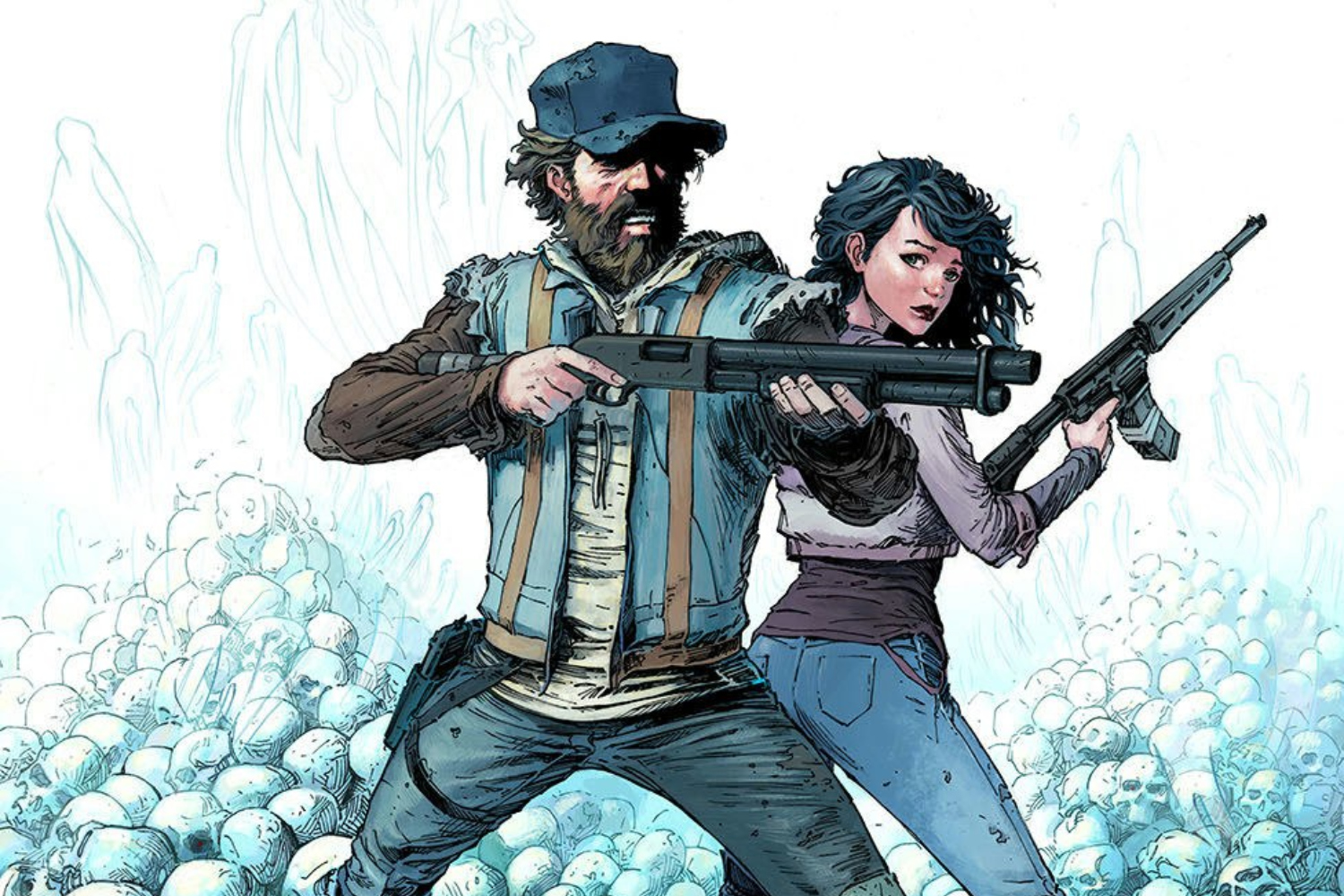

You might best know William Harms as a writer on Mafia III. For his latest project, Harms has ditched the seedy underbelly of 1968 New Orleans for an apocalypse like few others in White Sky.
Co-created by artist Jean-Paul Mavinga (and colorist Lee Loughridge), White Sky takes place in a world where, you guessed it, the sky turned sleet white and everything ended. We follow Violet and her dad David as they “flee toward the ruins of San Francisco, where they believe they’ll be safe.” But in a world where ghosts/the dead are everywhere, safety is more extinct than soy lattes and smartphones.
On the surface, White Sky may remind you of properties like The Last of Us and The Road. And while those are fine enough sign posts, White Sky is altogether more stirring and effective. The book explores the value of life in a world where death rules everything, and asks all of us what we’d do to maintain that spark when giving up is so much easier. White Sky is a ghost story, yes, but it’s also a tale about the tiny ways life sustains itself through the mist and chaos.
White Sky #1 is due out this week (February 18) via Image Comics. Ahead of the debut, we caught up with both Harms and Mavinga via email to discuss the series. That includes working in the “tradition” of ghost/apocalypse stories, exploring the David-Violet dynamic, their favorite moments from issue #1, and their world-building efforts as it relates to the main narrative.

Variant cover by Eliza Ivanova. Courtesy of Image Comics.
AIPT: Where did the idea for White Sky come from?
William Harms: It’s always hard for me to trace the exact moment an idea originates, mainly because something random will pop in my head and I’ll think to myself that I should turn it into something. But in this case, it was imagining what would happen if there was a ghost so powerful that it could change the weather. Then that single ghost turned into several, and before I knew it, White Sky was about the entire world being haunted.
I talk about this in the afterword to the first issue, but Violet is also very important. That part of the story is personal to me, and I’ll likely discuss it at some point, but she comes from an extremely powerful dream I had.
AIPT: This story feels like the best amalgamation of ghost and zombie stories. Is there some kind of commentary here and/or y’all playing around with these “traditions”/tropes?
WH: I really enjoy playing with traditional monsters and pushing them into interesting and new directions. I did it with my series Impaler, which cast Vlad Dracul as a vampire hunter. And in this case, it was about trying to take ghosts and not only maintain what makes them scary but also tweak some things so that the people in the story can fight back.
I really like the idea of action horror, where you take the key elements of horror and then layer in big set pieces because seeing characters fight ghosts seems really cool to me. This is also why we incorporate traditional folk defenses like salt and iron.

Courtesy of Image Comics.
AIPT: Bill, I’m curious about the transition from writing games to comics. How much overlap is there (if any) and when/where does that pop up?
WH: In most ways, they’re completely different from each other. Games are all about interactivity and making sure the player has agency, while comics are a linear, static medium.
The one similarity they do share, though, is forced brevity. Comic pages have a physical limitation in terms of how many words can fit onto a page, while games have limits in other ways. In both cases, you want your writing to be direct and to the point while also weaving in definable character traits.
AIPT: Similar to the last question, what was the collaborative process like between the two of you considering your respective backgrounds?
WH: You should see our text chain! We talk about everything. JP definitely wants to know as much information as I can give him, including the context for certain story decisions. I work up a full script, then he goes from there. At the end of each issue, we also go through the finished pencils and inks and discuss if we want to change anything.
Jean-Paul Mavinga: I think it’s pretty straightforward. I try to execute the scripts as best I can, which at some points means revisiting them or the ideas behind them in the first place. For me, understanding the “why” of a thing has a big impact on the choices that I make — or the ability to make one at all — so I try to understand as much as possible. This is an unfamiliar genre for me, so it’s important to admit that I don’t know what I don’t know, if that makes sense.
Once the problems are solved, the fun is in crafting the images. I hope the work is effective but from my own eyes, I can’t really tell.

Courtesy of Image Comics.
AIPT: Is there one of our leads that stands out more or you resonate with to a deeper extent?
WH: Definitely Violet for me. There’s another character named Errol that shows up in the second issue, and he’s kind of taken on a life of his own. One of the things I love about writing is that moment when you discover a character isn’t who you originally thought they were.
JPM: David, the father. For those who are parents in the 2020s, many things look different than they were when we were children. So much has changed and I think many approach parenthood with a lot of understandable fear. There is always a tension because a child has to go into the world eventually, with independence and agency. At the same time, a parent will always want to protect, to guide, and to be present. Being unwillingly separated from one’s child is a pain that seems to have its own distinct and perpetually raw nerve.
AIPT: How much of the “lore” of this world is going to be revealed? Or would you rather not give folks info and let them fill in the blanks, as it were?
BILL: By the end of the initial six-issue arc, more about the world and its lore is definitely revealed. I intentionally structured the story so that a lot of the world-building comes later for a couple of reasons. One, I wanted to start the story with a bang and sell the fear and isolation that Violet feels once the events of the first issue conclude.
And two, Violet was pretty young when the sky turned white and the world ended, so she has a lot of gaps in what she knows. There’s some parity between what she knows and what the reader knows, so they learn things at the same time.

Courtesy of Image Comics.
AIPT: Is there something relevant and newsy about a country overrun by ghosts? Or is that mostly the domain of readers to infer after the fact?
WH: I hope readers feel they can take what they want from the story, but the tone of White Sky was definitely influenced by the state of the world. Regardless of your political beliefs, I think there are a lot of people, especially in America and Europe, who feel like we’re at the end of something. We have a memory of how the world once was, but a lot of people who created that memory are now gone. It sounds a little corny, but what’s a ghost if not a memory of the past?
JPM: I wonder if there is something we’ve noticed about consumerism and maybe just addiction to hyper-stimulating, rapid-paced input from entertainment media to food with a bit of absent-mindedness that we express in fiction.
When I see zombies, I think of consumerism. Ghosts, to me, suggest loss and past tense, the idea and visual of a lost soul in general. Not villains, though, they’re more like forces that lack a plan.
As far as the news or relevance, the consciousness at the vantage point is the key there.
AIPT: I’ve always been fascinated by ghost lore from across the world. Are there any traditions that shaped/influenced the supernatural creatures/elements in the story?
WH: I grew up in what I affectionally call “an extremely fucking haunted house,” so I tried to pull from those experiences and hone in on what was scary. I already mentioned salt and iron, which traditionally ward off evil spirits, and we also pulled from other traditions around the world like the idea of vengeful ghosts.

Courtesy of Image Comics.
AIPT: I had a folklore professor once who told us that we tell ghost stories so that we can’t ever escape our mistakes. Does that hold any resonance here, or what else might be a thematic tentpole?
WH: I think there’s some truth to that. With ghost stories, we want to know why the ghost’s doing what it does. Was that person murdered in real life? Was there some other tragedy? Other than the stone tape theory, which posits that ghosts are simply a tape of the past that keeps replaying, we assume there’s a motivation behind what’s happening. Shows like Dead Files even make this a part of their structure, with the past of the location being investigated.
I think that points to a universal feeling that the dead should be at rest, and if they’re not, it’s because something significant happened. And if you can figure out what that was, maybe you can fix things and help that person rest.
The central conflict in White Sky is how do you do that when there are millions and millions of ghosts running around? Or should you even try?
JPM: I think we have characters who are all navigating losses [at] several levels. Whatever the world is, once is is broken, there is no going back.
AIPT: This book feels very much in the vein of stories like The Road and The Last of Us. How do you balance those connections/connotations with other stories and still do something novel and/or different?
WH: There’s no question that The Road looms large over all stories like this. Cormac McCarthy is one of my favorite writers, and he’s been a tremendous influence on me. (And I loved The Last of Us games.) For this story, though, the main influence was a book called The Reapers are the Angels by Alden Bell. It’s about a teenage girl named Temple living during the zombie apocalypse, and it’s fantastic.
We very intentionally created a story, though, that feels different and is its own unique self. People might think they know where the story’s going, but if we did our job, they’re going to be very surprised.
JPM: I’ve been to places that were broken by either a halted in industrial development or violence and warfare. I try to revisit those memories and represent this world as it would be when the normal infrastructure decays and people start to improvise. It’s not much more complex than that as far as the visuals for me.

Courtesy of Image Comics.
AIPT: Is there a stand-out moment for you in issue #1? And why that page, panel, etc.?
WH: For me, it’s when David and Violet talk about him counting his bullets, and he shared the anecdote about change and pickle jars. My dad did that, so that moment is pretty special to me.
JPM: The transition from rain to snow on page four, visually expressing the passage of time, is one of the signature and beautiful aspects of this medium.
AIPT: What moments or tidbits can you tease from the rest of White Sky? Something to watch out for perhaps?
WH: I don’t want to ruin anything, but at the end of the first issue, we tease a character that plays an important role, and we also have something I call a “ghost storm” in issue #3. It’s pretty bananas.
But the core of the story is Violet trying to find her dad, and that will always be its center.
AIPT: Is there anything else we should know about White Sky, ghosts, family, comics, the End Times, family, etc.?
WH: If you run into me at a signing or convention, I’ll tell you a story or two about the ghosts I’ve experienced. (I also love hearing other people’s ghost stories.)
I also want to thank everyone who gives our book a chance. We’ve been working on it for quite a while, and it means a lot to the both of us.
JPM: I believe stories are the highest structure of language. They allow us to say or transmit ideas at the density level of an experience. I hope this story is a fun and meaningful experience.
Comics are a treasure.



You must be logged in to post a comment.