

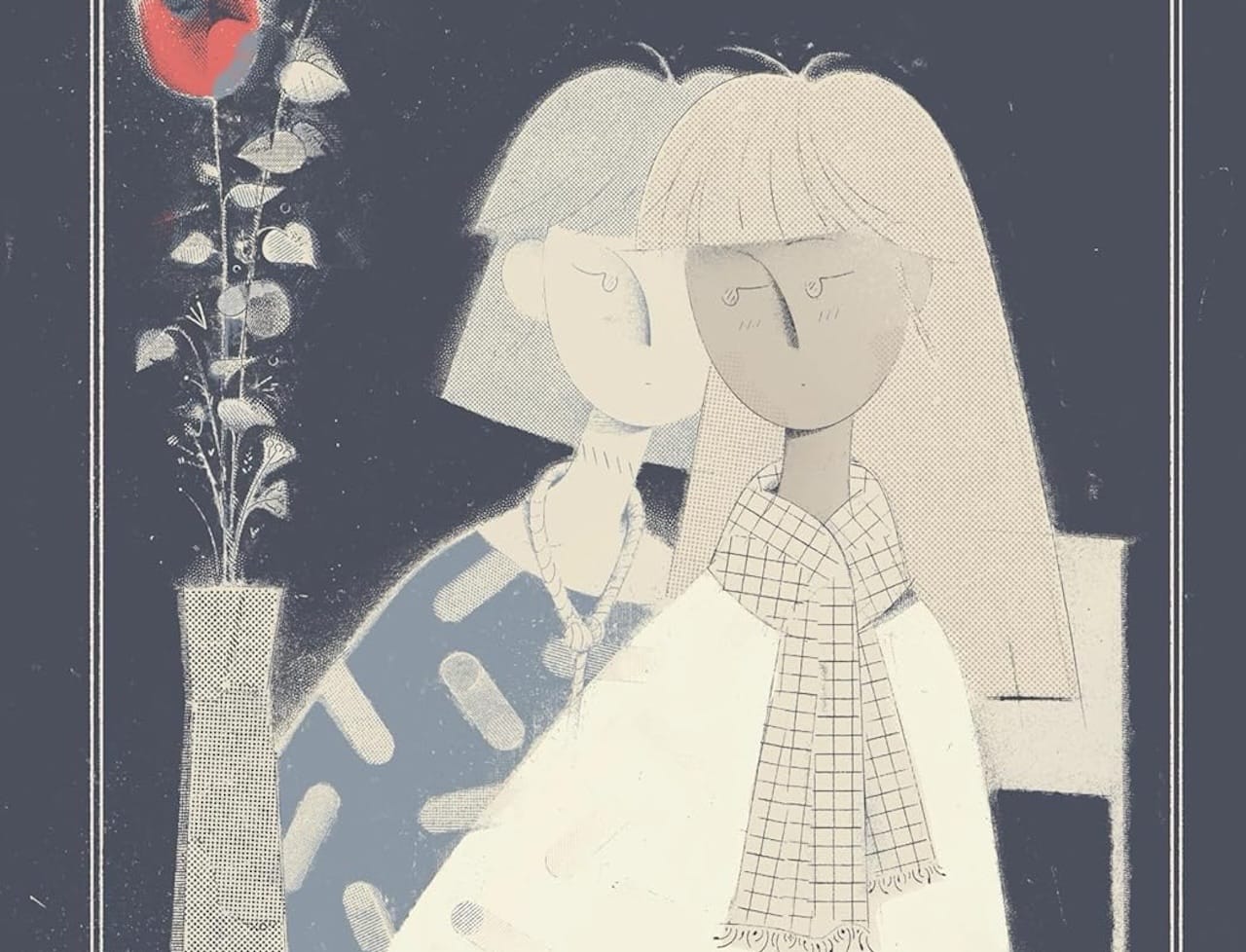

Perhaps the best word to describe Roman Muradov’s All the Living is “ethereal”.
Set in an abstracted city and an abstracted afterlife, All the Living tells the tale of a woman’s return from death, interactions with ghosts, and nebulous loneliness. It’s a book jam-packed with ghosts, absent pain, and slight social awkwardness, and somehow all these things make the book almost warm and cozy. An austere comfort, to be sure, but one that feels tangible, lived-in, almost as if the reader has felt these things alongside the character.

Fantagraphics
After dying, our protagonist is presented with a sort of afterlife lottery, which she wins: she is returned to life despite firmly wishing to stay dead. This opens for her a spiritual world. She meets – and learns to live with – her own ghost. Her place of work has its own ghost, as does every odd corner of the city. As the book goes on, ghosts seem to pile up, cluttering her commute and smudging the colors of the comic book. Death is ever-present, but it presents a chance for connection; our protagonist seems to live a very quiet, disconnected life, and the ghosts give her a chance to communicate, to connect.
The book might feel unapproachable to some; Muradov’s cartooning is nebulous, emotionally representative over figurative. The outlines of characters are never quite the same, lines occasionally drifting and disconnecting. The world is blocky, hard-angled, and colors are sometimes well out of their lines. The story moves at its own floating pace, with silent panels piling up and insisting on the pregnant tone of the story. This is abstraction for narrative sake, however: there is meaning in the fractured lines, if one can bear to decode them.
Nothing on the shelves looks like All the Living, and few things are as existentially touching. The protagonist’s despondence and loneliness is palpable and oozes from every page. That this somehow makes the book inviting is a wonder – we feel our own tendencies toward loneliness call out, reach out, connect. Even the most outgoing of us know the sting of being alone, and the small moments of this story’s warmth feel soothing.

Fantagraphics
But even the ghosts keeping one company have the chance to alienate; when her own ghost finds a lover, the protagonist is left once again to ponder the quiet stretches of her life alone in the bath. There is a cycle to depression, there are peaks and valleys; there are also long, open spaces of it, a highway of loneliness without horizon.
All the Living dwells on that long stretch, but it does so without dragging the reader into malaise. This is an ethereal window into experience, however abstract and difficult to follow it might be; we can always close the book and return to normal.




You must be logged in to post a comment.