

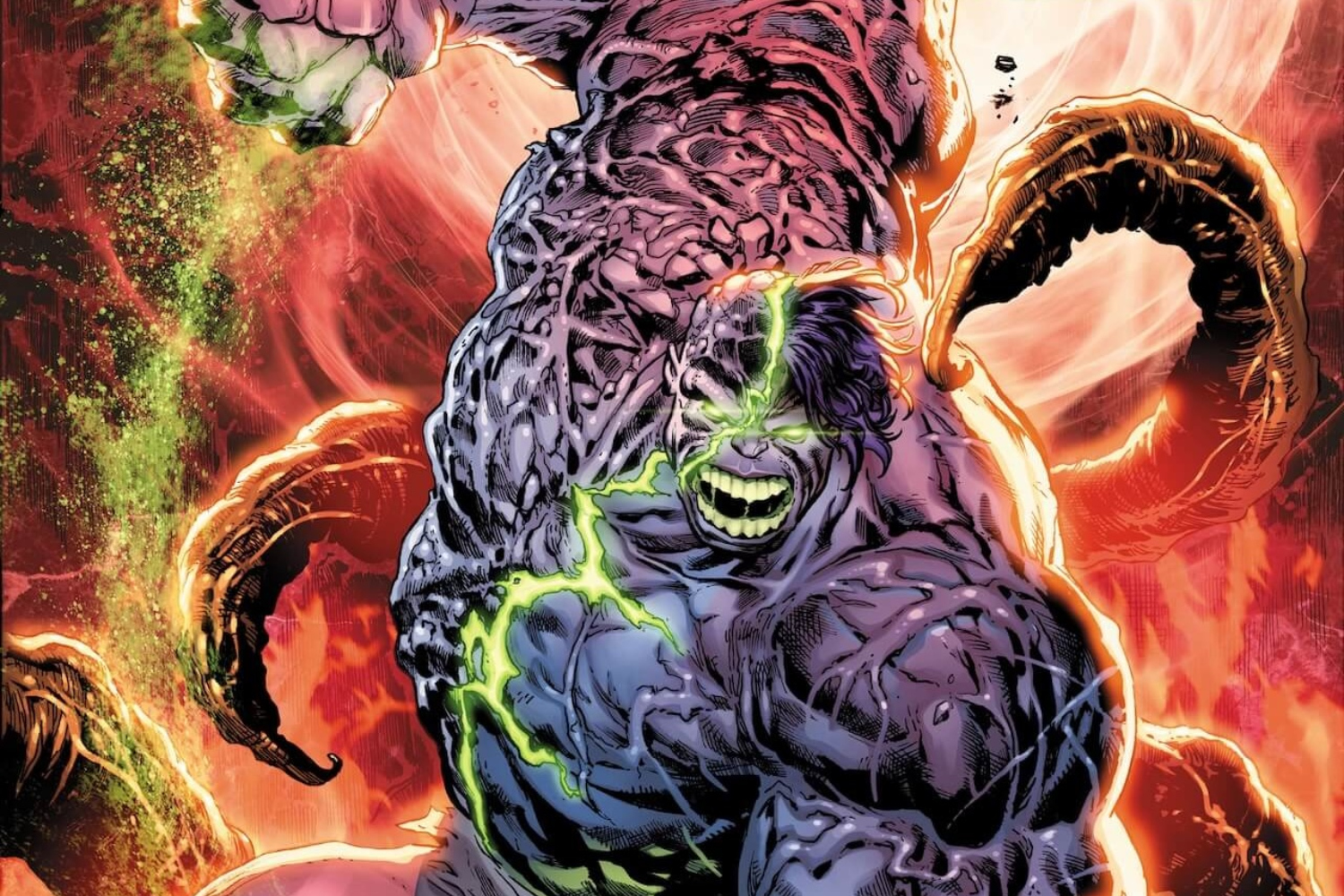

When Marvel revealed that the Infernal Hulk would soon clash with the X-Men, the reaction was instant. By the dozens, readers lit up social feeds with one central question: Who exactly is Infernal Hulk? For writer Phillip Kennedy Johnson, that curiosity is part of the design.
“The Infernal Hulk chapter of the story is the one where Hulk really interacts a lot more with the wider Marvel universe,” Johnson said. “Now he’s on the radar of all the biggest, all the heaviest hitters in the Marvel U.”
After spending the first 30 issues of his Incredible Hulk run positioning pieces on the board, Johnson has entered what he views as “Act Two.” A new Hulk alter is running the show. Banner is sidelined. The scope is widening. Covers have already teased battles with Iron Man, and the X-Men are next. The escalation is intentional.
“This is the time when I’m going to keep that promise,” Johnson said, referring to earlier hints that Hulk’s presence would become a larger problem for Marvel’s power players. “Trying to make it really clear in the stories, but also through the covers to readers that this is becoming a bigger and bigger problem for the Marvel leaders.”
No Mandates, Just Momentum
Despite the crossover energy, Johnson is quick to clarify that there was no top-down directive forcing characters into each other’s books.
“There’s definitely no mandate,” Johnson said. “I’ve been really grateful for how the high-ups are letting us do our thing and tell our story. I think there’s been very, very little micromanaging happening, basically none.”
Instead, cohesion has grown organically through Marvel’s creative summits.
“When somebody’s talking about what they’re doing in their book, there’s a lot of questions or offers from other people in the room,” Johnson said. Ideas are floated. Timelines are compared. Opportunities emerge. The result is a universe that feels connected without being forced.

Infernal Hulk #7 (out in May) variant cover by Ken Lashley. Courtesy of Marvel.
Returning Hulk to Horror
Horror has become the defining lens of Johnson’s Hulk, though he sees that direction as a return to form rather than a reinvention.
“Hulk is just a literal monster,” Johnson said. “That’s been his mission statement since the beginning.” Stan Lee drew from Dr. Jekyll and Mr. Hyde and Frankenstein for that initial look and feel. Over time, Hulk drifted into more traditional superhero roles, but the monster roots remained.
Al Ewing’s Immortal Hulk embraced body horror with a black science, Cronenberg-inflected approach. Johnson admired it deeply.
“If anything, the hardest part about taking the gig was like, what do I do,” Johnson said. “How do I not just do more Immortal? Because that’s what I wanted.”
The answer came in a different strain of horror.
“More of like a [Mike] Mignola/[Guillermo] del Toro kind of a thing,” Johnson said. He found inspiration in the American South, in folk horror, in stories where the landscape itself feels haunted. Hulk became a lightning rod for monsters hidden from ordinary sight. That approach allowed Johnson to expand the bestiary of the Marvel Universe while building toward something larger.

Courtesy of Marvel Comics.
The Rise of The Father of Horrors
At its very core, Infernal Hulk represents that escalation.
Johnson has drawn from deep Marvel lore, revisiting the ancient Great Old Ones like Gaia, Set, and Chthon. He even introduced the Mother of Horrors as the catalyst for an ancient corruption. Now, he positions the Father of Horrors, embodied in Infernal Hulk, as the next evolutionary wave.
“It’s just a fun way to tie it into Marvel lore and just blow it out and make it feel bigger and older, but also newer,” Johnson said. Longtime readers have noticed, and Johnson delights in rewarding those who recognize the threads.
“When I play a beat like that and somebody who really knows those old books is like, oh my God, they get it,” Johnson said. “They just feel so rewarded.”

A panel from Infernal Hulk #2. Courtesy of Marvel Comics.
Banner Without the Monster
While Hulk grows more mythic, Bruce Banner has been stripped of power. In January’s issue #3, Banner steps back from the chaos, living quietly in Indiana while trying to build a life detached from the monster. Johnson saw that as true to the character.
“Banner never wanted to be Hulk,” Johnson said. “He’s wanted to be free of it, and now he is.” Even if the world burns in his absence, Bruce feels a measure of relief. Added Kennedy, “I’ve done my works of war. Now I’m going to do my works of peace.”
Yet that suburban calm reveals cracks. The news still plays. The guilt lingers. The illusion of escape falters. Johnson calls it a statement about hiding from the world and living a lie.
The issue was a structural risk. After two explosive installments, the third slowed to focus on domestic unease. Johnson noted that he was “a little bit nervous” that readers might reject the tonal shift. Instead, the response was overwhelmingly positive. Artist Kev Walker, brought in to capture the quiet horror of small-town USA, delivered pages that seemed anything but mundane.
When the Avengers confront Banner, their reactions are not gentle. Reed Richards is baffled. Tony Stark is furious. Johnson stands by that important friction.
“I feel like everyone’s reactions are true to their circumstances and who they are as people,” Johnson said. Tony’s impatience, even his bullying posture, reflects years of frustration and shared trauma. Heroes are not always kind, it seems.

Courtesy of Marvel Comics.
A New Chapter at Marvel
In addition to his work on Infernal Hulk, Johnson recently signed an exclusive contract with Marvel, closing a chapter over at DC Comics that included celebrated runs on Superman, Batman and Robin, and Green Lantern. Still, the timing just felt right.
“Marvel made me a great offer,” Johnson said. “Not just in the business sense, but also I get to work on characters I love.” He teased major projects on the horizon, including a “dream gig” that grew into something even bigger than expected.
Infernal Hulk is no longer Bruce Banner’s private burden. He is becoming a shared terror, one that threatens heroes, mutants, and the fabric of Earth’s ancient monster lineage. As Johnson builds toward his still-secret act three, one thing is clear: the monster has outgrown the man.
Infernal Hulk #4 is due out this week (February 25).



You must be logged in to post a comment.