

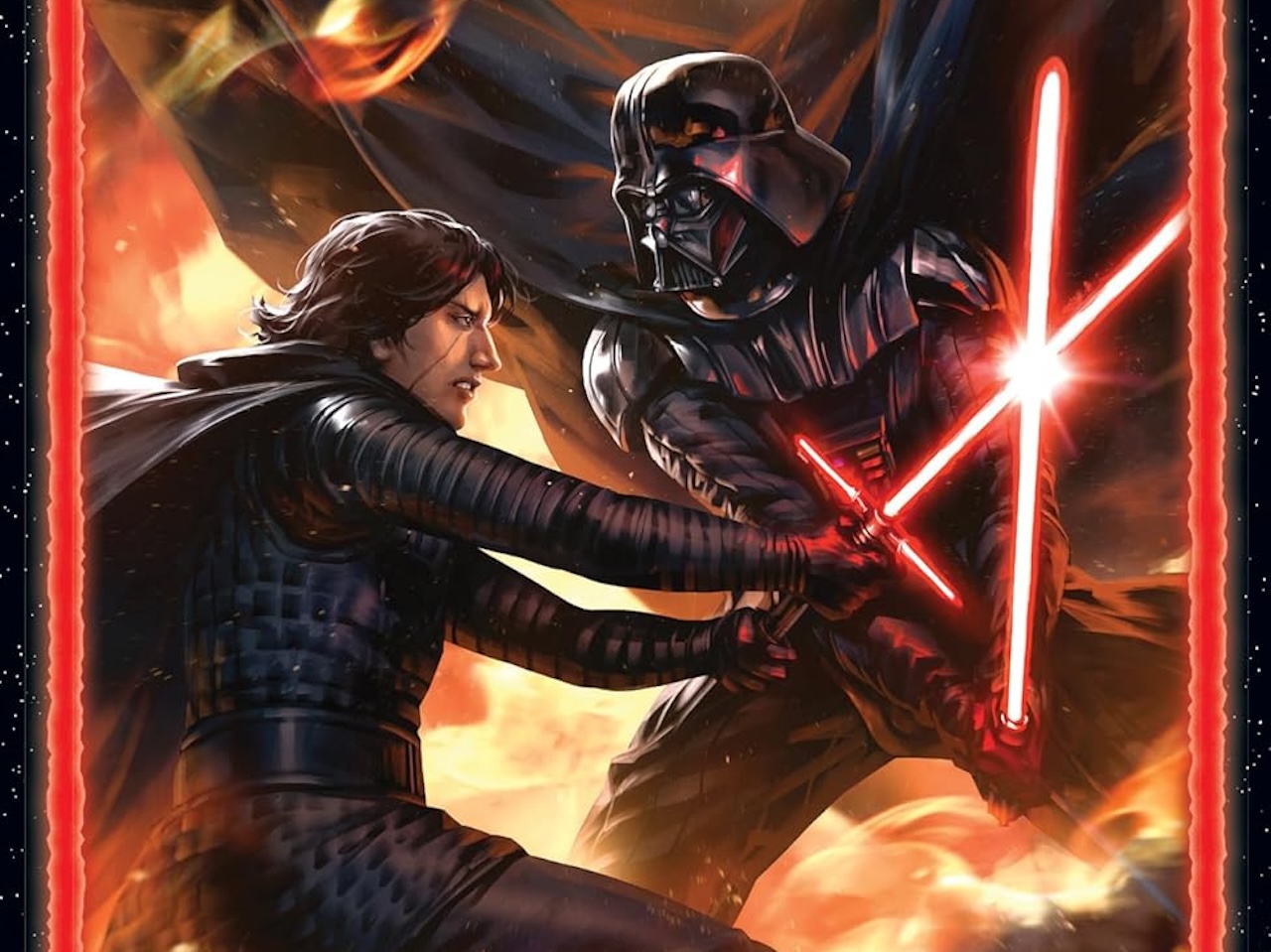

Where the first collection of Legacy of Vader set Kylo Ren on a quest to find a purpose, the second volume struggles to find such a singular narrative.
Still desperate to prove himself worthy of his grandfather’s legacy, Ren’s biggest problem is an understanding that he has no given purpose, no great quest to turn his attention to; he’s attempted playing at war against himself, has taken up Vader’s hunt for the Jedi, and while this series has not touched upon it, his relationship with Rey continues to vex him.

Marvel
What makes this version of Ren so endearing is a sense of listless, directionless anger – he is every bit a moody boy whose petulant anger has forced him on this path despite his upbringing rather than due to it: he is a boy whose loving parents and doting uncle set every precedent toward goodness and decency. His volatile, violent and evil path is undeserved; he is all but playing pretend.
Legacy of Vader is at its best when it embraces his journey to follow in his grandfather’s footsteps: he haunts Vader’s castle on Mustafar, trying to uncover secrets which may or may not still linger there. Vader’s servant, Vaneé, fuels these desires with faint hints and inference; Vaneé’s true purpose isn’t to guide Ren but to replace Vader. A fool’s task, and a fate that Ren easily sidesteps – to Vaneé’s doom.

Marvel
But Legacy of Vader stumbles when it steps out of its titular quest, and The Reign of Kylo Ren – the book’s final six issues – finds itself spread too thin as it attempts to set a broader path for the character. The Knights of Ren are reintroduced as a major concern for Ren; their new leader, Tava Ren, sets out to either kill or serve Kylo. This encounter is deserving of its own, dedicated series or at least serves best as a distraction in this one, which has up to this point hewn close to its singular narrative purpose.
Writer Charles Soule understands the larger goal of the book: to develop Kylo Ren’s extracurricular concerns – everything outside of the trilogy of films that introduced him. The Reign of Kylo Ren succeeds at this, however scattershot. Ren is believable, driven, and fearsome – even if it’s a fearsome nature that comes from a base misunderstanding of his place in the universe.

Marvel
Artists Luke Ross and Stefano Raffaele provide dazzlingly dark locales in which Kylo Ren skulks; a surprisingly deep supporting cast (including, briefly, the ever-intriguing Ninth and Thirteenth Sisters) feel fully realized; the Knights of Ren are rendered as imposing, gruesome figures. Vaneé, a sort of sniveling head in a droid body, is designed in such a way as to fit in with the larger Star Wars aesthetics but to illustrate how twisted the world of Vader truly was.
The Reign of Kylo Ren is uneven, yes, but it adheres to its main character closely. It’s the best way to discover a character whose chief plot points in the films disregard his more complex, more intriguing characteristics. It’s good to know our villain and to understand his fallacies.




You must be logged in to post a comment.