

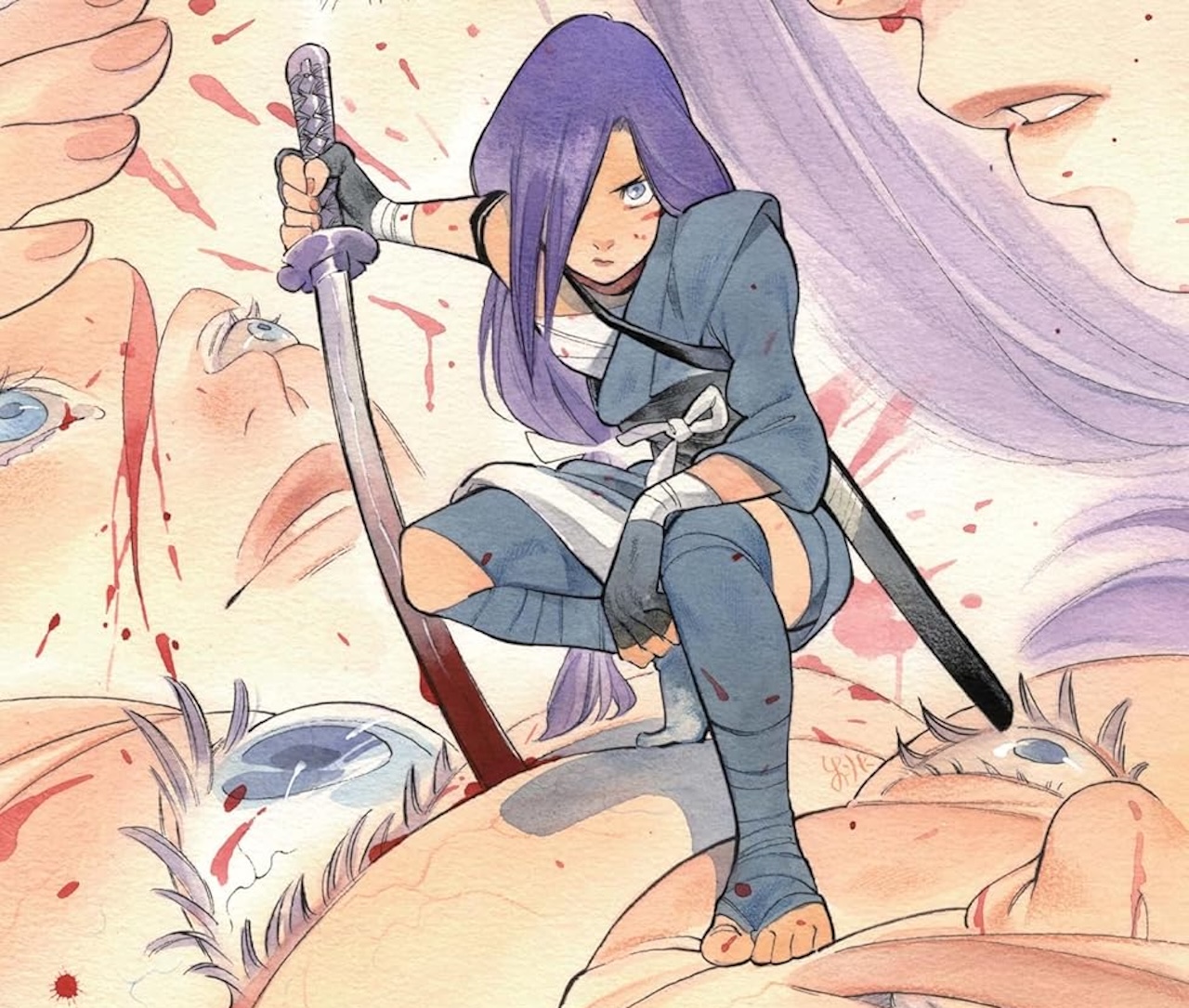

After the visually genius Sai: Dimensional Rivals #3, it’s a no-brainer to see what a whole new batch of artists will bring to the fourth issue that’s out this week. In issue #4, Peach Momoko’s jam session is joined by Jim Mahfood, Giuseppe Camuncoli, and Phil Noto. Time to get real weird with it, especially with such different art styles.
Kicking off Sai: Dimensional Rivals #4 is Mahfood, with colors by Mike Spicer. If you’re familiar with Mahfood’s work, this longer ten-page story has everything you love from Mahfood. That includes crazy creatures, beautiful flower-like structures, funny cutaways to cartoony reaction shots, and trippy as hell sequences. Sai faces some kind of space creature, which devolves into a meeting with a space donut, who then sends her through new lives as a rocker, a comic artist, ’80s-style action TV hero, and an axe-wielding horror movie final girl. The art is insane, with many renderings that are worthy of tattoos, let alone a comic book page.
Momoko jumps in from here, with two pages, including a one-page check-in on the witch who sent Sai after a seventh Infinity Stone. The scene acts more as a reminder of what Sai is after. Before that, though, Sai is seen satisfyingly eating donuts in space, presumably the ones Mahfood introduced.

Trippy!
Credit: Marvel
The portal through the stories is clearly holes this issue, as Camuncoli then has Sai pull herself through a fountain in Venice. Dressed in a gondolier’s outfit, we soon see Sai is up against a Venomezia symbiote! Talk about wacky. Seeing as a symbiote is involved, the recurring theme of symbiotes continues in this series, possibly acting as a clue. If you’ve ever been to Venice, it’s nice to see the location being used here, even though it’s a brief five-page story.
From a smash cut, we then turn to Noto’s story, as Sai is in a quasi-Kirby-style city. She’s up against a celestial, and the fight looks impossible. Running five pages, this story looks great under Noto’s pencils with a refined, more straightforward look. It also promises some real answers with a tease for the conclusion.
Generally, the direction of these stories is fairly light on plot progression, and the shorter stories serve more as brief conflicts than as deep dives into new dimensions. As a free-for-all for each artist, it works, but I admit the lack of direction towards a central goal continues to be quite vague.
Sai: Dimensional Rivals #4 thrives as a visual playground, giving each artist space to experiment and push the concept in bold directions. The variety keeps the issue fresh and unpredictable, even if the larger story continues to drift without a clear focus. It stands as a celebration of style and imagination, offering bursts of creativity that make the journey worthwhile despite the loose narrative.




You must be logged in to post a comment.