

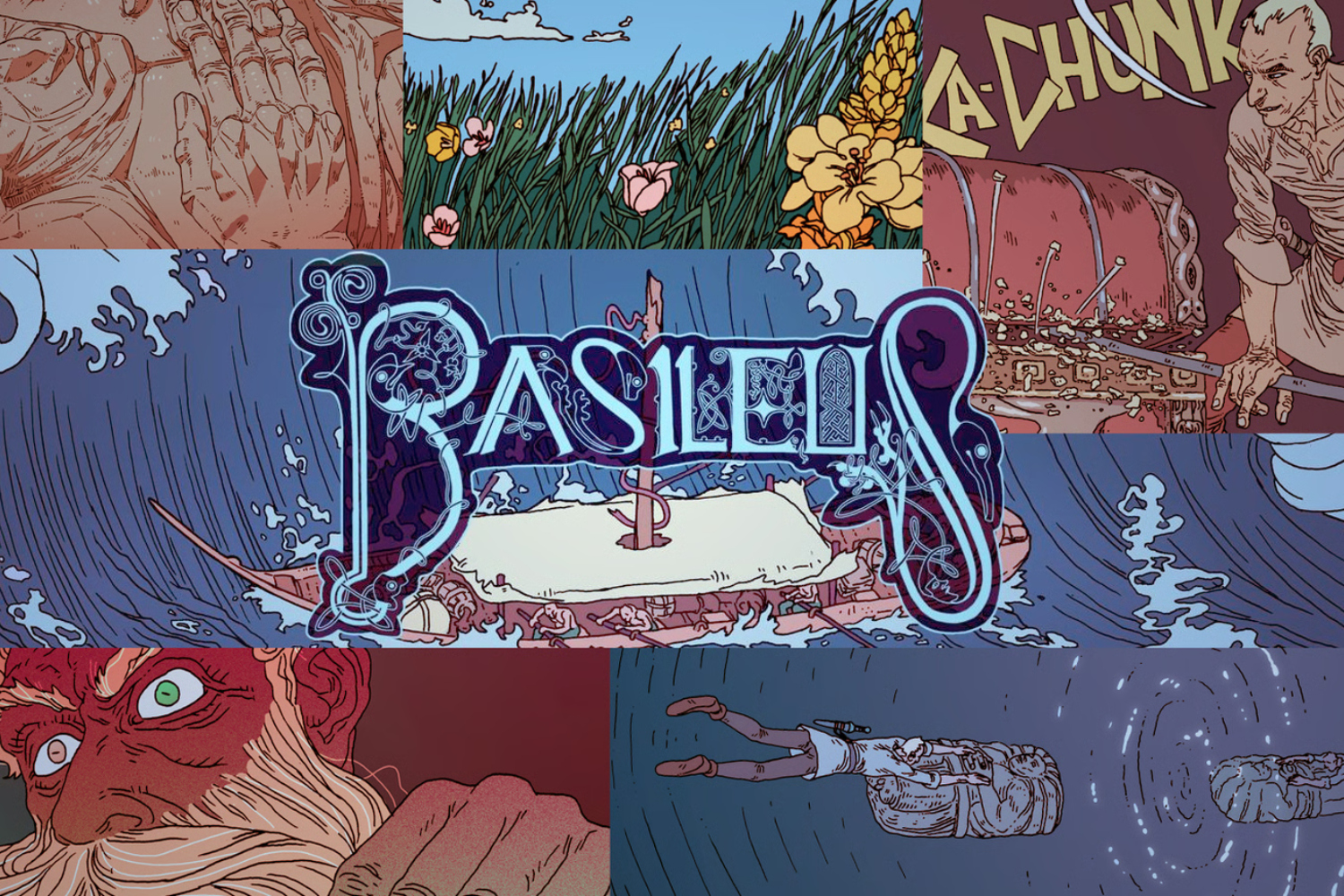

Here at AIPT, we pride ourselves on being up-to-date on many of the latest comics-centric Kickstarter campaigns. The aim is that, with a little extra attention/spotlight, books that might go under-discovered can land the eyeballs they truly deserve. But in the case of Basileus, writer-artist Andrew Whyte didn’t need much help, wracking up well over $10,000 (of a $4,700 goal) in just 30 days. And while money isn’t the one true sign of success and/or quality, it is an important metric that proves that Basileus is something that demands your attention.
The Kickstarter itself was launched to print Basileus: Book One, which collects the first two chapters of Whyte’s “ongoing, low fantasy adventure.” Here, we follow Uz and Javan, a pair of “characteristically impoverished rogues, who are on a streak of failed schemes intended to finally free them of their material chains.” As luck would have it, their mission from the bottom comes just as the “strictly ordered world that for centuries had held everything in stasis is now beginning to crack.” Talk about opportunity!
And from that premise, Whyte has fostered heaps of significance and relevance across the early part of Basileus. There is, of course, the whole “social order thrown asunder” that should feel deeply, painfully familiar. Then, of course, given its starring rogues, Basileus opts for gritty, accessible fantasy over anything else. And, obviously, there’s Whyte’s own art style: This engaging, highly textured approach that makes the world of Basileus feel so much more real and compelling. (You can practically smell every blade of grass and feel every swing of an axe.)
Regardless of why you might come to the book, however, Basileus is a novel slice of fantasy that feels as culturally resonant as it is just plain old exciting. Still not sold just yet? We caught up with Whyte recently (via email) to discuss all things Basileus, including the success of the Kickstarter, the story’s development process, the dynamic and overarching journey shared by Uz and Javan, the influences at the book’s core, and the series’ future beyond book one.
AIPT: Congrats on the Kickstarter! How does it feel to have blown through your initial goal and raise over $10,000?
Andrew Whyte: Thank you! Mostly I feel a sense of relief at finally getting the book properly into print after having worked inconsistently on it for many years. Exceeding the goal allowed me to increase the print size, which means eventually it can find its way into the hands and minds of more readers. That is the Sisyphean struggle!
AIPT: Where did the idea for Basileus come from? And did you have any initial goals or objectives with the project?
AW: I have always loved fantasy as a genre as well as ancient and medieval history. My earliest ideas for the setting and story developed from criticism of the genre; that it repeated increasingly cartoonish tropes, and relied upon superficial, modern, and formulaic storytelling to explore what must by necessity be a mysterious and alienating setting. On the other hand, I found that some writers took an excessively abstracted method for structuring their fantasy, which made their work boring as it was incapable of cultivating immersion. So I was compelled to try to strike a sort of balance, which unsurprisingly is more difficult than you are allowed to acknowledge when you are in your 20s.
The actual setting for Basileus, and its name, came from my interest in historical dark ages; in this case, the transition out of the Mycenaean period, where the elite structure of Mycenaean society collapsed from supporting a single ruler called Wanax to many smaller kings called Basileus. This deconstruction of the calcified monopoly of power is a central theme, the characters viewing the chaos of a dark age as opportunity rather than disaster. Whether I got the history correct is doubtful, and immaterial. I just enjoy it thematically.

Courtesy of Andrew Whyte.
AIPT: What’s the appeal of fantasy stories – why do we still keep revisiting this “genre”?
AW: That is a good question. There are perhaps a number of interrelated features of the genre which people find appealing.
If you want to just immerse yourself in a historical setting, it can feel overly restrictive to do so with actual history, as the writer feels a compulsion toward accuracy in describing the setting and narrative. It can also feel inevitable, which reduces some of the excitement of reading a story.
Fantasy allows you to pick and choose the elements of pre-modernity you want to apply to a setting as well as giving you total freedom in following the logic of their implementation (instead of being shackled to actual historical events). There is also magic and the supernatural which are very present in the pre-modern world, but when examined through a historical lens must be rationalized and stripped of their mystique. Thus, fantasy may allow you to more authentically present that world, the feeling or texture of it.
AIPT: You’d said that Basileus is written more in the “vein of Conan the Barbarian, than the mythological or ethnographic manner of Tolkien.” Is that born out of a preference, and do you have an idea why you prefer the grounded over the magical/whimsical?
AW: I was thinking there more of the structure of Tolkien’s “high fantasy” as it is sometimes called. Tolkien was a philologist and a sort of ethnographer, and I think that flavor bled into his writing (though he was also very whimsical and modern in other ways). As a result, his writing has a certain historical or academic quality to it, which I think is great but I was always more interested in just proceeding with a story, allowing the details to be resolved in the telling instead of in pages of extraneous world building.

Courtesy of Andrew Whyte.
AIPT: Building off that last question: Aside from Conan, do you have any fantasy stories that you really love and/or served as a continued inspiration?
AW: I have enjoyed quite a variety of fantasy literature, like Michael Moorcock, a lot of Forgotten Realms stuff, C.S. Lewis, and was probably most impressed by [E. R.] Eddison’s The Worm Ouroboros. Then, in comics and animation too, there are great works of fantasy. I am thinking now of the comic series Donjon or the [Hayao] Miyazaki films, whose subtly I always tried to emulate. But I am too cynical, ultimately, to follow Miyazaki. My chief interest in literature, however, is probably not directly from the genre, but rather various 19th century romantic authors, most especially Edgar Allan Poe, from whom you can sense the essence of the fantasy genre percolating.
AIPT: Uz and Javan are really great leads: they’re broke, aimless, and coming into their own just at the time of an empire’s slow dissolution. Why focus on two rogues, and what does that offer to the larger story of Basileus?
AW: It was a deliberate attempt to invert the hero archetype pervading fantasy. Occasionally, writers will use a character who is weak, like a child, to try to bring contrast to traditional heroic fantasy archetypes, but I find that rather saccharine usually.
Instead I felt it benefited realism to use men of low station, and it fit well with the central theme of the book. Also, I enjoy the restraint of constant poverty, like in Cowboy Bebop. I think it is humorous to have characters scrounging all the time, accomplishing great feats for a bit of cash, only to lose it all in the end. There is a panel later in the second chapter where you can see Uz’s purse flying off his belt into the river behind him.

Courtesy of Andrew Whyte.
AIPT: You’d also mentioned this book being “influenced by French and Belgian comic artists.” What about those creators and those “traditions” inspires you, and how do you think that informs or filters into Basileus?
AW: I really enjoy a detailed drawing with a clean line. A big disappointment with American comics for me was always that they concealed so much with large black fields and abstract shapes. The figures often feel like they are floating, and being rushed by deadline Americans tend to neglect drawing backgrounds. For speculative worlds, this will not do, and does not utilize the unique ability of comics to elaborate on a moment visually to its fullest extent. In Mœbius, Hergé, or Geof Darrow, along with so many other illustrators, I found what seemed like an exciting method for drawing in a very concrete manner while retaining style and some of the shorthand you get in cartooning. That’s what I tell myself anyway; drawing is hard.
AIPT: You draw the human body and violence/gore in such a deeply powerful way. Do you feel like that’s a “speciality” of yours and/or the book, and why’s it so important to have these huge moments of gore and intensity?
AW: Violence has always been interesting to me, and again somewhat neglected or misunderstood in fantasy. I want both the ideation of violence and its results to be treated with honesty, as it is so often at the core of whatever story is being told. Almost always a story hinges upon avoiding violence or prosecuting it more efficiently than your enemy, so it is strange to write it in such an abstracted fashion, where, say, you get to a point that two beings of pure unfathomable power are projecting colored light at each other as a sort of sterile simulacrum of physical struggle.
I would rather they are just bones and sinew, and they wrestle until one of their joints pops out of place and they are forced to stop. You can see this in the set-up for the opening caper, where the villagers believe they have an opportunity, with one swift and violent action, to change their fate, but of course they miscalculate the level of violence that is being held in reserve by their target. Perhaps also years of thinking about the muscles in the body has made me morbidly curious about how they stretch and what might happen when they are bisected or exploded.

Courtesy of Andrew Whyte.
AIPT: Similarly, your dialogue is great; so many fantasy stories feel cheesy and bloated because they over-commit to things. What’s your secret to writing really great speeches/conversations that feel authentic but modern enough?
AW: The didactic nature of dialogue in Basileus I have taken straight from Poe, and is so instinctual now I almost cannot avoid setting things up in that manner. A strategy I like is for one character to be lecturing another, badgering them about some theory they have, or explaining something. This is fun, but it can go too far when eventually you do want some interpersonal drama.
As with all things, there is a perfect balance between didactic speeches, and [Joss] Whedon-esque archetypal quipping, devoid of any content, like pablum. I think the latter is more popular, and as I get older, I begrudgingly find some of it necessary for the emotional aspect of characterization. Though some people have found my dialogue writing curious, it hasn’t seemed to grab a mass audience the way the other end of this imaginary spectrum has.
AIPT: Do you have a favorite moment from the first story? Something that maybe speaks to your larger goals for the project or how it stands out from other fantasy offerings?
AW: My favorite moment is probably Javan declining to continue with Uz in his dubious schemes, due to feeling unfit for the adventuring lifestyle, inadequate in comparison to Uz, and that his fate is inevitably just basic manual labor. It was rather subtly done; they don’t really argue about it emotionally, they don’t even say goodbye. It draws a good distinction between their characters, and is fairly adept at capturing some sort of universal dynamic of friendship I can’t quite put my finger on.

Courtesy of Andrew Whyte.
AIPT: What’s the future of Basileus look like? Can we expect more releases/Kickstarter campaigns?
AW: The next book is called “Theophany at Locris” and will come out eventually (when finances permit). I may release it in chunks on Patreon first, and then collect it once again into a similar hardcover as this one. The Kickstarter provided me great feedback as to realistically how many people I could expect to lure in over the internet, [and] who might be interested in such a niche piece of media, so I will certainly try again with the next one.
AIPT: Is there anything else we should know about Basileus, comics, fantasy stories, etc.?
AW: If anyone reading this interview is interested in checking out the comic, there is a bit still up on basileuscomic.com. And I can be contacted through all sorts of different pathways if you are interested in following along or purchasing a hardcover: Bluesky (@basileuscomic.bsky.social) and the website formerly known as Twitter (@basileuscomic) and Instagram (@waxedthread).
Thanks, Chris, for the great questions and the opportunity to ramble about my comic!



You must be logged in to post a comment.