

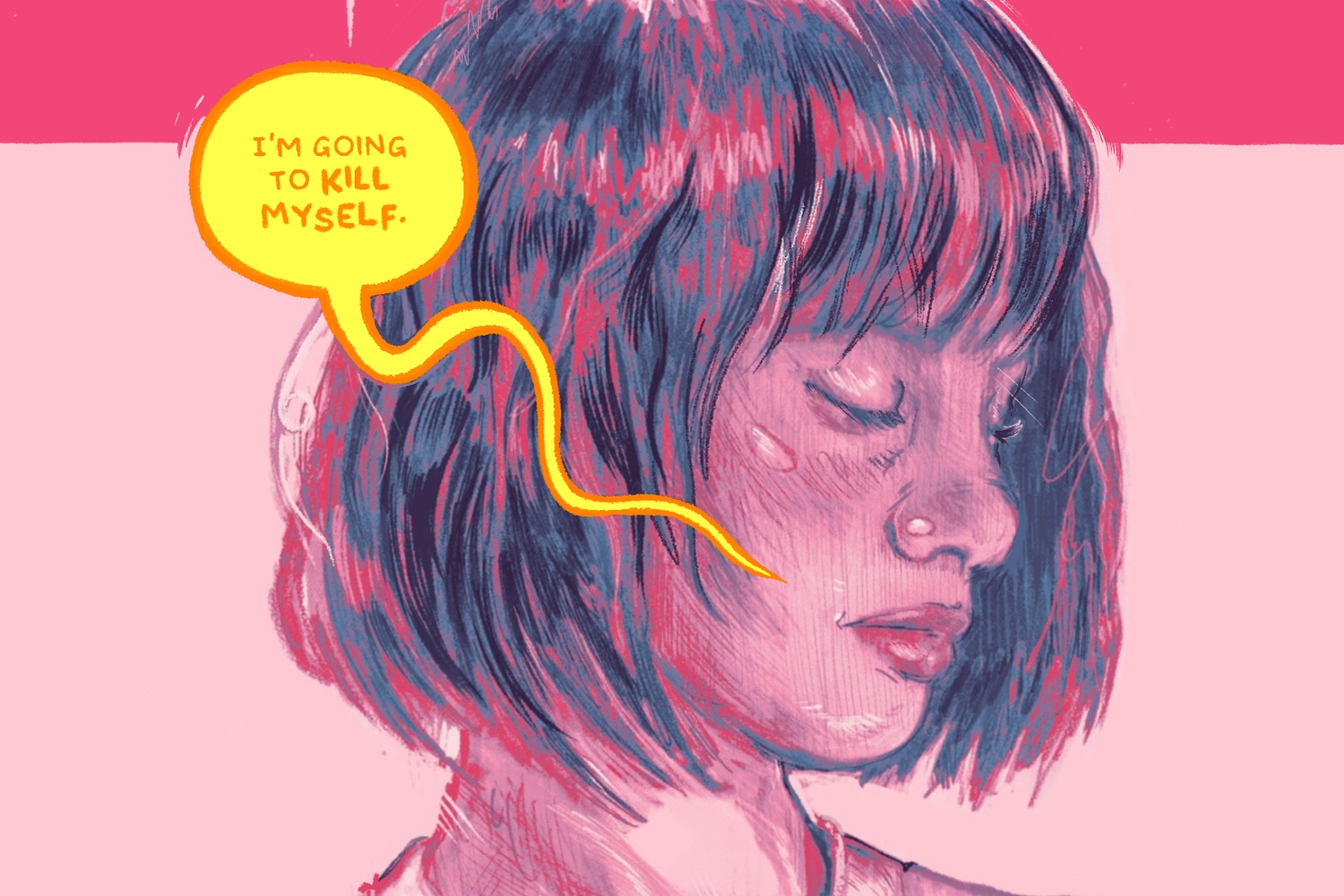

You may have heard that comics are for everyone — turns out (likely as an extension of that premise), they’re also for every story. If you require motivation and hope, there’s superhero stories. Meanwhile, if you need to be grounded, I’d suggest a steady diet of horror. Heck, there’s even a title that’s basically D&D meets Martha Stewart Living.
And there’s a million other tales for a million other feelings, ideas, and states of being, with comics serving as the perfect vehicle to delight, unnerve, excite, etc. through its unique abilities and functions as a medium. But if you’d like to be challenged personally, ethically, and even artistically in a refreshingly novel manner, then I’d suggest picking up The Machine is Broken.
Created by writer-artist Jared Sarnie, The Machine is Broken follows a woman named Lux as she’s made an especially important life decision: she’s going to kill herself. More specifically, she’s headed to Zurich (with her mom and sister) to make use of “the world’s first fully legal suicide pod.” It’s sort of like EuroTrip, only markedly more depressing and increasingly relevant.
If my EuroTrip comment seems flippant for the subject matter, even the solicitation promises that “hijinks ensue.” Because The Machine is Broken is one of those genuinely rare and amazing stories — one that captures both the absurdity of modern life while also poignantly exploring ideas of depression, family, and death. And it does so through Sarnie’s unique visual identity, a media- and influence-spanning approach that confronts with bold colors, innovative layouts, and an unrelenting devotion to the story.
The end result is a project that, like any great comic, will absolutely uplift, upset, and generally affirm the wonders of life. This machine works perfectly to connect in all the ways that absolutely matter.
The Machine is Broken is out now via Fieldmouse Press . To get a better understanding of the book’s singular magic, we caught up recently with Sarnie via email. There, we talked about the book’s development and real-life implications, the importance of the larger assisted suicide discussion, how to use comics to talk about important or “uncomfortable” subjects, and other topics and tidbits.

Courtesy of Fieldmouse Press.
AIPT: Where did the idea for The Machine is Broken come from?
Jared Sarnie: The core concept is directly ripped from the headlines and pasted right into the pages of the funnybooks. There’s this plucky little Euro tech start-up called Sarco (abbreviated from Sarcophagus). They put together a design for a 3D-printable euthanasia device, The Sarco Pod.
When I initially conceived of The Machine is Broken, The Sarco Pod was also in its conceptual infancy. The device only existed in the form of concept renderings. Sarco provided the press with this promotional image of a seemingly alien blob, made of chrome and glass. The thing was crudely Photoshopped onto a positively screensaver-esque field of grass.
That image was so strikingly surreal to me. It’s kind of giving Kubrick, giving 2001, with the completely inhuman monolith starkly juxtaposed against the natural world.
That image stuck with me.
AIPT: What’s the balancing act in tackling such a serious topic with a story that is, in parts, over-the-top and silly and humorous?
JS: I think this is a very Jewish book, and that’s a very Jewish approach.
I’ll paraphrase Felix Biederman, who was probably stealing this line from someone else:
“Don’t sweat the big stuff, sweat so much over the small stuff that you drive yourself so crazy with stress that you don’t live to see 35.”
The Machine is Broken definitely carries that ethos when dealing with extraordinarily dire subject matter.

Courtesy of Fieldmouse Press.
No one’s life falls neatly into comedy or drama; it’s not the Golden Globes. There’s always laughter at funerals, tears at weddings. I think this idea we can hermetically seal the ridiculousness and inanity of the human experience from, like, the deepest horrors of existence…that’s completely unrealistic to me. So this kind of blending of tones, that’s really the most genuine expression available to me.
AIPT: Why do you think assisted suicide is such an important topic to address?
JS: It’s a really challenging topic to me personally, and that’s what draws me to it. I wanted to avoid any didacticism in the book, I wanted to stay in wishy-washy artsy feelings territory.
Broadly speaking, I think most people are sympathetic to the notion of euthanasia within the context of “death with dignity” and terminal illness. I think these attitudes are already reflected within our modern conceptions of hospice care in America.
However, the book deals with the bleeding edge of medically assisted suicide in a European context, where there’s a much more permissive approach. Physically healthy people, people suffering from mental illness or even grief, are given access to euthanasia. All under the auspices of “a right to die,” an individual autonomy over one’s life that extends to the furthest possible extreme and supersedes any underlying notions of an inherent sanctity to life.
There’s something so endlessly ironic to me that this is low-key the greatest expression of European post-war liberalism, of an enlightened and libertine individualism.

Courtesy of Fieldmouse Press.
It’s literally the reinvention of the gas chamber, but this time, even our death machines are subject to austerity. It’s no longer a state project anymore; it’s completely individualized, made into these boutique, custom-ordered consumer solutions.
I don’t know, that’s really only part of my thoughts on all this. I think it’s all better expressed through my creative work than by me desperately trying to sound smart here. I can’t even, like, name a country in Europe — I don’t know why I’m trying to make these grand cultural critiques. LOL.
AIPT: Should even more comics tackle these big, big topics? Does comics offer something in addressing these topics that you can’t find in books, TV, film, etc.?
JS: Yeah, for sure, I think they should.
Let me give a wildly self-contradictory answer. I’m of two minds about this; I’m often of two minds about the things that I really care about.
On the one hand, I think comics are basically low-brow trash for babies. Like, they’re picture books, let’s be real here. And that’s great, I love stupid baby-stuff, it’s pleasant and nice. You should see my apartment, it’s chock-full of kitschy bullshit.
But on the other hand, this is a real art form. Let’s treat it like one. OK, I’m getting on my darn soapbox.

Courtesy of Fieldmouse Press.
I feel like for the past forty-something years, we’ve been trapped in this endless “Zap! Pow! Comics! They’re not just for kids anymore!” conversation.
I think your question, should comics tackle big subjects, that’s a legitimate question. But the fact the question still needs asking is kind of sad —it reveals a broader insecurity of most artists in our medium. No one would ever ask that of literature, or film, or even TV, because the legitimacy of those art forms is presumptive in our culture.
Every cartoonist, though, we’re thrust into this role as evangelists for the medium. We’ve got to give the hard sell to take these comics seriously.
A lot of indie cartoonists, I think, they adopt a stylishly defeatist posture, comfortable in the perpetual shadow of the Big Two. Would any other artist in any other medium accept that type of self-marginalizing rhetoric? Would Martin Scorsese ever position himself as secondary to a Marvel movie?
I’m going way off the rails here. My point is this: I think if you’re an artist, comics or otherwise, you’ve got a responsibility to at the very least make something that is deeply important to you.
AIPT: I love, love, love the way you layout pages; it feels very intense and also claustrophobic at the same time. Can you walk me through what you’re trying to do with this approach that feels so alive and consuming?
JS: Thank you! That’s so nice of you to say. I think claustrophobic is a great word. I don’t want to reveal too much in my response here. But I’ll say the book starts with Lux in this extremely confined space within the suicide pod, and I wanted to maintain that feeling as the book progressed.

Courtesy of Fieldmouse Press.
AIPT: Similarly, it feels like you’ve almost used mixed media with the way you balance so many different vibes, aesthetics, fonts, etc. Can you talk about that approach, and why things on the page feel so explosive and multifaceted?
JS: Most of my interaction with comics as a medium is mediated through the Internet. It’s not the experience of sitting down and reading an issue in isolation; it’s really Instagram where I mostly engage with this art form. I don’t think I’m alone in this. So to me, and I think to other artists of my generation, we primarily experience comics in that seemingly endless, context-collapsed scroll:
We see a half-finished sketch by an artist whose name we don’t even know, followed by a re-posted page out of a ’70s superhero book, followed by the most atrocious footage of genocide in Gaza, then a picture of our cousin’s baby, and then an AI-narrated clip from a network sitcom, and then fan-art, and then official promo, and then, and then, and then, and then.
I consciously want my work to reflect that cacophony. I think this is the predominant visual language of our time, and it is inherently multimedia. When it comes to capturing this maximalist aesthetic, I’m inspired by certain editors; Committee of Affairs comes to mind.
In general, my work is just very influenced by film and digital media outside of comics.

Courtesy of Fieldmouse Press.
AIPT: The three women across The Machine is Broken feel so vivid. Is there a character you resonate with the most?
JS: I’d say Lux definitely sits closest to me. I let a lot of my own fears and vulnerabilities speak through that character.
AIPT: Do you have a favorite moment from the book? Something that perhaps speaks to the true heart of this experience?
JS: I really like Bonnie’s little monologue at the end. I love Bonnie.
(I always think it’s really funny when authors refer to the characters they created like they’re real people in interviews. But now that I’m doing it, it feels so fricking dope I’m going to keep doing it. Shout-out Bonnie.)
AIPT: An interesting kind of subplot is what it’s like to be an American abroad. Why is that such an interesting idea to tackle on top of assisted suicide?
JS: There’s that phrase, “Wherever you go, there you are,” and I play on that a bit within the book. I think there’s a classically romantic idea of suicide as escape, “crossing over to the other side.” I’m thinking of the Smiths’ depressive anthem
“Asleep”: “There’s another world, there’s a better world, there must be.”
I think travel plays a similar idealized role in a lot of people’s lives. Travel as vehicle of transformation and discovery, that you’ll finally go to a place where your inside matches the outside and you’ll be the version of yourself were always meant to be.

Courtesy of Fieldmouse Press.
But American soft power is completely endemic. There’s no escape from it. There is no other world, no better world; it’s America all the way down.
You’ll notice Lux doesn’t meaningfully interact with Swiss culture in any way throughout the book. For all intents and purposes, though the book takes place in Zurich geographically, it plays out in a completely American context. Even the American anti-vax movement makes a bit of a cameo in the book. Anti-vax sentiments — that’s something born entirely out of Americans’ alienation from and lack of trust in our hyper-predatory privatized healthcare system. It’s not something that should really even exist in a place with socialized medicine. But lo and behold, across Europe, you can find pockets of these fringe movements. That’s how powerful America is with cultural export.
So these big ideas of travel, transformation, death, anguish, America — they’re all wrapped up in some way.
A big influence for the book was Nein, Nein, Nein! by Jerry Stahl. It’s this memoiristic account of the author on a bus tour of all the concentration camps in Europe, and it’s way funnier than it sounds. I think he gets to the heart of these ideas that I’m fumbling with here.
AIPT: Reading The Machine is Broken really affirmed an idea I’ve come to hold in recent years: The more I think about my own death, the sillier I ever felt about fearing it. In crafting this story, did your ideas or feelings on death/dying change at all?
JS: Fortunately, I’ll never die, so this question doesn’t really apply to me.

Courtesy of Fieldmouse Press.
AIPT: What’s the one thing you hope people take away when they set this book down? Is there anything else we should know about The Machine is Broken, you/your work, comics, etc.?
JS: I’m trying so hard to sound smart in this interview. This is really my first interview. Let me just drop all pretense. I guess what I want people to know is that I really honestly feel a fire within me. For so long I’ve wanted to make art that connects with people, with you. It’s really the thing I want more than anything. It’s been that way since I was 16. I’ve just felt this burning, and as I get older, I worry that the light is going to go out. So this is the first time I’ve ever been given an opportunity to share my art with someone, with a stranger, with you reading this. And that really means a lot. So I hope you like the book.
For more on Sarnie and The Machine is Broken, check out his official website and Instagram.



You must be logged in to post a comment.