

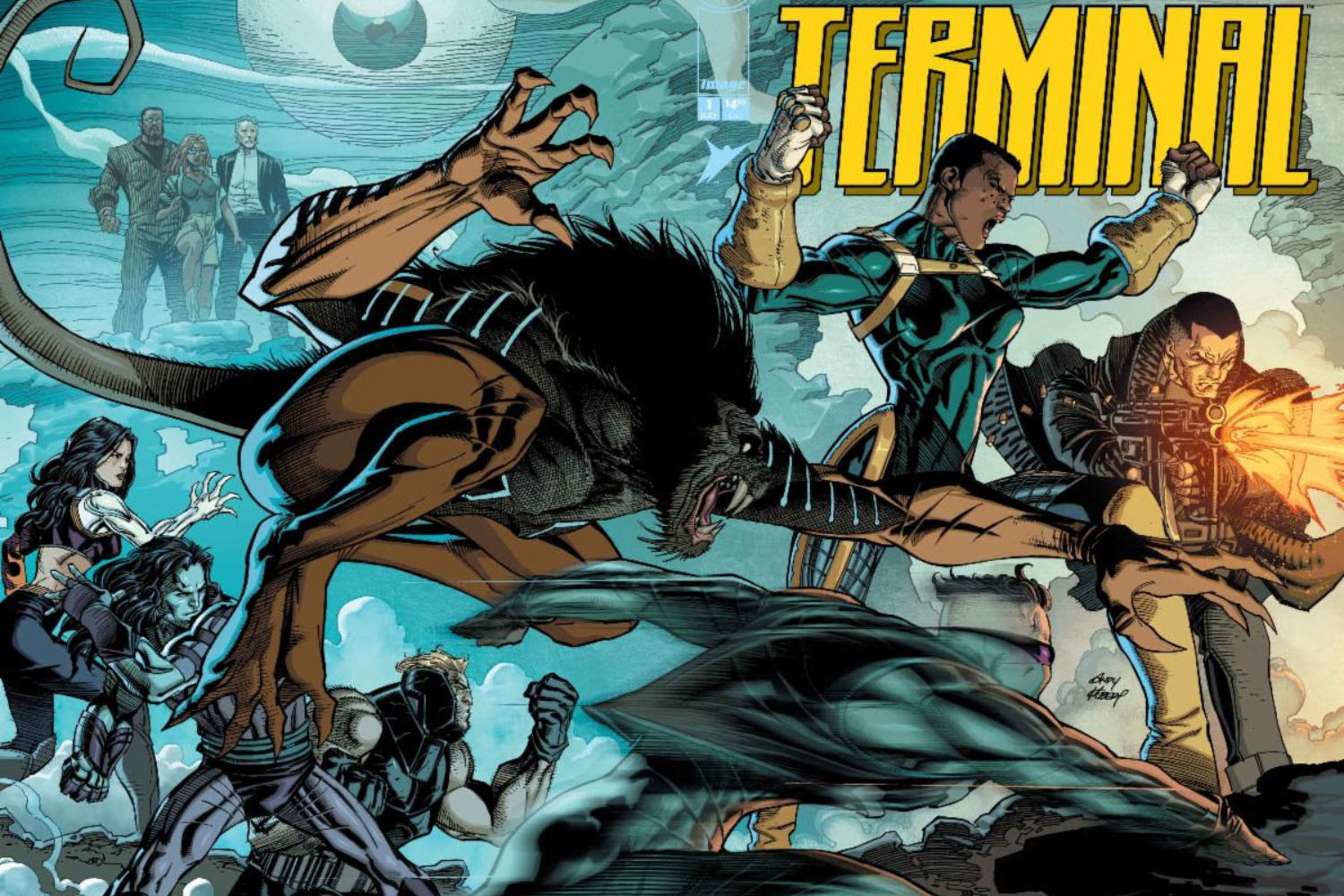

When a creative lineup includes Robert Kirkman, Joe Casey, and Andy Kubert, expectations are already sky-high. But Terminal is aiming for something even bigger: a sprawling, violent superhero story rooted in mystery, ever-evolving characters, and a long-game vision that could stretch for years.
At its core, Terminal follows a hidden global conflict between two superpowered factions, with ordinary people caught in the middle. That includes Marilyn Howe, whose search for her missing sister pulls her into a world where power comes at a cost. As Kirkman explained to me earlier this week over Zoom, that sense of discovery is baked into the book’s central DNA.
“We wanted it to be an unfolding story that… constantly has more to reveal,” Kirkman said. “As much as we reveal in the first issue, I think that’s the tip of the iceberg.”
That approach draws heavily from the kind of comics that defined a singular era in comics,
“We want this to feel like a…’90s flavored, action-oriented comic book,” Kirkman said, pointing to the mystery and layered intrigue that once defined team books like X-Men.

Courtesy of Skybound.
A World Without Easy Answers
From the outset, Terminal avoids a clean divide between heroes and villains; Casey made clear that ambiguity is the exact point.
“To present a conflict that’s just black and white is boring,” Casey said. “You want it to have some levels to it and some uncertainty… about who’s on what side and why they’re on that side.”
While the first issue introduces a genetic component tied to how characters gain power, Casey hints that it’s only part of a much larger idea.
Added Casey, “The idea of how these characters are recruited and which team they join up with is a much bigger concept… it’s going to take a while to really get it out there.”
That slow-burn philosophy extends to the book’s structure. Rather than centering on a single protagonist, Terminal embraces a rotating ensemble.
“I think that ensemble is really the way to go,” Kirkman said. “There will be arcs where certain characters will be focused on more than others…the protagonist slot will be kind of a rotating one.”

Courtesy of Skybound.
The Truest Collaboration
Unlike many high-profile projects, Terminal is built through close, ongoing collaboration. Kirkman and Casey regularly meet in person to break down the story, shaping the script together before refining dialogue as a team.
“We know what the book should be…that’s always the guiding light,” Casey sai.
Kirkman describes the process as fluid, adding, “From scene to scene…the level of collaboration can change.” He called it “a pretty interesting mesh” of their respective approaches.
That same collaborative spirit then carries into the art. Kubert is joined by a rotating group of top-tier artists, including David Finch and Arthur Adams, each contributing to the evolving look of the characters. That includes character design with the book, with many issues already in production.
“At the end of the day, the makeup of the series will be kind of a mix of all of their different input,” Kirkman said.

Courtesy of Skybound.
Kubert also approached the designs with a clear goal of honoring the past without falling into the trap of nostalgia.
“This whole series is kind of a rip-off of ’90s X-Men stuff,” Kubert said. “But I did not want to do ’90s X-Men stuff. I didn’t want to go back and do pouches and all that kind of thing.”
Instead, he aimed for something that bridges eras.
“I wanted to get a happy medium between modern stuff and that,” Kubert said, noting that the designs evolved through constant back-and-forth with the writers.
That balance gives Terminal a familiar energy without feeling stuck in the past, letting the characters feel both classic and new at the same time.
Even the strangest elements of the book reflect that balance. The mysterious Maculox, a key figure in the story’s mythology, was intentionally designed with striking simplicity.
“I just want a circle…an eyeball on it,” Kirkman said as he recalled a convo with Kubert, rejecting more elaborate designs in favor of something cleaner and more iconic.

Courtesy of Skybound.
Planning For The Long Haul
If Terminal feels super ambitious, that’s because it is. According to Kirkman, the team is already far ahead in production, with a long-term roadmap firmly in place.
“We should be staying at least a year ahead of release,” Kirkman said , noting that this approach allows for flexibility and bigger storytelling swings further down the line.
As for how long the series might run, the answer is intentionally open-ended.
“Whether that ends up being 50 issues, 100 issues, or 1,000 issues…we have far-reaching plans for the book,” Kirkman said.

Courtesy of Skybound.
Blind Bags Beyond The Gimmick
One of the most talked-about aspects of Terminal isn’t just the story, but how readers will experience the book at launch. The series will feature a blind bag program, but Kirkman insists this isn’t the standard variant cover shuffle.
Added Kirkman, “I think that there are blind bags and there are Skybound blind bags.”
Instead of just alternate covers, the bags will include entirely new material.
“We’re actually producing fully original comics that make our blind bags… more special,” Kirkman said. Each bag will include Terminal #1 alongside three mystery books, with their contents kept under wraps until readers open them in-store.
“We want that to be special…having the product in your hands and opening the bag and finding out what’s inside,” Kirkman said.
Casey emphasizes just how unusual that approach is.
“Even what we know about the economics of making comics, no one else would dare do this,” Casey said. “It’s the most mind-boggling thing I’ve ever been involved in.”
Kirkman is quick to acknowledge the playful side of it all, adding, “It’s definitely a gimmick, but it’s a cool one.”

Courtesy of Skybound.
The Endless Drive for Mystery, Momentum
For all its spectacle, Terminal is designed to keep readers guessing. The first issue introduces a world of shifting alliances, evolving powers, and unanswered questions, and the creators are in no rush to explain everything.
“I like first issues that keep you guessing,” Kirkman said. “You want to be intrigued and curious…you want to be coming back for issue two.”
With a powerhouse creative team, a deep bench of artists, and a rollout strategy that leans into surprise, Terminal is positioning itself as more than just another superhero book. It is a long-form experiment in scale, collaboration, and controlled chaos. Given Kirkman’s now iconic run on Invincible, and having read the first issue, we may have our next hugely popular IP heading to comic shops this summer.
And if the team has its way, they’re only just getting started.
Terminal #1 will be available at comic shops on July 22. (The FOC is Monday, May 25.)



You must be logged in to post a comment.