


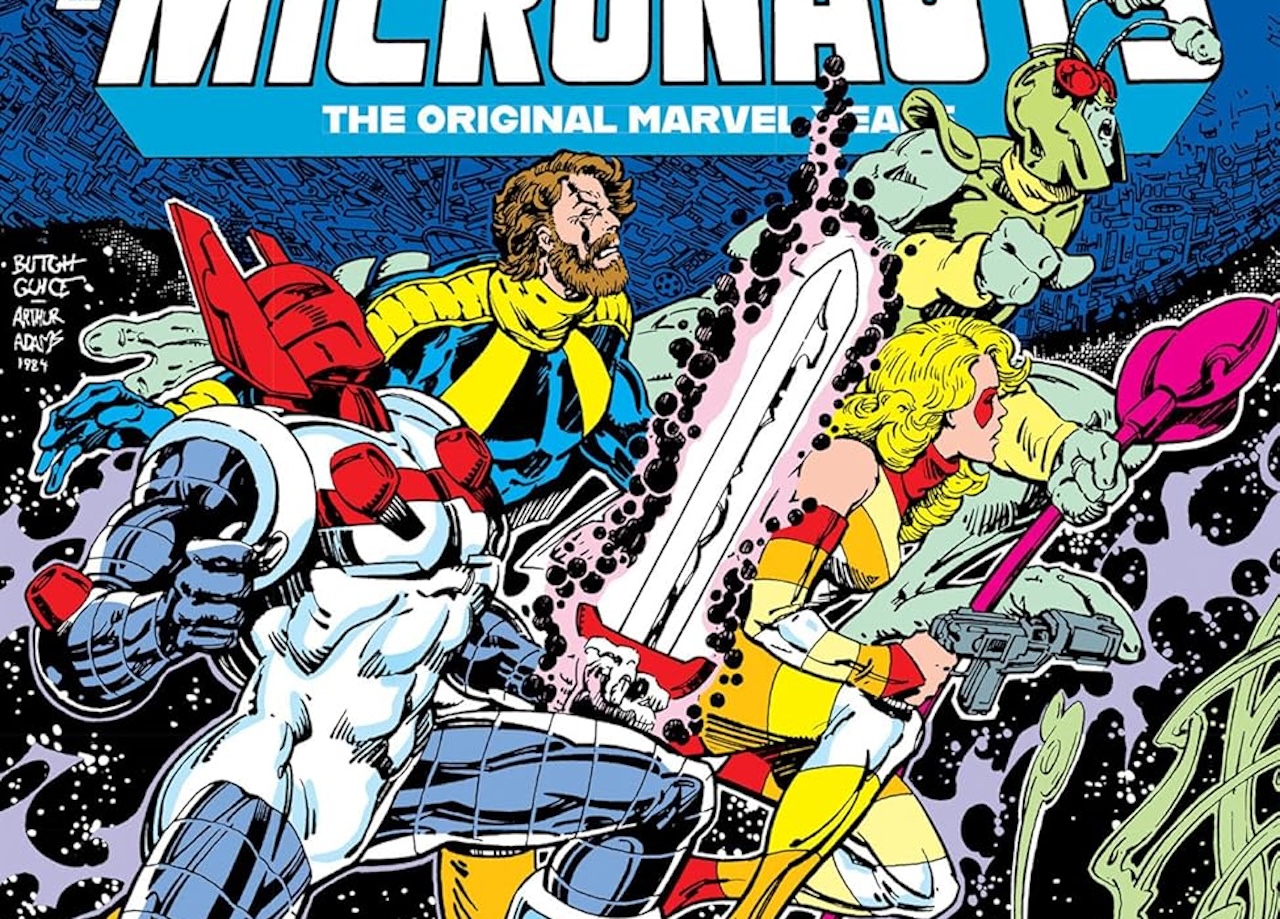

It’s surprising that Micronauts was a going concern by 1984. The toy line that the comic books had been created to support – an American repackage of Japanese toy company Takara’s Microman figures, imported by the Mego company way back in 1976 – had disappeared from shelves by mid-1980, only a year after the Marvel comic hit shelves. For children of the era, the only familiarity they might have with the property might have been some hand-me-down action figures and the four-color faces peering out of the pages on comic racks.


Marvel
But Micronauts persevered: for 59 issues from 1979 to 1984, the original series held strong, due in no small part to original writer Bill Mantlo, whose idea it was to license the toys in the first place (common legend has it that his kid was a big fan of those Mego toys). Mantlo all but single-handedly carved out a mythology from the very, very basic ideas presented by the Mego packaging. He created a rich, sub-atomic universe that bled, here and there, into the main Marvel continuity but largely concerned itself with its own interior dramas.
But Mantlo and company had come to a natural conclusion in their series: the Micronauts persevered over a series-long villain, Baron Karzo. 59 issues of build-up had resolved, and Marvel still felt the characters – now without the support of a toy line, and with no guarantee of finding new readers – deserved to continue.
Micronauts: The New Voyages, under new series writer Peter B Gillis and ongoing artist Kelley Jones, sees our heroes adrift without a purpose. Their war concluded, the team takes on a sort of Star Trek-like quest of exploration, drifting through the cosmos at their whim.

Marvel
The book immediately suffers from this lack of direction – our heroes, long defined by their heroic quest, have lost their heroic luster. These are characters, once selfless, made facile and hollow. Their adventures follow an easy formula of making contact with alien life, coming into conflict with it, and escaping out the other side of that conflict not with new purpose but with a random new trajectory: they literally drift from story point to story point without much agency.
This doesn’t mean that there is no drama and revelation: their happenstantial bopping about starts to uncover a cosmic mystery in the Makers, some godlike force that created the life they encounter – and, possibly, created the very Microverse itself. Dramatic and transformative moments come and go: Huntarr, a later addition to the team in the previous book, is literally transformed by his contact with a cosmic egg. Marionette loses the use of her legs; Commander Rann, a thousand-year-old man kept in his youth by science, suddenly ages to his true age.
The book insists on new characters and creates new villainous monsters who become members of the crew. There is a lot of momentum to these stories, however pointless it feels in the moment; in an early issue, conflict is presented by Bug’s nervous imagination; no actual danger is presented in the issue.

Marvel
Where the narrative struggles not to fall apart, Jones provides a backbone through his stunning pencils. There are no stray panels, no misused artistic space; the heroes look dynamic and lively, and the monstrous certainly looks monstrous. Jones hasn’t hit the flamboyant, iconoclastic heights we would see in his later Deadman work, but that sort of experimentation would never work in a book like Micronauts. Instead, he creates perfectly genre-correct dynamism, just cutting-edge enough to make the book feel much more adventurous than its contents suggest.
Micronauts: The New Voyages is a bit of a disappointment, whether the reader is familiar with the earlier epic or not. By the time of its arrival, it had little reason to exist, and readers clearly clocked the fact: the series only ran 20 issues, quietly disappearing in 1986. The characters would persist, for a time, in the Marvel universe, but the license ended not long after; that this Marvel Epic Collection exists at all is a wonder.




You must be logged in to post a comment.