

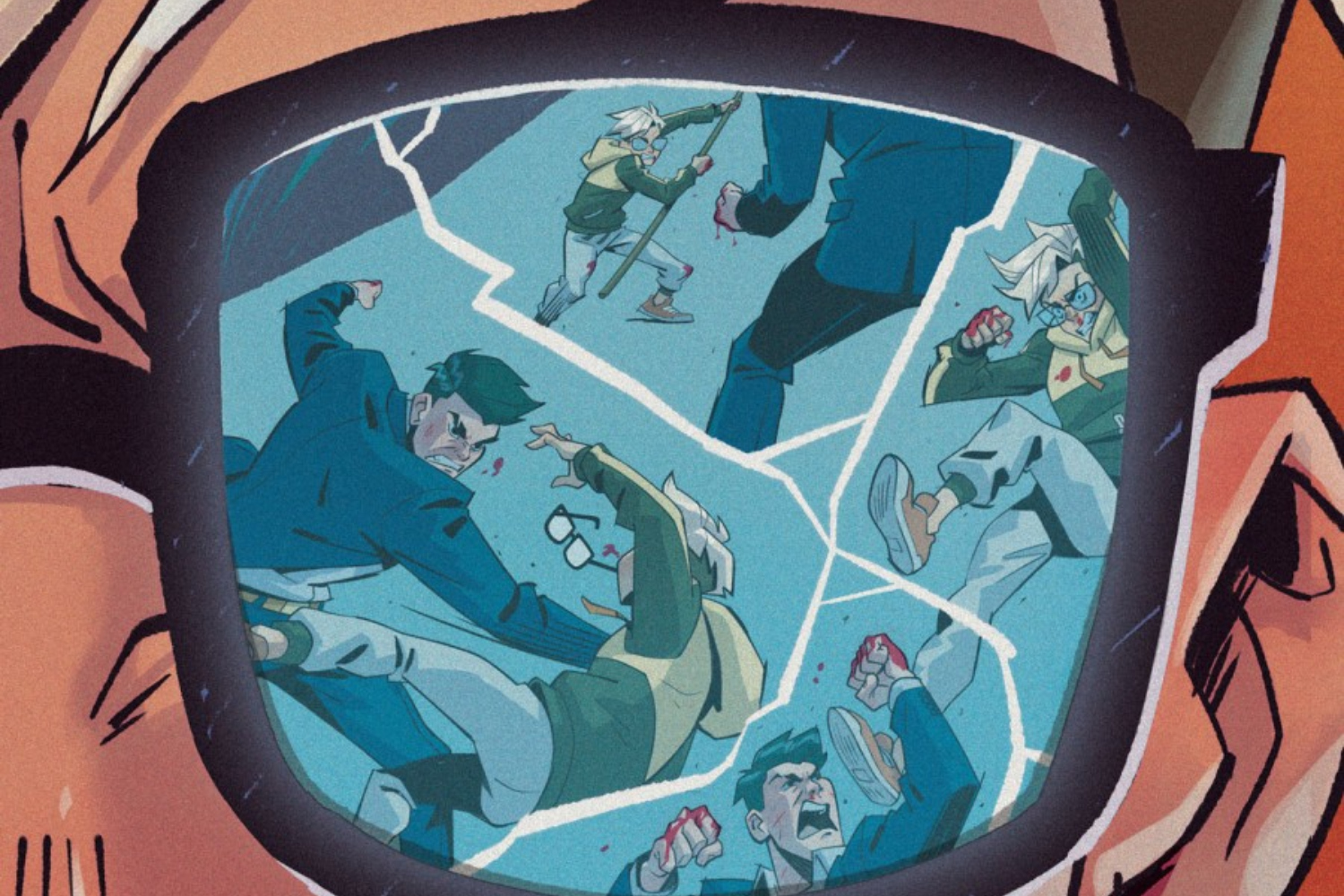

Most comic book fans have a solid idea about what they’re going to buy every week as they descend upon their local comic shop. With that said, there’s still a lot of fun to be had just glancing at the week’s new releases and taking a chance on a book that looks promising, funny, scary, etc. That’s where covers come in. A fantastic image can make the difference between trying something new or saying, “Nah, not this week.”
In that spirit, here are the covers that captured our attention this week, with entries from comics editor Chris Coplan. This is Judging by the Cover.
The Deadman #1
Variant cover by Tula Lotay

Don’t get me wrong: Having the Ice Cream Man team (W. Maxwell Prince, Martin Morazzo, and Chris O’Halloran) taking on a Deadman story is a brilliant idea. (Especially when said story involves Boston Brand “upholding the Laws of Spiritual Math and protecting humanity from evil.”) But I’m quite particular with Deadman; I still haven’t totally gotten used to his more skeleton-leaning depiction in the 30-year-old Kingdom Come. But even before we get into the story proper, I already feel comfortable based on this excellent Tula Lotay variant cover. Because this version lands the most important aspect of Deadman (to me, at least): that distinctly human visage. It’s that sense that he’s just one mask removal from walking back into his old life that adds a certain extra texture and depth to Brand’s unique brand of existential wandering. The whispy smoke and red suit also give this is an oddly Sandman-esque quality, and while I don’t know if that’s true, it would be a really cool story angle to explore. Heck, the piece even just reminds me of the overlooked Deadman series from 2006-2007, and while I know that no one’s touching that book, it’s enough for me. Sure, this book wasn’t made for me, but that doesn’t mean it’s not checking all the most essential boxes.
What If…? Uncanny X-Men #1
Variant cover by Mahmud Asrar and Matt Wilson

Not to be a hater for two blurbs in a row (that’s my curse, really), but I’ve often had problems with Marvel’s What If… stories. Specifically, I’ve always gotten caught up with the often “nebulous” directions of these stories. Like, why did this change, and not something else? Or, how much impact do these stories have (if any at all)? And should I just pump my brakes and have a little more fun? When it comes to addressing those clearly important concerns, I like what Mahmud Asrar and Matt Wilson have done for their variant cover to What If…? Uncanny X-Men #1. In a story about “what would happen if Cyclops stayed with Madelyne Pryor, there’s so many details and tidbits that could shift, presenting readers with a veritable bible of new history and context to sort through. Yet as my head swims in those possibilities (realized and otherwise), the simple act of these characters having weight, literally carving out a giant question mark in the Earth, does so much to provide me with stability. I’m not exactly climbing up the wall about it all, but it’s just nice to get a sense of some permanence and a definitude, even if it’s only super briefly. Add in the fact that this specific gathering of characters might have significance, and I can like enjoy this tale as intended: as a fun aside. And not, as I’ve come to see them, an exercise in amping my innately worried nature.
Only the Savage Are Left #1
Variant cover by David Mack

As far as I’m concerned, Zack Kaplan earned a permanent thumbs up from me after he helped make magic with Kill All Immortals. And his latest book could be just as good, as Only The Savage Are Left sees a young man having to wander a monster-laden dystopia in pursuit of true love. (The monsters are former people infected by some virus, adding some real layers to our young hero’s forthcoming peril.) While the main cover (from series artist Stefano Raffaele) is a solid snapshot of the story to come, I found myself really drawn to this David Mack variant. For one because it’s David Mack, and he could draw directions to a garbage dump that’d be rich and compelling. But mostly it’s because the way the cover realizes the book’s premise. The sense of violence as an everyday occurrence; the tension and interpersonal conflict that such a virus would foster; the slightly magical quality to this strange new world; and how things feel like both a warning and a mere expression. (Reusing that road sign, as Raffaele’s own cover does in a similar manner, is also quite brilliant.) Each aspect just works so well to get us thinking about the way humanity will be explored across this book, and how it’s a story about change (for better and worse) and how we maintain ourselves throughout. Not only is it hella relevant, but it’s done in a way that feels as gripping as other Kaplan tales. I just hope there’s axes in this book, too.
The Ring: The Man Who Beat the Man #1
Cover by Oliver Barrett

Speaking of magical creators, we’ve got Gail Simone writing a g-d boxing story. Admittedly, I was more into the sweet science as a younger man, but a sport that encourages punches to the jaw will always hold a special place in my heart. And in a story that’s just as much about the man behind the fists as the blows themselves, Elisa Romboli’s style was a great pick for a Simone script. (Go read You Never Heard of Me soon-ish, yeah? Great premise, super fun story.) In the meantime, Oliver Barrett is a solid enough preview of the brutality and heart I hope is at this book’s core. His resulting cover plays out like some Renaissance painting; only there’s broken, busted men and not, like, cherubs or whatever. And while our long-haired friend is clearly the winner, you get the sense that 1) it might only be temporary and 2) perhaps his “victory” isn’t worth it on a number of levels. But then that’s boxing for ya: It’s brutal and unforgiving, and the difference between a winner and a loser is one well-placed shot. Plus, a little blood loss may seem like an OK enough price to pay, but it really typifies the sheer cost of winning just one bout (let alone becoming a champion in the long-term). This one will likely land like a haymaker — not just to the gut but to the heart and soul. Hurts so, so good, yeah?
Junk Punch #1
Cover by Carlos J. Olivares

And from the sanctioned kind of punching to the kind that might get you kicked out of a TGI Fridays, we come to my most anticipated title in some months: Junk Punch. It’s a profound mediation on our impermanent culture, and the casual cruelty of violence. Just kidding: It’s about a girl (Clara Castanelle) who is “addicted” to punching people in the junk. (In her defense, the world she lives in sees people affected by similar, slightly less weird compulsions.) The idea of this cheery, bright-eyed young girl just walking around speed-balling people’s nether regions is all I need from a comic. Series artist Carlos J. Olivares has such a simple but personality-laden style that he makes the humor feel both perverse and approachable, and he shows us so much of this world and story with such a direct but effective moment. Will all of this junk-punching lead to a big, more potent story? I’m almost sure of it. Do I necessarily care about said story? Mostly, because I think writer Paul Tobin can make something generally interesting out of such a weird, weird premise (without muting the coolness of a book simply called Junk Punch). But even if this cover is the very peak of this project, we already get a really cool moment. Not just one about junks being punched, but how silly ideas can impact people; the singular way comics can tell certain stories with layers and commitment; and even that good stories just need to be genuine to actually matter. Say it with me: Junk Punch!
Royals #3
Variant cover by Bryce Collins

Sort of like with the promise of Junk Punch (love writing that out!), Royals is a book that has actually (and quite quickly, I might add) outpaced its inherent “gimmick.” What was billed as two brothers using telepathy to cheat at card games has nigh immediately become this profound meditation on the complicated and extra dramatic relationship between brothers. Now, based on the covers to issue #3 at least, Paul and Castor may be headed for blows as they’re forced to enact a nasty little heist for the The Bloody Cocks. (Yes, it’s a South Korean mob, but that would also make the dopest band name ever.) Bryce Collins’ variant cover captures this brotherly animosity in some interesting ways. On the one hand, it’s extra brutal, and no one can cut you deep like a male sibling. At the same time, the fact that it’s depicted in this way makes me think it all could be a fantasy, or maybe some shared telepathic message the brothers are signaling each other back and forth. And if that is the case, it’s not only still quite brutal, but it feels more thematically appropriate and a great way to explore some huge tension in the larger context of the story. (Which further elevates the book in some subtle but mighty ways.) However the brothers’ issues get worked out, I have every confidence that Royals will make it big, bloody, and deeply, deeply cathartic.
Batman #10
Variant cover by Ryan Sook

I get that at this point, we need another Batman-Catwoman cover like we need more lead in our drinking water. But when it comes to depicting the most over-depicted comics couple ever, this Ryan Sook variant to Batman #10 was interesting and insightful the second I laid my eyes upon it. First off, note the distance between our love birds; it speaks volumes to their “will they, won’t they” dynamic and how they often seem to be deliberately keeping one another at arm’s length. From there, note the posture of Catwoman; it’s not exactly novel that she’d slink like a cat, but that to me speaks to how she’s consistent, and how Selina Kyle will always be exactly who she says she is. Meanwhile, Batman, may seem to be stoic AF, but I thought he was also showing off like a male peacock, and that to me is this subtle way of exploring how he approaches this relationship and the way it both extends and lowers his defenses. Now, I’m assuming that building reads “La Parisienne,” which is the name of several bakeries as well as fashion lines and jewelers. But maybe it’s also a comment about how these two seem to be their best couple selves when away from Gotham, and what that says about their pairing in relation to their hometown. Admittedly, that last part is a wee bit of a stretch, but one thing’s clear: Maybe the world does need more Bat-and-Cat art if it’s this dang good.
Spawn #376
Cover by Don Aguillo

If you haven’t been paying attention, Spawn #376 is a big deal as Matthew Rosenberg takes over from Todd McFarlane on writing duties in massive departure for the long-running series. In the months leading up to the changing of the guard, I’ve looked at both Spawn #374 and #375, trying to uncover some insight and meaning that might explain what’s to come (and how it connects to what’s already happened). Jeff Monk’s main cover for #374 was a “singular image [turning] our ‘hero’ into more of an icon than ever before.” Meanwhile, Harvey and Kevin Tolibao’s cover for #375 was basically “the most Spawn looking thing since Spawn #1 itself.” So, then, what’s that got to do with Don Aguillo’s cover for #376? Well, it’s basically more of the same — a quintessential moment in Spawn’s history. In fact, I swear I’ve seen a version like this cover before (please confirm or correct me, Spawn-Heads!), and that just plays up my whole angle of “time is a flat circle but also really layered and intriguing.” Yes, Aguillo’s whole technique and vibes are new and singular, and that certainly does a lot to help define the identity and intent of this book moving forward under its new “management.” But it’s the connection to the past, a kind of artistic nostalgia if you will, that matters most — it’s about embracing what’s worked on this book for years as the way to tell a Spawn story with real teeth. (And part of that is redefining and reinventing where need be.) Good luck, new team — not sure you’ll really need it if this is how your “reign” begins.
Supergirl: Survive #1
Variant cover by Homare

Just last week, we got a bit of Elseworlds wonder with Superman: Father of Tomorrow #1 (in which Jor-El comes to Earth instead of his infant son). Now, we get another such slice of alt world magic with Supergirl: Survive #1, in which Kara Zor-El and baby Kal have to abandon Krypton in what’s seemingly a more dangerous mission than even Kal’s “original” trip to Earth. But what’s great about this book so far isn’t that Kara is some badass warrior; the solicitation makes references to her “small problems,” like her relationship with young Kal and choosing a dress for some formal. That sense of being overwhelmed is powering this really great Homare variant cover. Much like with Father of Tomorrow, Kara’s suit says it all — more specifically, it looks like the equivalent of some homemade number you’d use to go space mining or have a space picnic. Ya know, the thing that wasn’t made for space combat and general danger, her very terrified and unprepared state made practically manifest. From there, I get the sense she’s calling for help or trying to make herself look less like a threat, and the body language is such a small but potent choice. And, of course, there’s wee baby Kal; it’s an image that offers both both hope and also concern, and another way this cover captures the layers of this story with genuine efficiency and humanity to spare. I reckon things will turn out OK for these cousins, but that doesn’t mean it won’t be harrowing AF in the meantime.



You must be logged in to post a comment.