


Most comic book fans have a solid idea about what they’re going to buy every week as they descend upon their local comic shop. With that said, there’s still a lot of fun to be had just glancing at the week’s new releases and taking a chance on a book that looks promising, funny, scary, etc. That’s where covers come in. A fantastic image can make the difference between trying something new or saying, “Nah, not this week.”
In that spirit, here are the covers that captured our attention this week, with entries from comics editor Chris Coplan. This is Judging by the Cover.
Batman #163
Variant cover by Mico Suayan

In determining the quality of H2SH (still don’t like the way that looks), consider the fact that it was bumped from mid-February to this week. And I get both sides of the “debate”: Hush is a pretty essential Batman story, and any addition to it (even one that’s still quite good if not generational somehow) will always feel like a singular disappointment. But if this endeavor only musters this really great Mico Suayan variant, then everything feels like a worthy follow-up. Now, across both books/”eras,” you’ll find plenty of imagery associated with Tommy Elliott’s bandages; it’s sort of the best representation of our calculating psycho, and there’s so many contextual layers. And yet rather then go as heavy as some other pieces, the bandages are relegated solely to the ol’ chest crest. It’s a massively effective image that shows where the “Hush stuff” resides in Batman’s mythos, and the overt intimacy and emotional connected represented by this narrative. You almost get the sense he’s tried to unwind it all himself, giving up because the act ultimately proved fruit-less. There are things about Batman he must accept and work through, and this one cover elevates Hush to the realm of, say, his fear of Bats or abandonment issues. Talk about the best kind of “wrap-up,” amirite?!
Doomquest #1
Variant cover by Pascal Garcin

This is not the first Pascal Garcin cover I’ve gawked at over the years. There’s just something about the way he lays out and layers other art and images, drawing from a character’s rich history, to celebrate and dissect them all in one fell swoop. And while this latest cover offers the same kind of intimacy and connection with Doom as it did with, say, Sam Wilson, there’s other ideas and threads here given the bad doctor’s singular status. I was initially curious if this might do too much to throw off the “sympathy formula” that makes Doom a well-balanced character, and that if this much nostalgia might overpower the brain. Instead, be it through the design or the final layout itself, Doom remains this richly complicated figure. If anything, being faced with all this history and insight has only made me revisit storylines and connections in a way that reinforces just how much Doom’s own vast, multifaceted tendencies have evolved into one of the more engaging and satisfying characters on the Marvel roster. I can see and trace all sorts of references and ideas, and in doing so, Doom is all the more alive and dynamic than ever before. Thanks, Mr. Garcin, for the most exciting character study in quite some time.
Did You Hear About Mimi Green? #1
Variant cover by Nick Robles

My feature on Did You Hear About Mimi Green? is no doubt the longest Deep Dive (TM) I’ve done perhaps ever (well, in the 2.5 years I’ve been really been doing these bad boys). And perhaps rightfully so: Connor Goldsmith and Josh Cornillon have something really special on their hands — this wonderfully intense bit of body horror that also explores our relationship with social media and each other with a depth and integrity you don’t always find on the shelves. It’s an idea very much found across the whole book, including this Nick Robles variant cover that I’ve been obsessed with the whole time. You’ve got what I’ve just been assuming is a giant bloody monster that’s eaten a cell phone, and how that’s the most perfect visual metaphor for how technology and social media exists in our lives. And the way those hearts seem to float into the “mess” itself speaks to a vaguely meta or self-aware quality that really augments this whole story. Even the crack on the phone, which could come off as mere cliche, just speaks volumes to how we view the digital world and Mimi’s own messed up journey of self-discovery/destruction. It’s all cute and creepy, unsettling and undeniable, a cover that captures so much of this book’s story and intellect without oversharing whatsoever. Maybe my Deep Dive isn’t quite as efficient, but both should prove that Mimi Green is the real flippin’ deal.
Star Trek: Celebrations 2026 #1
Cover by Adelle Kincel

Fun fact: Paul Stamets and Dr. Hugh Culber (from Star Trek: Discovery) are the first openly gay characters in a central TV cast across this beloved sci-fi franchise. And if you asked me, I would’ve assumed a feat like that would’ve happened much earlier in Star Trek‘s history, which I think speaks volumes to the openness and effective depiction that’s defined these stories for decades. It’s the same kind of commitment and integrity that also defines Adelle Kincel’s variant for Star Trek: Celebrations 2026. Even if you didn’t know much about Star Trek (new or old), you’d likely recognize what matters: the community and connection that defines this canon. This sense that these are real people living and working together, and they just so happen to be gay (without mitigating the significance, of course). Folks of all walks and life who come together to celebrate not just the simple thing that binds them, but also that they can live and laugh to bolster their community in new and important ways. Factor in that this piece has a certain Norman Rockwell-esque quality, and you feel not only the weight of this “moment,” but just how integral Star Trek is in some shared progressive identity across multimedia. It’s a party in the simplest terms, but one where the real fun is just how much life and meaning can occur with a few folks sharing champagne.
The Life and Death of Lucas Dreamwalker #1
Variant cover by Nimit Malavia

If an R.L. Stine script ain’t enough, this one-shot asks a very important question: “How many times can you be killed in a dream before you die?” (I’m no expert, but god I hope the answer is, like, 1 billion times or something. Or never ever, if we’re really lucky.) If you read parts one to three as they were originally published in Hello Darkness, you might already have your answer. But I still want to talk about this excellent Nimit Malavia variant cover as it relates to this oh-so important query. Because, yeah, the question is scary, and the story tries to flip the script on dream deaths (and our connection to what dreams really represent) in a deeply interesting way. But what this cover makes clear (for me, at least) is this question isn’t about fear; it’s about being set free. Because even if Lucas Dreamwalker does pass on, considering the things he’s seen and experienced (even just in this cover), maybe that death is really worth it. That if we can foster something so wonderful (a great dream, a compelling life, etc.), then any price would instantly be worth it all. That the book’s main question should perhaps be, “Would you be OK with dying if you thought it all worked out OK?” Maybe that’s not the most eloquent expression, but as this cover signifies, life is big and beautiful and then it’s not. When the “not” happens, it’s better to have a damn good story than more time on the clock.
Universal Monsters: Phantom of the Opera #4
Variant cover by Anwita Citriya

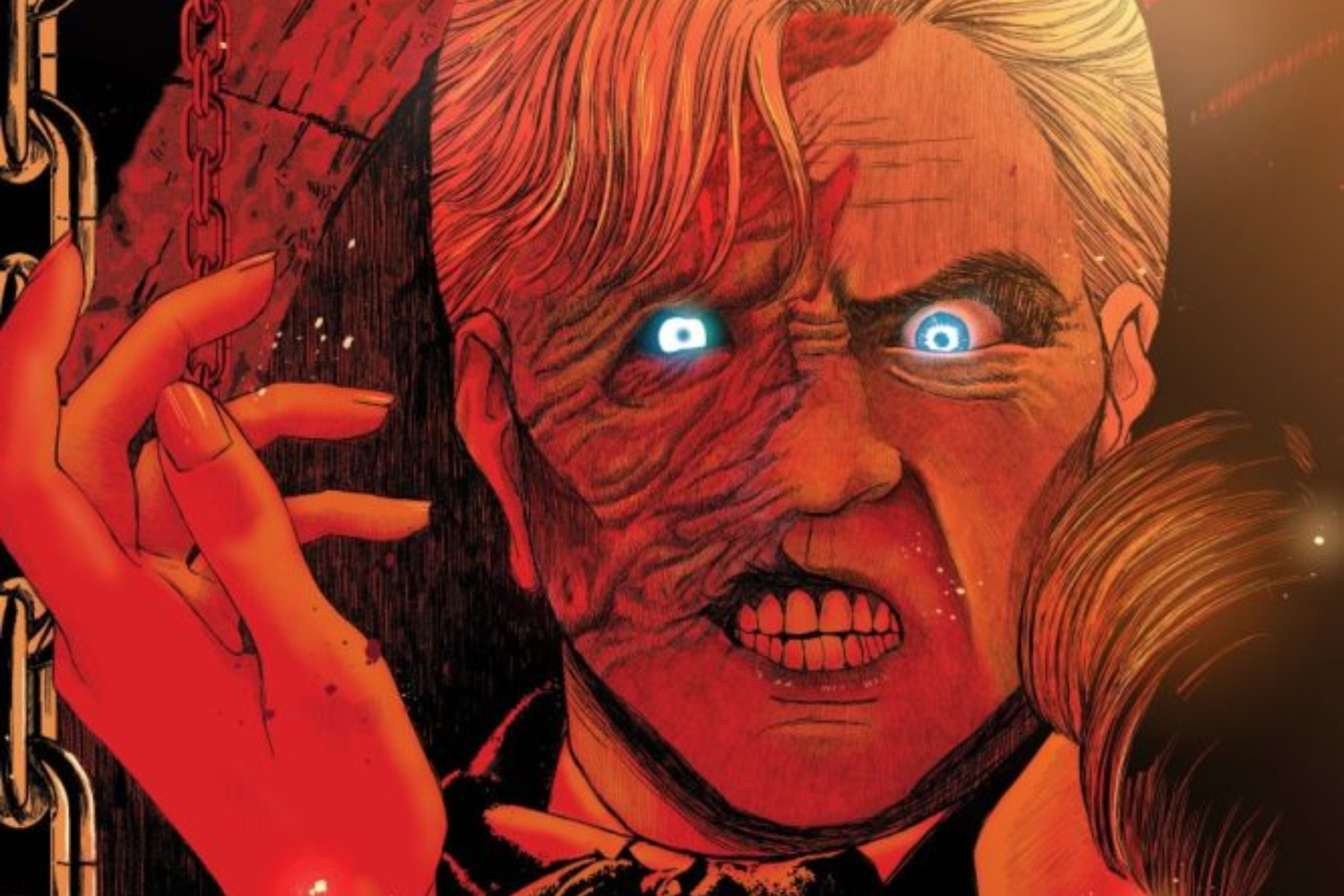
Not to keep talking about Mimi Green, but I will for a few more moments. Cause in our extended chat, Goldsmith mentioned that, in a story where the main character’s life is “ruined” over one comment, we’d never get to read what said comment actually was/where it even popped up. And as much as I also want to hear that, I get it: Sometimes you have to deny your audience to make them engage with the text. On the flipside of this is Universal Monsters: Phantom of the Opera, which like most (but not all adaptations over the years) has opted to show the Phantom’s true face. And based on this Anwita Citriya variant cover, oh what a face it is, with seemingly a supernatural spin on some Christoper Nolan-era Two-Face. And all that endless red is such a brilliant design choice, blurring the line between blood, anger, and a stage show in a way that the thematic weight really resonates in a big way. (Not to mention Citriya’s clean, detailed approach adds even more power to an already gripping moment.) Whereas Mimi Green wants to deny as to empower, Phantom wants to bring us in as close and intently as it can, and to make this story less of an exercise in exploration and deduction and instead one about pure reaction/feeling. Ya know, a tale that cuts through the noise and makes you engage with big, hard truths and ideas, and that doesn’t so much reward your engagement as compel it. The show may be over, but this one will stick with me for a long time.
The Ultimates #24
Variant cover by ACO

After two full years, we come to the swan song of the Ultimate Universe with the final Ultimates issue. And oh what a ride writer Deniz Camp and company have brought us on, doing so much to maintain the elemental parts of these heroes while making pointed changes/shifts to get us to really consider them in a new light. Given that, it felt only right to cap off this momentous run by discussing ACO’s variant cover to #24. Because by narrowing them down to a few pieces of equipment/icons and symbols, ACO has captured the dynamic at the heart of this book. The endless drive (perhaps bordering on revolutionary optimism) as demonstrated by Iron Lad’s still-glowing visor (and what that emotionality means as we compare Starks). The utility and heft of Hawkeye’s bow, and how just a few tweaks both connect and disconnect Charli Ramsey from the arrow-slinging canon we already know. How I’ve always felt Reed Richard’s mask expertly bridged the Iron Man-Doom divide, and what that felt like such a poignant encapsulation of the character. Even just how Cap’s shield looks so dang familiar, and how that’s both a source of ongoing comfort and a novel thorn in our side in further exploring Ultimates‘ true value. The Ultimate Universe might be over, but this cover demonstrates that we’ll be revisiting these heroes for years to come. Wait, I didn’t even mention the true standout: that tiny Wasp helmet!
Superman: Father of Tomorrow #1
Variant cover by Riley Rossmo

I love and adore Superman: Father of Tomorrow already for its simple but genius premise: what if instead of a tiny baby Kal-El emerging from that ship in Kansas, it was full-grown, gorgeous-beard-to-the-rafters Jor-El. It instantly reworks our very understanding of Superman — because what happens when an alien isn’t raised to take on our best values, but he has to find his way in a strange new world while dealing with the sting of a lost home and understandings that might run counter to his new “family.” For now, I just really love this Riley Rossmo variant cover because it shows what might be different about this alternate take. For instance, there’s a bit of foreboding as a 32-year-old dude steps out onto the Kansas plain; that’s the face of a man who isn’t sure exactly how he’s going to actually react. The fact this it’s also basically a “Krytpon-i-fied Daily Planet” feels significant; I’m not sure how that kind of thing works out in the story, but it feels like our whole frame of understanding and sense of story-related gravity has been removed (and that’s a very good thing). And there’s other touches, too — not only is Jor-El’s suit different, but it adds to my feeling that this could be an Invincible-esque spin (and there’s a lot of good and bad to unpack there). Either way, Father of Tomorrow is already running full sprint with its premise, and I for one can’t wait to start the journey into “Upside Down Smallville.”
BRZRKR: Light Draws Breath #1
Variant cover by Roanld Wimberly

Why did I choose this cover? It wasn’t for the connection to the story: In a tale of Bronze Age B. getting cloned from his own “protoplasm,” this slice of French Revolutionary politics is way off the mark. Maybe I chose it because looking at it makes me realize why so many people like One Piece (no, I won’t be explaining why and/or how that thought and connection came to be). But if I’m being really, truly honest, it’s because like many Americans right now, I’ve got Guillotine Fever. Now, legally, that’s not for any one person or group in particular, but rather the consistent thought that removing a few strategic heads from a few strategic bodies might make a bit of good for someone somewhere (and that I might be include in that “bubble,” even tangentially). And the cover itself reflects that kind of manic joy and irreverence; it’s a proper show as much as capital punishment, and while the practice might otherwise feel unsavory, you can’t deny that sometimes such a release is demanded. Sure, B. can’t be killed, and that kind of permanence does a lot to counter the messaging here about finality and justice. But the fact that it’s not a perfect fit doesn’t stop this cover from practically singing to me, and it serves as the best kind of wish fulfillment (i.e., pure fantasy). And if more books could do just that, maybe the world wouldn’t feel nearly as dire all the dang time.



You must be logged in to post a comment.