


(Editor’s Note for 6/19: Now through Monday’s FOC, you can grab Cold Open for free. Snag your copy via Ignition Press’ website)
All great artists put their very heart, soul, and essence into their work. In the forthcoming Ignition Press book The Patron, that analogy is made wonderfully, terrifyingly real.
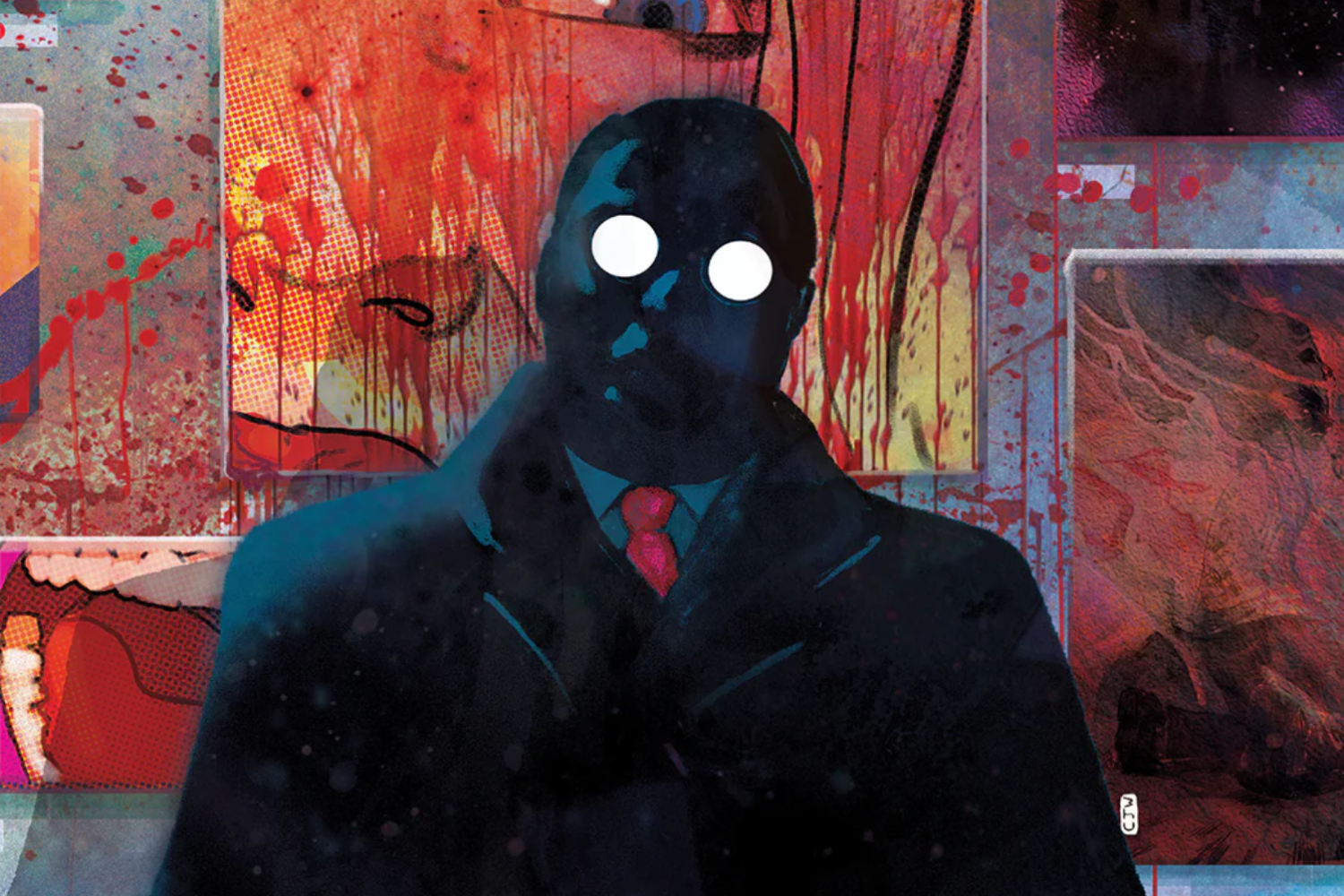
Created by writer Christian Ward and artist John J. Pearson, The Patron introduces us to Mr. Cherish, who has “dedicated his life to scouting and supporting emerging artists, launching countless unknowns from obscurity into industry superstardom.” The catch? Most of Mr. Cherish’s own patrons die a gruesome, untimely die. (Not exactly what Robert Hayden had in mind, right?) That is, of course, until Cherish encounters and “makes famous” a young painter named Matty Barnes, which eventually sees the “the artist’s fate and legacy [called] into question, putting the patron’s empire in the dueling crosshairs of law enforcement and a merciless third-party connoisseur.”
To an extent, the wonder of The Patron is that wonderfully delicious medley of the macabre and the horrific. Ward’s script relishes in the bloody murder mystery vibes, bringing us in like a classic slice of noir with layers and edges galore. Meanwhile, Pearson’s art is at its genuine apex, creating a world that merges the sleek realm of the fine arts with life’s undercurrent of darkness that will delight and unsettle all at once. But underneath all the violence and intensity is a truly thoughtful story, with two high-level artists coming together to explore the intersection of art and commerce with both honesty and intent. With true inventiveness and efficiency, The Patron is basically the Dead Marilyn of wildly effective horror comics.
The Patron #1 is due out July 29. (The FOC is Monday, June 22.) A zero issue, which serves as a standalone “introduction” to Mr. Cherish, drops this week (June 17). Ahead of each book, we caught up recently with Ward via email. There, we discussed the story’s long-running development, his friendship/collaboration with Pearson, exploring the role of both creator and the audience in this story, and the book’s specific “lack” of influences, among other topics and tidbits.
And be sure to enjoy three primo exclusives: an Anand RK variant to issue #1 as well as Ward and Pearson covers for issue #2!

Variant cover by John J. Pearson. Courtesy of Ignition Press.
AIPT: I’d read you had this idea but it took 3 years to find the right story. What happened during that time and what makes this the right choice?
Christian Ward: The initial kernel of the idea was born from a conversion I had with John Pearson, where he told me about one of his collectors joking that when John died his collection would be worth more money. It was the perfect light bulb moment. An art dealer who kills his artists before selling their work…but a hook, even a great hook, doesn’t make a good book without a good story. More so, a great hook deserves a great story. So for three years I let it cook…building the characters in my head, exploring what they wanted and where those desires would take them. There was no further light bulb moment beyond that. Just giving a story time to grow.
AIPT: Do people need to read issue #0 before hopping into #1? I feel like it really enhanced the experience on my end.
CW: Absolutely not, but those that do while have an added level for sure. The Cold Open is a very personal (almost biographical ) standalone story that in many ways is the beginning of the book’s mission statement. It’s the thesis rather than the starting point of the narrative.
AIPT: You also mentioned in our emails that this is closer to Two-Face. Can you expand on that — is it more than just they’re both sort of thrillers? Is it a personal connection for you?
CW: I’m a horror guy, and I tend to lean towards either sci-fi/supernatural/cosmic. But the thing I love about Two-Face and The Patron is its storytelling with the tighter restrictions of reality. I love the challenge of taking stories to wild places without the crux of ‘anything can happen.’ All stories, regardless of genre, live and die on their characters, but without the genre trappings of horror/sci-fi, that’s even more true.
View this post on Instagram
AIPT: This book is such a great avenue to explore the weirdness and harsh realities of being an artist in a commerce-based system. Is it easy to talk about those ups and downs, or were there concerns you may be revealing too much somehow?
CW: It’s incredible easy to talk about. The big goal of this book was to make the reality of being an artist very relatable. I didn’t want the book to feel elitist. And the only way to do that was to be very open, vulnerable, and honest.
AIPT: I got some real Dexter meets Silence of the Lambs vibes here. Were there any specific influences or landmarks for you and John?
CW: There are times when you want to tip your hat towards existing stories. (I’m certainly doing that in my ongoing Event Horizon series.) But with this, I didn’t want this stories to take cues from any existing story. I wanted it to be as unpredictable as possible, which meant it had to walk it’s own path. All that being said, I was inspired by a lot of Korean filmmaking. Nothing story specific but just the vibes of …anything could happen.
AIPT: I think you also make a great argument in this debut that fans/readers are culpable in this system. Was that intended, and did you fear ostracizing your audience?
CW: Any storytelling or piece of art only exists when, there is someone to view or experience it, so the viewer/reader has to be discussed in this story. That said this isn’t Funny Games. There’s no direct criticism here.

Variant cover by Anand RK. Courtesy of Ignition Press.
AIPT: John’s work is so absolutely amazing here (and just generally speaking). What does that unique style/technique do to help the story, especially given its art within art in a really fun, decidedly meta kind of way?
CW: This book is and was always John’s. He was part of the concept, and I wrote every scene and chased every sentiment with him in mind, both John the artist and John the person. We share a lot of common experiences; we’re both ex-art educators and we both come from a fine art background before doing comics. The book is a love letter to art, and John has hand-painted not just each page, but every painting we see in the comic is a real painting that John has painted in real life. It’s been incredible to see John paint dozens of real paintings in a way that all appear to be by different artist. The thing I love about John is that he understands the way in which art is made, the context of it, [and how that] can add greater layers of meaning. In regards to The Patron, that gives our story greater layers. This story is richer because John is co-creating it.
AIPT: Speaking of John, how much did it help for the two of you to be able to commiserate about these feelings and fears, and to work it all out as artists in collaboration? Did this book extend your friendship/bond?
CW: I adore John and his work, and working with him on this book has been everything I wanted it be.
AIPT: How much of your own actual, real-world experiences in the art world filter into the story? Or is it more vague or universal in that way?
CW: As I said, it’s painfully honest. There are most where I’m directly expressing my own thoughts and feelings of being an artist in today’s world, but also my experience of being a consumer of art, an ex-art educator, and even my time of being a poor artist. There are years in my life where I tried to make it as an artist where everyday I’d have to choose between feeding myself or whether I could afford to see a film [and] buy a CD or DVD or a comic. Now, though, I feel very privileged and feel very lucky to be a full-time comic creator, but it’s important to me that I remember those early days. All of that is in this book.

Variant cover by John J. Pearson. Courtesy of Ignition Press.
AIPT: I love the way AI is mentioned in the story. It feels like you engage the real threat without overwhelming the narrative. Why was that approach the way to go?
CW: Because you can’t talk about being artists in 2026 without addressing the threat of AI. To me, AI (when it comes to art ) encompasses every ignorance that is unable to appreciate or contribute to the culture of the world. It’s utterly soulless and is rooted only in capitalism, which is the opposite of art. Really, though, that’s what the thesis at the heart of The Patron: capitalism and art are strange bedfellows, but in many ways, they both need each other to exist. The Patron explores that tension.
AIPT: Hear me out: the villain, who murders artists to elevate their careers, doesn’t seem all that bad to me. (Again, for a murderer.) Is there some part of you that maybe could like or just feels complicated about this dastardly fiend?
CW: It was very important to me that he wasn’t a cartoon villain. That he felt like a real person. So with that in mind, he’s complex and does have some redeeming qualities alongside being terrifying. He genuinely loves art, but there’s a contradiction in that he is able to kill artists. This is partly because he’s selfish and greedy and absolutely is a psychopath, but also he believes there is an endless supply of artists, and in this twisted mind, he is helping them by making his artists stand out from the very crowded crowd by being dead.
AIPT: You’ve written a handful of books so far. How did it feel going into this one, and were you more confident than with any other titles?
CW: The Patron is the eighth series I’ve written, but writing comics was always the goal. (I just got sidetracked along the way by amazing collaborators like Matt Fraction, G. Willow Wilson and James Tynion. ) I actually enjoy writing comics more than drawing them, but I adore all storytelling whether it be with words or art. I wouldn’t say I was more confident with The Patron than with any of the previous stories I’ve written, but I was definitely more personal.

Main cover by Christian Ward. Courtesy of Ignition Press.

Variant cover by John J. Pearson. Courtesy of Ignition Press.



You must be logged in to post a comment.