


Given we’ve already lauded the book with an industry-defining “KAPOW Moment of the Week,” it only makes sense to actually talk about Gigs in earnest.
Here, creators Mark Mosedale and Si Smith have crafted a cutting, inventive slice of near-future sci-fi that deserves heaps more praise and awards. On the one hand, the premise of Gigs is direct enough: In a world where “Basic Income is supplemented by gig work assigned by ‘the app,'” we follow a small section of people simply trying to make it through. That includes an “octogenarian punk and a lonely young worker [seeking] escape through music”; a “has-been detective [chasing] a case into a forgotten world”; and a “refugee [asking] for help in the last free place.”
And while there stories might be different enough (and also still interact/connect in small but important ways), Gigs treats these tales with the utmost in respect and intent. Pair that with a genuinely novel structure for these tales, and an unflinching level of design and planning regarding the book’s overarching look and feel, and it’s clear that Gigs is truly powerful book for the here and now. It is, in many ways, exactly what it promises to be: A “powerful warning about the oppressive world to come and a defiant celebration of the humanity that will sprout up in the cracks.”
Gigs debuted on shelves earlier this month via Top Shelf Productions. Over the course of the following Q&A (done via email), both Mosedale and Smith had lots to say about their unwaveringly human book. That includes their interest in the “gig economy,” the book’s standout moments and characters, nailing the near-future vibes, the connection between arts and labor/commerce, and even if Gigs left them feeling more or less optimistic about the future itself.

Courtesy of Top Shelf Productions.
AIPT: Concerns with and interest in the gig economy have been going on for some time. I’m curious as to why now felt like a good time to tell this story? Is it just the “added” AI component or is it something else?
Mark Mosedale: Honestly, “now: wasn’t exactly a choice! We started developing Gigs back in 2019. As it dawned on me how long making and publishing the book was going to take, I worried that the moment for this story would come and go, but the world keeps showing that I needn’t have been concerned – at least not about that. I definitely think the rise of generative AI makes questions around work and employment more pressing, but the growth of the gig economy is, in one sense, just one more pronounced example of employment trends that have been going on for years, treating people as units on a spreadsheet to be used as a resource. It’s alienating. With AI, a lot of companies seem to think they can do away with the squishiness of people and deal more straightforwardly with tokens and compute.
AIPT: How close or accurate do you think Gigs is in predicting the next 10 to 15 years, and does that scare or encourage you (or some combination of the two?)
MM: The sci-fi writer’s dodge for questions about predicting the future is to say that SF isn’t really about the future – it’s about today. I’m pretty inclined to invoke that here! But I will say that I think it’s pretty reasonable to consider something like the world of Gigs to be a possibility. When we started making Gigs, it felt pretty bleak. At this point, I think it looks vaguely optimistic. At least, by providing a basic income, someone has taken hold of the situation in some sense. It’s not hard to imagine worse futures than Gigs right now. I do believe we can do better, though!
AIPT: Does the fact that you live and work in the North of England inform or shape how you view work and industry and how society is structured around employment?
Si Smith: Traditionally, the narrative around The North is that it’s the overlooked and underfunded part of England (and Britain generally, if we’re thinking about Scotland, too). In the ’80s, when the industries were shut down and the UK pivoted to become a service economy, wealth concentrated in the South, and up here communities were left feeling abandoned and forgotten about. From up here, there is definitely a North/South divide, and when the work up here went, nobody in government seemed particularly bothered about the communities it left behind.
So there’s a residual thread of that post-industrial fall-out running right through Gigs, for sure – that sense that capitalism is absolutely and very visibly not something that ever has your/our best interests at heart.

Courtesy of Top Shelf Productions.
AIPT: You’ve nailed the best kind of near-future aesthetic where things seem just wondrous enough without divorcing the proceedings from the depressiveness of it all. Were there any influences or decisions that helped foster the Gigs‘ look and feel? This very much feels in step with Tim Maughan’s Infinite Detail.
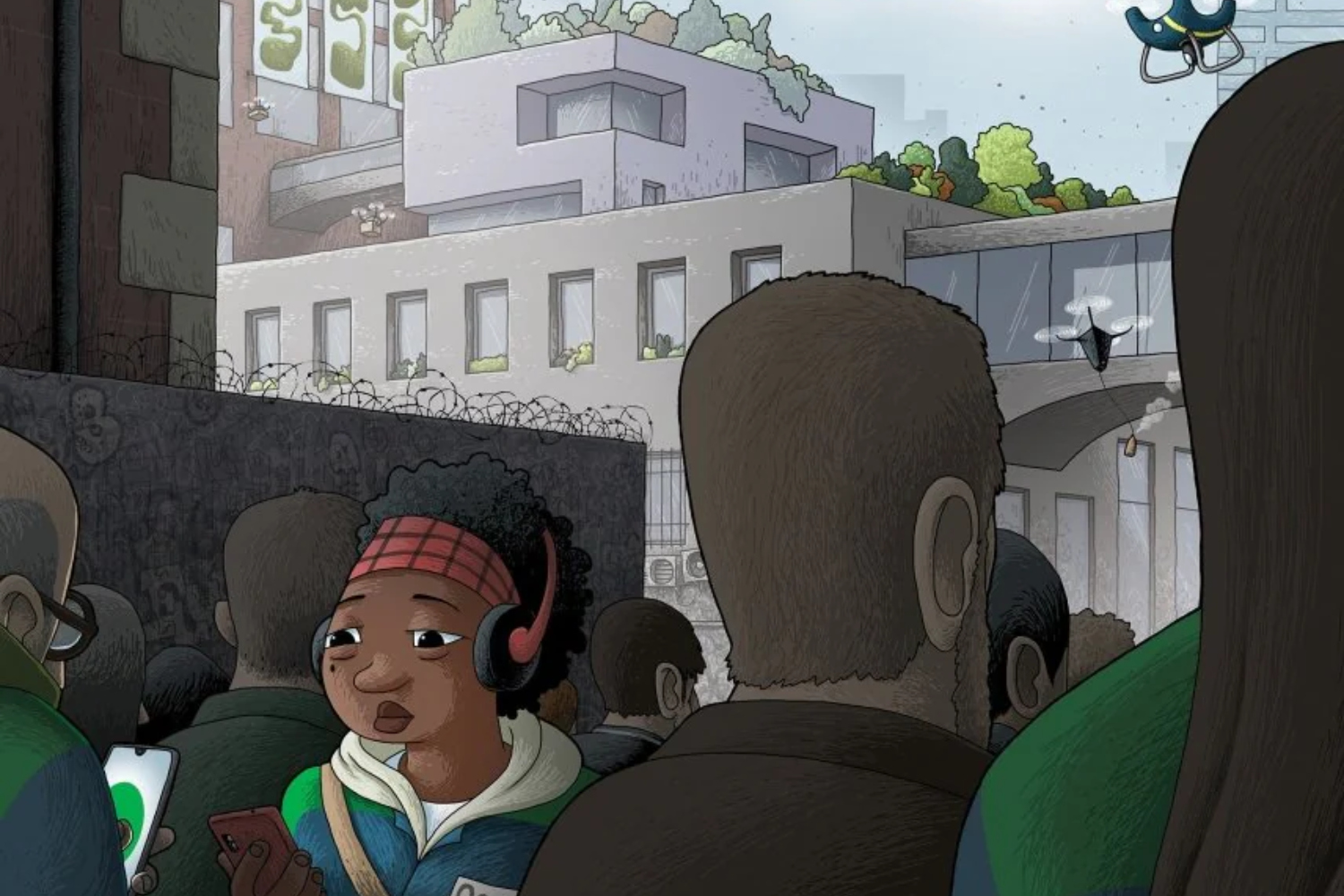
MM: I think one important decision we made early on was that Gigs would be “today, but 20% worse.” Whether we landed exactly there is hard to quantify, but we didn’t want to plunge the world of Gigs into complete dystopia. We wanted it to be a world where people were still living their lives and getting by, albeit in a way that feels heavier and more squeezed than the present.
SS: In the early stages, when I was trying to imagine the world that Mark was writing, I looked at the work of Liam Young a lot. He’s a speculative architect and a worldbuilder and his stuff is really interesting. There’s a lot of his thinking folded into the world of Gigs.
Comics-wise, I love the density of Mathieu Bablet’s work – his environments always feel very gnarly and lived-in.
Alan Moore’s nine-panel grid in Watchmen was a big influence when it came to the page layouts – our characters are largely trapped in a rigid and repetitive system, and hopefully the panelling invokes that.
Eleanor Davis’ The Hard Tomorrow is a brilliant near-future dystopia that I thought a lot about as we embarked on Gigs, and I was also looking at Gipi for his pacing.
Frederik Peeters, Rosemary Valero-O’Connell, Jillian Tamaki, and Shaun Tan are artists that I very much look up to.
And last for now (though there are many others), I was looking at Anna Mill’s Square Eyes for the way that she handles the density and bustle of urban scenes…
Elements of all of those (and loads more) are somewhere in the look and feel of Gigs. Ask me tomorrow and I’d probably come up with an entirely different but equally valid list :D.

Courtesy of Top Shelf Productions.
AIPT: So much of the humor here happens visually and is never really uttered (or, at least the stuff that really tickled my funny bone). Why is that an important function in a story like this one?
MM: We were shooting for a certain degree of naturalism, and I think if you try to make every funny moment verbal you’re probably over-writing. That said, it depends heavily on someone like Si being able to deliver those moments – he can do a lot with a facial expression!
AIPT: What were some of both the challenges and opportunities in opting for several individual (but obviously connected) stories over one larger narrative?
MM: This is my first comic, and my first piece of fiction of any length. In my naivety, I thought that having shorter stories would be easier to handle. In reality, it multiplies the work! It doesn’t change the number of pages you have to write, but it means having multiple story ideas to generate, multiple plots to engineer, a multitude of characters to figure out. All that heavy lifting you have to do at the start of a given story isn’t really reduced by a smaller page count.
On the flipside, I think weaving together these different narratives is super-satisfying. I love stories like that – they’re gnarly and chewy in really interesting ways. And we got to poke around situations we couldn’t have got to if we’d only focused on, say, Ivy.
AIPT: Building off that last question, is there one story/character that resonates more for you (and why that one)? The runner “segment” just absolutely gutted me.
MM: Yeah, #RUN was a big one for me. I did my own 100-mile run a few years back and drew on it a lot. It’s such an arbitrary, pointless thing to do, but I think that arbitrariness is what makes it kind of inspiring, too. Even though there was something of a larger goal for his run, our runner really just did it because he needed something to give himself a sense of purpose. I’ve probably over-explained the story now, but I think that really gets at something that underlies the whole book.
SS: For obvious reasons, I can relate a lot to the street artist (we called him Lloydy, though he’s unnamed in the book) in #CREATE – the dilemma of art versus commerce that ensnares him is something that I’ve wrestled with a lot in my career.
And Syd, the care-homed punk was probably born about five or six years before me, so culturally I know where she’s coming from. She’s kind of curmudgeonly too – we definitely share that trait. She’s also possibly not quite as cool as she’d like to make out, and that’s probably true for me, too.
Around the time that we started work on Gigs, my mother-in-law moved into residential care, and that informed a lot of Syd’s story arc. So I have quite a lot invested in her narrative.
But having said all that I loved drawing the scenes up on the Space Orbiter. And the AR scenes in #SEARCH were also an absolute blast to create.

Courtesy of Top Shelf Productions.
AIPT: Besides living and working in a depressive timeline, what’s the thread (or threads) that unite all of the characters here? Is it an acceptance of their status and a stubborn drive forward regardless?
MM: They’re all just people being knocked about and squeezed and crunched by a system that doesn’t give a shit about them, but doing their best anyway. They’re all confined in some way, whether it’s literal or circumstantial, and doing their best to live their lives within those confines in a way that means something to them.
AIPT: I’m wondering if being in the arts (to whatever full- or part-time extent, of course) specifically shaped your views on work/employment?
SS: I think that when you’re an artist-for-hire, there’s always going to be something slightly paradoxical going on – it’s “commerce versus art,” and you’re often having to choose between the two. I definitely have very separate strands to my practice – there’s the work that I make to earn money to live on and then there’s the art that I make out of a compulsion to make art, and there’s a tension between the competing demands of those two very necessary aspects of what I do. That conflict is very much written into #CREATE, the story of the street artist in Gigs.)
And meanwhile, whilst it was ever easy, it’s particularly hard to make a living working in the creative industries in this moment. Successive governments here in the UK have cut arts funding and undermined arts education to the point where the arts and artistic expression are seen as a luxury and not a necessity.
And then of course freelancing – in any industry – will always be a bit precarious…I grew up with the idea that jobs meant security – salaries and wages – but that has gone now and we’re completely in the world of zero-hours contracts and the gig economy (great for businesses, bad for workers). Grim, isn’t it!
AIPT: I think what makes the satire here so sharp is how deeply interested it is in humanity. Is that the key — not just to poke fun at people, places, systems, etc., but to uplift and empower wherever/whenever you can?
MM: I’d frame this as a preference rather than some grand artistic duty, but I just don’t think I could write a book that only exists to skewer something. I need to make (and read and watch) stories that offer at least some little nub of hope, some little gloop of humanity. Making work that’s only mean or bleak or misanthropic would feel like giving up to me. I want to, as Woodie Guthrie put it, keep the hoping machine running.

Courtesy of Top Shelf Productions.
AIPT: I also think you do a good job hitting at technocrats as much as liberal approaches and stances. Why is that “it’s everyone!” approach so absolutely important?
SS: Well, I think that the fundamental problem is that capitalism doesn’t work, and it’s dragging the planet inexorably to oblivion but we’re stuck with it, and can’t really escape it. In that sense we probably really are all in it together. (Even the tech bros with their fantasies of humanity as an interplanetary species.)
MM: It seems fair to say that no one really thinks the system is working all that well at the moment, and we’re all at least a little bit complicit in that. However, I would say that some people are more complicit than others, in particular a fair old swathe of the billionaire class and the populists.
It would be easy to take Gigs as a pretty downbeat take on a universal basic income, but personally I’m fairly in favor of it, at least in principle. (I couldn’t really tell you whether it’s actually economically viable.) It’s just that I find it easy to imagine it being done cynically, or being subverted, and that’s how we ended up at Gigs.
AIPT: When reading this, I was thinking about my own working history, and how my relationship with employment has changed with certain trends. Is this book somehow pro-employment — is it a love letter to finding that thing that’s actually worth doing as a job with all the intended ups and downs?
MM: I don’t want to overly romanticize work as a driver of purpose. For some people, it’s a tremendous source of meaning and satisfaction, but for a lot (maybe more), it’s a source of brain-rotting or back-breaking tedium and drudgery. But I do think that if you take it away, then for a lot of people you create a hole that’s at least purpose-shaped. If we’re going to end up somewhere where a lot of people aren’t working any more, then society’s going to have to do a lot of thinking about what fills that hole and what shapes people’s identities.
SS: I don’t know that it’s a love letter to employment in the sense of working a job for cash. But I do think that it’s very much pro-creativity and pro-vocation. Find the thing that you love to do and do it, not because it feeds your bank account but because it feeds your soul. Find the thing that gives you a sense of meaning and purpose. I think that’s a big part of the struggle for our characters in Gigs.

Courtesy of Top Shelf Productions.
AIPT: Do you feel better or worse about the future and your place in society having made Gigs?
SS: Sadly, I think that things will get worse before they get better… but then I’m the pessimist in this team :). Mark’s got a generally more positive and optimistic outlook than me, so…
MM: Writing Gigs has been kind of a weird feedback loop. Writing about people casting around for meaning while living in the cracks of a world that’s built for everything but ordinary people has been one way of…finding meaning in a world built for everything but ordinary people.
It hasn’t necessarily made me feel better about the future, but it has given me a little more hope about our ability to survive and even live well in spite of it.
AIPT: What’s the one lesson or thread you want people to take away from Gigs?
SS: To find your vocation, to persevere and hang in there? To be honest, the idea of the book having a “lesson” to teach folk makes me a bit uncomfortable… I’m not sure that we have any great wisdom to pass on :D.
My hope for the book is that it’ll move people and make them think. It’s quite a bleak book in a lot of ways, and the future right now doesn’t look too rosy, but we have tried to thread some strands of hope through it…
MM: I don’t know that I’d reach for a lesson, but if people read it and can feel, even for a few minutes, like there’s some sort of positive way they can live their lives in the face of the shit-blizzard we’re all fighting our way through, that would be a massive win.

Courtesy of Top Shelf Productions.



You must be logged in to post a comment.