

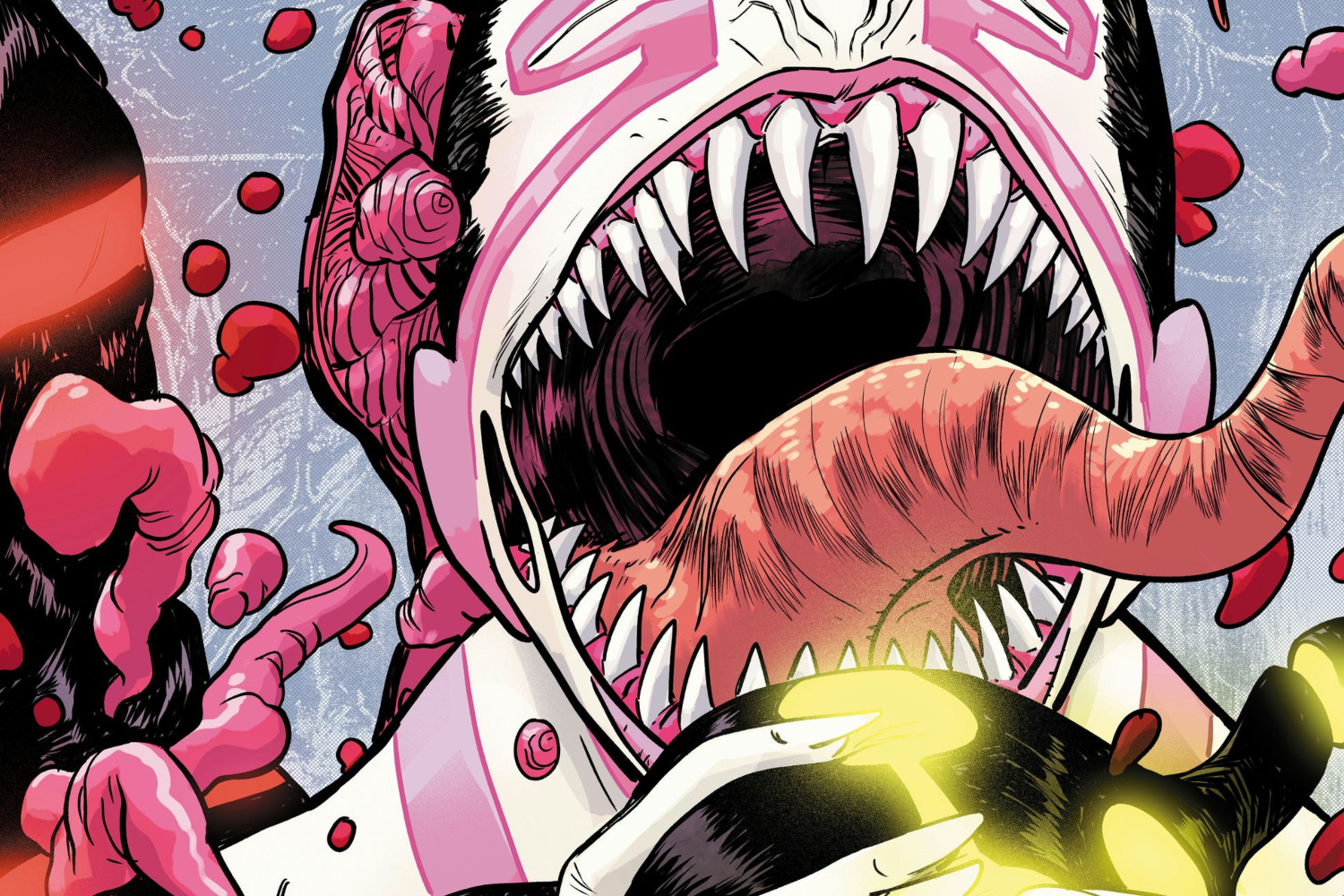

In some ways, Malevolent #4 was a source of both relief and fresh anxiety.
Because, after two mostly iffy issues, Malevolent #3 started making good on the premise of Mals versus humans — and then Malevolent #4 doubled down in all the absolute right ways. By going back to the start of the “invasion,” the creative team (writer Justin Jordan and artists Felipe Sobreiro and John Bivens) were able to realign our understanding and expectations going forward. But there was also heaps of nervous energy attached to issue #4 — given the book’s rougher start, the whole thing could just as easily back-step going forward.
And while Malevolent #5 didn’t blow me away in the same manner as issue #4, I certainly feel good enough about this book.
A lot of that is because issue #5 is basically a continued origin story of sorts. More specifically, we focus on one Mal, seeing things from their perspective in an interesting enough way. Without revealing too much, we understand their primary motivation upon entering our plane/dimension (that’d be hunger), and how satiating that need could potentially “make them whole.”
Admittedly, that’s not exactly the most novel or inventive reasoning, but it’s sturdy, undeniable motivation, and I’ll take it all the same. Plus, the hunger stuff inevitably informs at least some of Morgan’s “journey,” and in issue #5, we get a vague understanding of her birth and life. Again, it’s maybe too nebulous to an extent, but it makes you further unsure of her (in ways both good and bad), and even that feels like a character making moves that are organic and deliberate.
Because one of my chief complaints about Malevolent has been the character work/development. As much as Morgan — again, she’s the half-Mal badass who works with the cops — has grown in some interesting ways, her squad mates have remained a little flat/2D. (Morgan’s performance in issue #5 also sees her grow and engage with one teammate in some interesting ways that foster a greater depth, intellect, and range. I just wish the team could feel as real without her being around.)
At least with this hunger “angle,” Malevolent is giving meaning and more shape to the Mals, and we understand their motivation and desires in a way you’d want and likely need in any story. Even if the humans still feel a little underdeveloped in their efforts to fight back, it almost feels like we have something to really latch onto and perhaps even care about.
Fortunately, the Mals also have “help” courtesy of a daring new stranger that’s introduced in this issue. With some neat-o tech and a pretty dope hat, he may be someone playing both (all) sides, and it’s nice to have a player comparable to Morgan that also facilitates a different function. Still, there’s a bit of whiplash that comes (that’s also good and bad) when someone seemingly so vital appears from thin air.
It’s sort of how I feel in regards to Klein (Morgan’s “handler”). Despite being around this entire time, it’s Malevolent #5 where he actually feels alive and solid for the very first time. Yet he could go either way — Klein could be an interesting companion for the themes fostered in Morgan, or he could just be another distraction. If nothing else, at least Klein has a connection with Morgan where you can feel some push-and-pull and understand the intricacies of how folks really see her.
Still, Klein may also just be our way into a new character, a mysterious former government agent named Fox. On the flipside to the “stranger,” even though Fox also feels suddenly shoehorned in, I already get a sense of who he is (an important scumball). And even if that’s also not especially novel, it’s more fully-defined context to play around with and something that will really lend the story added weight moving forward. At this point, as much as I still yearn for the cops to feel fleshed out, I’ll take any shard of dramatic human interaction I can get it in Malevolent.

Courtesy of Image Comics.
Now, though, it’s back to the Mals. Our new demonic “associate” at least manages to look different/feel special. Visually, he’s got a modified feel and look, and his size and specific orange coloring/hue draws the eye in a way that builds on the promise of their hunger and “ascension.” (Again, it’s maybe a little underwhelming, or perhaps even a case of “too little, too late,” but it speaks to the power of this book’s premise that it doesn’t take much for it to actually start making big moves.)
Yes, there was similarly inventive design stuff early on in Malevolent, exploring the Mal-technology connection in a way that stoked our interest but mostly built toward some thematic focus. This latest monster design doesn’t feel quite as cool and significant, but it does enough to humanize and lend new agency to the Mals. And that is one of the first times we ask questions about their larger role and sense of “humanity” outside the framework primarily associated with Morgan.
That uptick in the visual output — which includes a sweet battle in an alley that felt exciting for its use of distance and perspective — included more lore with our “special” Mal friend. There’s a sense with some dialogue that they’re really, really trying to demonstrate how what he does (it involves summoning, basically) is so wildly different. And while I think that bashing us about the face with it is indicative of some core issues with Malevolent (and how it “communicates” with readers), it’s another instance of something big-ish actually happening.
It feels like we’re finally, truly moving toward a conclusion (of the arc or maybe even the entirety of Malevolent), and either way I’m just jazzed. It’s ultimately about generating more stakes and even more chances to really get to the heart of this book. And, randomly enough, there’s also moments/panels with a kind of X-Ray-ish effect applied to the proceedings, and that’s a great visual realization of the deeper dive that’s been undertaken to position these demons for the remaining story.
But what makes this sense of finality really hum is that as much as it extends the Mal’s sense of purpose, it does a lot to humanize Morgan. She comes off less like the action hero with a bottomless stomach, and more like someone who can bleed and might even outmatched at some point. Just like the stuff with her reactions and responses to the world, her suffering makes her ever more human. She can be hurt, so is this where she really has to rely on her team.
And if that’s the case, how do the cops step up, and will it prove convincing enough given the uneven character development in this story? But just those questions are baseline are proof that (once again) Malevolent is finally putting in the bigger, more intensive work. That it might have taken its sweet time, but at least the stakes are high (well, high enough) by this point in the narrative.
There’s no longer just some vague (but increasingly cool looking) threat; we have an enemy with a plan and an overarching personality. There’s tension (emotionally, physically, etc.) experienced by our lead, and that feels like the textured experience we need to make sense of the book’s thematic interests. There’s also more meat to the story overall, and even some bigger mysteries to solve, and that feels like the premise of the book coming alive like never before.
Sure, there’s still downsides and underwhelming bits: the cops remain half-cocked and under-developed; Morgan and the team had almost no interactions in this issue (why?); and I can’t shake the slightly nebulous connection to The Return of the Living Dead I now experience following this issue.
But I’m choosing to look on the bright side — as I probably should’ve done more effectively this entire time. Because Malevolent may not be perfect, but it’s clearly affected me in some key ways. And with that inventive enough premise, some great monster action, and a core of human suffering and triumph that grows increasingly sturdier, how could I not want to buy in?
The fact that it’s been an uneven process is less of a red flag, and more of a testament to the risks this book is taking in trying to do something inventive enough in making us reconsider the essence of humanity, our struggle for control in an increasingly chaotic world, and what it really means when we learn we’re not alone (for better and worse).
My only hope is that Malevolent #6 can cut away the anxiety and/or irritation, and instead just leave me feeling fully compelled and satisfied.




You must be logged in to post a comment.