

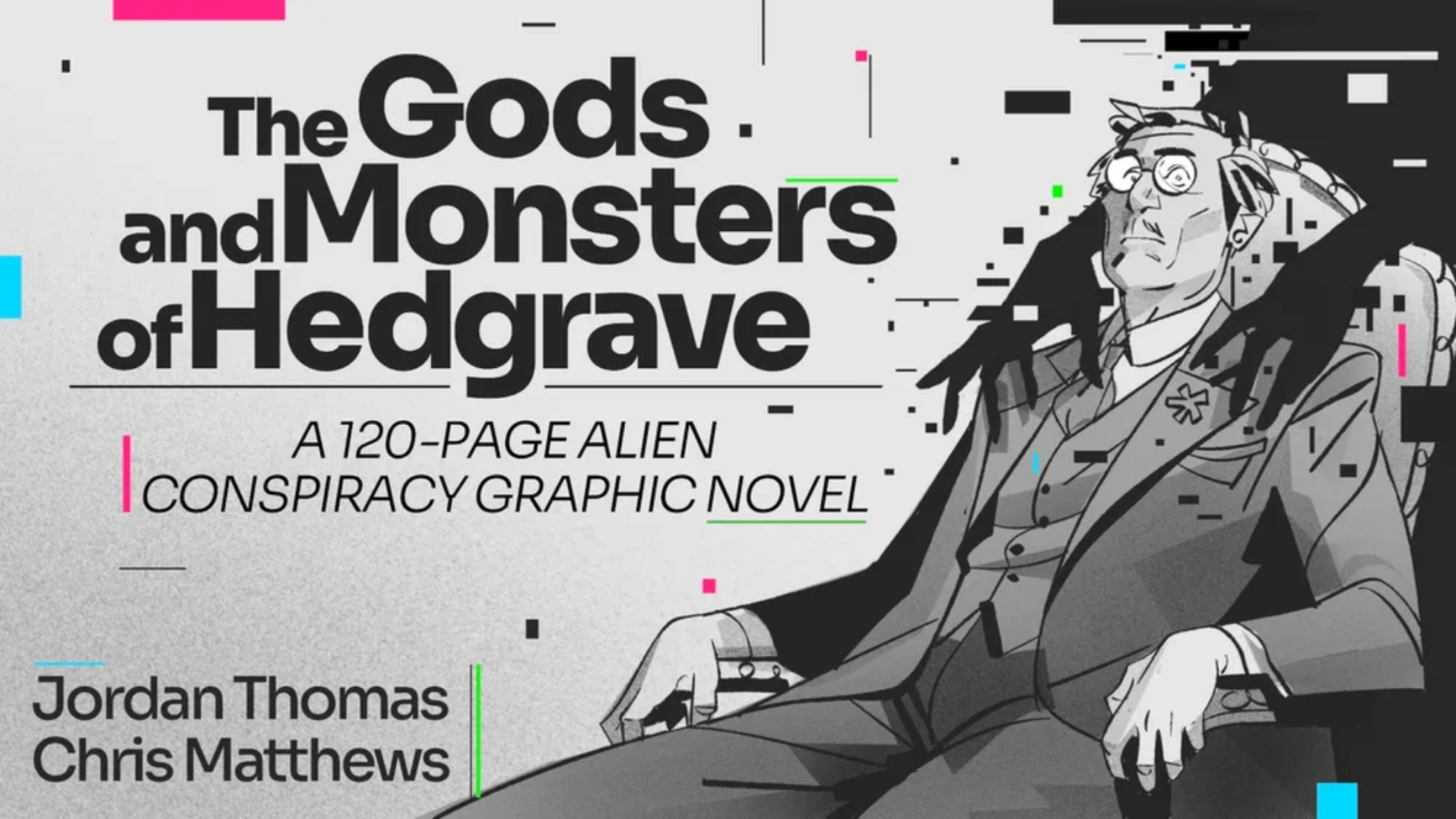

In recent years, writer Jordan Thomas and artist Chris Matthews have made a case as one of comics’ most compelling new duos. They tackled the UK crime circuit with the excellent Mugshots, and then brought Hell to a tropical paradise with the undeniable Exorcism Island. Now, Thomas and Matthews have turned to Kickstarter to crowdfund their latest project, The Gods and Monsters of Hedgrave.
Described as a “120-page alien conspiracy graphic novel, Gods and Monsters of Hedgrave focuses on “horror, obsession, conspiracy, and treachery in England on the eve of the Second World War.” We meet William Wendell, who after years as a mere hobbyist, moves his family to a large estate to join an elite cadre of Britain’s biggest inventors. Only the Wendell family quickly find that this “seemingly life-changing turn events won’t come without terrible costs.”
If you’ve read anything else from Thomas and Matthews, you likely already know that Gods and Monsters of Hedgrave should be a similar mix of peak genre storytelling; immaculate, unnerving vibes; and inventive twists and turns. But this one feels like said twist and turns will be extra confrontational and gut-wrenching, proving that this duo is coming into their own as a couple of comics inventing whizzes themselves.
The Kickstarter for Gods and Monsters of Hedgrave launched yesterday (July 1), and in just a couple hours had already raised over $2,400 of its $23,823 final goal. (The campaign runs through Sunday, August 2.) Ahead of the campaign, we caught up with Thomas via email to ask some of the most burning questions of this still-mysterious project. That includes how the Thomas-Matthews partnership continues to evolve, how Gods and Monsters of Hedgrave relates to their other titles, the effectiveness of William Wendell as a protagonist, and even what to expect from the OGN.
To support Gods and Monsters of Hedgrave head here!

Page 1 of Gods and Monsters of Hedgrave. Courtesy of Jordan Thomas and Chris Matthews.
AIPT: This is now (I believe) the third Matthews-Thomas book. What does the process look like now for developing and executing stories as a unit?
Jordan Thomas: Chris and I met at school when we were 11 years-old, so our collaboration is different to the rest of my work as we’re such long-time friends. We’ll generally fire ideas at each other and see what gets us excited – we probably have six other outlines for books we want to do together already where we’re always chatting about what we could do next.
With this latest book, The Gods and Monsters of Hedgrave, Chris sent me an image that he’d done in black, white, and grey scale of an English-looking village with several flying saucers hovering over it, and told me he’d like to do something with that kind of vibe, so I got working on what the story could be. That was probably three years ago; it actually predates us working on Exorcism Island, so these things can gestate for a while.
Then, once we get going, the story is very much my domain and I just keep in mind what I know Chris is particularly interested and good at drawing.
AIPT: Where does this book rest in terms of genre? Is it more horror, more thriller? Does that distinction matter to y’all at this point?
JT: I’d say it’s a sci-fi horror in an Invasion of the Bodysnatchers-type of mold, with a lot of drama thrown in. The through line of the story asks similar morale questions to something like Breaking Bad.

Page 2 of Gods and Monsters of Hedgrave. Courtesy of Jordan Thomas and Chris Matthews.
AIPT: Where do you think this book “fits” (in terms of feeling, tone, etc.) with Mugshots and Exorcism Island? Are we somehow working in a shared universe here?
JT: Definitely not a shared universe. Mugshots is its own crime universe, where anything that is crime and set in the UK will slot in there. We also have plans for a trilogy of horror books of which Exorcism Island is the first, but that will be more of a trilogy in spirit, like The Cornetto Trilogy from Edgar Wright and Simon Pegg.
In terms of how Hedgrave fits in tonally to our previous work, it definitely has some of the more ominous, creepy atmosphere of Exorcism Island. And then also the family dynamics and traumas that swirled around Mugshots, but is also very much its own thing.
AIPT: The story is about a man choosing between family and fame/power/etc.? Why did this make such a compelling idea, and do you feel like it’s perhaps seizing on some feeling or energy in the here and now?
JT: As mentioned, the actual story was sketched out a few years ago, but I think that’s always been an interesting theme to explore, whether it’s Citizen Kane or Breaking Bad. In a way with this story, the antagonists formed first and then I thought about what would be a really interesting counter-point to them and what relationships would create the most drama. It all started to come together from there.
AIPT: Building off that last question, why choose England of 1934? It was seemingly this weird post-Depression era marked by some big shifts (socially, economically, etc.)
JT: In general, I like stories set in the past as I think smart phones and the Internet kill so many story possibilities. But that time period just really suited the visual tone Chris wanted for the book, and also had really interesting possibilities when you combined the inventors with the idea that World War II wasn’t far away. It’s a really interesting time where the First World War had pushed so many things forward from a technological point of view and it was about to happen again.
AIPT: I always want to talk about Kickstarter. I feel like it both is and isn’t as viable as creators would hope. What’s it actually mean to use the platform in 2026?
JT: I’m as interested to know the answer to that as you are having not run one for around six years!
My feelings is that I wanted to be a new creator taking their first steps on Kickstarter as I was back in 2017 as the influx of major publishers and big name creators has morphed what it is in a lot ways. But in a tough comics market, it is definitely still a fantastic route to allowing extremely talented creators to bring their stories to life without risking their livelihoods, which can be the case in some of the other publishing models out there.
It seems that it is now a very accepted part of publishing and hopefully will mean that comics can be a genuine route to financially supporting yourself rather than having to rely on the unpredictable, always shifting direct market. That’s definitely a good thing, but I also think something may have been lost in terms of how, with social media having been nuked by various soulless people, it’s very hard for a newbie comic creator to get the visibility they need to build an audience.

Page 3 of Gods and Monsters of Hedgrave. Courtesy of Jordan Thomas and Chris Matthews.
AIPT: How do you feel about our “hero,” William Wendel? Do you have some pity or maybe even affinity for him? How much do you try to control and/or influence the audience’s own relationship with William, or do you let us choose instead?
JT: The way I write is to develop an understanding of the characters to the point where they can essentially make their own decisions. I won’t force anything for the sake of making William seems better or worse, but the type of person he is makes him susceptible to vanity and selfishness in a similar way to Harold in Stephen King’s The Stand or some of the characters in Black Science from [Rick] Remender and [Matteo] Scalera.
I have the plan for the story in place, but have only written the first third of the script, so we’ll see what he ultimately does. And, I have had to completely re-write the endings of my previous comics, like with Skin Police, where I got there and realized the plan didn’t work anymore as the characters had lives of their own and demanded different decisions, which is always very exciting and when you really know you have something special on your hands.
AIPT: I’m also curious: why the interest in inventors? I’ve always like that calling was about self-actualization, and all the ways William is described, he seems like a truly odd fit.
JT: William’s problem is that he’s small person who is desperate to be seen, but doesn’t really have any of the attributes that enable that for himself. He’s intelligent, and his interest in inventing I would say initially spurred from a desire for some kind of control. He doesn’t feel much control over his own life, but if he could somehow take control of some of the world’s fundamental building blocks, and force them to things know one else has, perhaps he can fundamentally change who he is as well.
AIPT: The KS asks a big question: “How much of your soul would you trade to make your dreams come true?” What’s it mean to ask this Q in 2026, with AI and feckless Trumpism and actual apps that let you pay people “bounties” to do stupid things?
JT: I hadn’t heard about that final one. That was the story of a particularly unsettling Black Mirror episode a few years ago.
If I’m honest I don’t think the decisions William has to battle with have much in common with Trump or Musk or AI snake oil salesman. Those people don’t care about anyone but themselves, and would have had no hesitation in accepting the devil’s bargain William gets presented with here. In a way, it makes this story a bit of a throwback to a time where there was still enough hope in humanity that people wouldn’t automatically take the awful selfish option and never look back.
I suppose that makes this story something the average person can more relate to, as I still believe that most people (especially comics readers!) have a fair amount of decency in them and are capable of thinking of someone other than themselves. In that way, rather than being about these real-life villains, it’s more inspired by the concept of the other 99.9% of people not taking the easy, selfish route and considering everyone around them before they cast that vote or write that social media post.

Page 4 of Gods and Monsters of Hedgrave. Courtesy of Jordan Thomas and Chris Matthews.
AIPT: There’s some rather interesting “glitches” in the preview art. What can you tell/tease us about those and what it all means?
JT: Chris is always looking to push his art forward, and this is a little addition he’s added to make his already stunning art feel just a little different to traditional black and white comics. The glitches mean the rules of science are being broken, which is rarely a good idea!
AIPT: Do you have a favorite moment or page/panel that gets at the heart of the story?
JT: I’ll stick to the pages we’ve already completed as everything else I have planned is still open to change. So, the opening of the book features a maid from a grand house seemingly trying to rescue a child for an unknown reason. As her plan falls apart and she knows she is likely going to be killed, she does everything she can to put the child’s mind at ease despite her own terror in an act of selflessness, and I think that concept is definitely something our story will wrestle with.
AIPT: Is there anything else we should know about the book, 1930s England, comics, etc.?
JT: Just that it is going to look absolutely stunning. I truly believe that Chris Matthews is the best artist to appear in comics in the past few years, and the way his art keeps getting better book to book is genuinely incredible. I don’t think anyone will feel short-changed when they turn that final page, either from the story or the art.



You must be logged in to post a comment.