


If I could more readily embrace my inner hack, I might just say the following:
“‘Worst Man?’ More like ‘Pretty Damn Impressive Man,’ amirite?!””
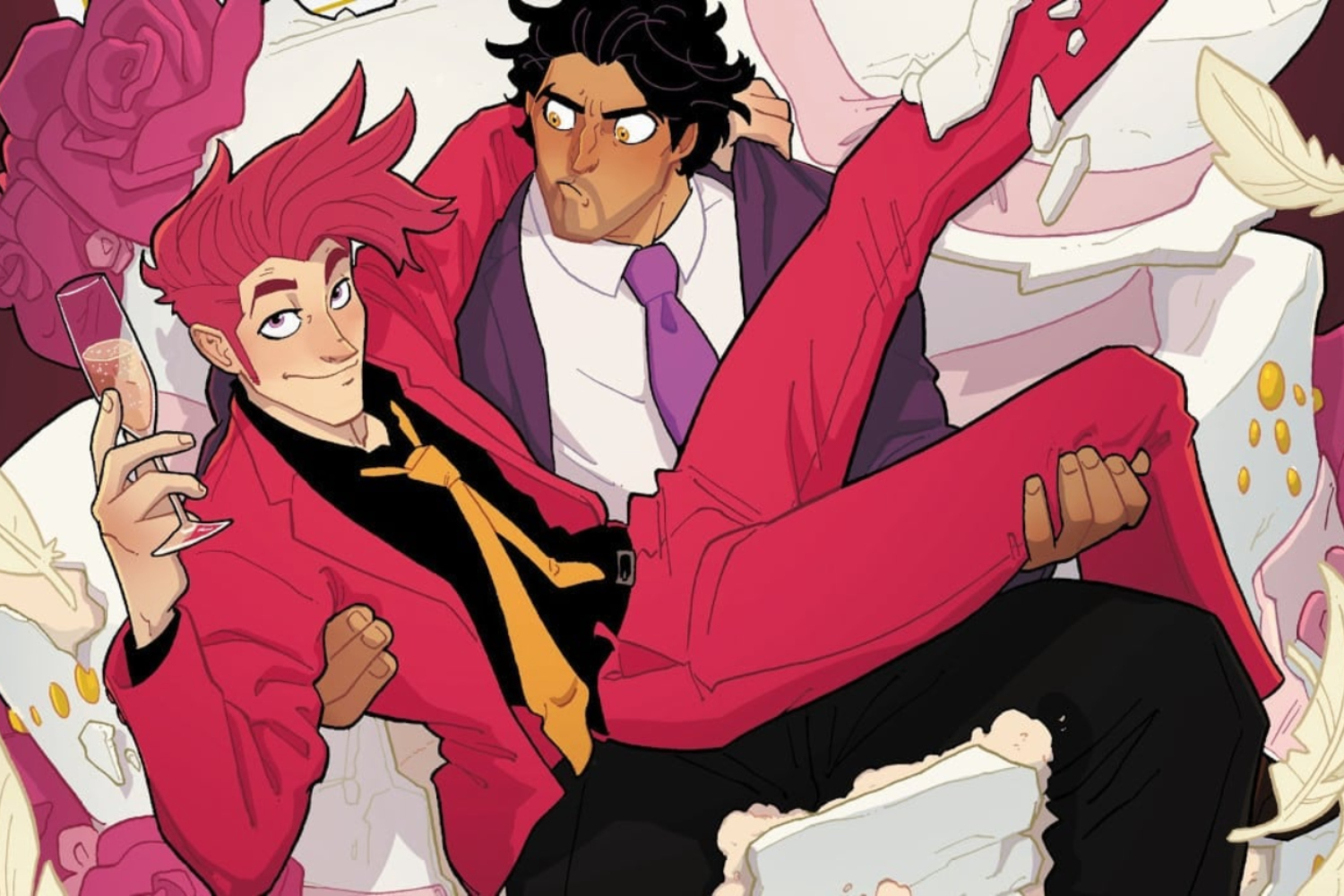
Because it’s true: The pair of Brandt&Stein (Ted Brandt and Ro Stein, the genius comics duo behind books like Crowded) really swung for the fences with their debut OGN. Here, we meet Radcliffe Raleigh, the titular Worst Man, who is hired by friends and families to break up weddings via elaborate ploys. When he botches a job for billionaire Valentina McElligott, Rad suddenly has a meager 32 hours to break up the island wedding of Domino McElligott (ol’ Valentina’s youngest child) and Battista Lovely (who may have the warmest, friendliest name ever).
And from that core premise, Worst Man becomes what press has described as “White Lotus meets Glass Onion.” It’s a madcap dash through an insane weekend, where a multifaceted cast of friends and family butt heads, flirt endlessly, position for new jobs, and generally plot and scheme under the guise of true love. (It’s also a commentary around modern humanity and the encroach of AI, if all the lovey-dovey stuff is somehow too much for ya.) Equally complicated but easygoing, layered but direct as heck, Worst Man is an exploration of love with wit and teeth to spare.
So, yeah, I’m a hack, but it’s a really, really good book.
No Vince Vaughn

Courtesy of Titan Comics.
Like some extra adorable meet cute that becomes a smash rom-com, the premise for their OGN is equal parts kismet and totally adorable.
Added Stein, “We were at a dog walk, and you [Brandt] just had the question of, ‘There’s a best man at a wedding, so why isn’t there a worst man?”
At least they’re honest in that regards. Because despite the movie’s relevance in the press materials, they’ve never actually seen White Lotus. (You may be shocked, but you can’t blame their PR/marketing folks from clinging onto a hot property to sell Worst Man.) At least Brandt&Stein have seen and admire Glass Onion; that reference is absolutely the best kind of shorthand for how Worst Man balances a huge cast, blends satire and farce with poignant storytelling, and is especially strategic in how it tells a rich, multifaceted story.
However, there’s another more vital inspiration, and one that fits the endearing nature of the “love story” within this book.
“It’s more Death at Funeral, actually,” Stein said. “The British version, because we haven’t seen the American version of that one.”
Added Brandt, “It’s got a very Robert Altman feel to it. The camera doesn’t leave the action in that way. It cuts as rarely as it can, and follows people and then bounces off them to the next person as much as it can. It’s not one take or anything, but it cuts as minimally as possible to make it feel like it is all one interconnected thing.”
But there’s one obvious wedding fiction reference you won’t find within Worst Man: Wedding Crashers. Brandt’s never seen it, and Stein said that “it’s been a very long time ago, and I don’t remember enjoying it that much.” Even if only 50% of Brandt&Stein does know the film, there’s another, more important reason it doesn’t factor in despite any genuine connections/similarities.
“A lot of Vince Vaughn films, especially earlier on, are quite mean-spirited. And that is definitely not a vibe we wanted to be shooting for at all,” Brandt said. “We like using books not as escapism necessarily – I’m never quite sure where I sit with that term – but definitely we like people to feel comfortable and to feel like they’re enjoying themselves. And it’s very difficult to have that if the guy that the story is oriented around isn’t behaving well and isn’t sympathetic. That’s a tricky level of buy-in to ask from the audience. And so that isn’t something we’d want to do.”
There’s a lot of love in this book. Weird, manipulative love, sure, but a deep affection and adoration all the same.
Working Hard, Failing Miserably

Courtesy of Titan Comics.
Because while other creators might have seen Rad’s job as an excuse for telling one long, hacky joke, Brandt&Stein took it especially serious.
“Then it was a case of building out what that job could entail and trying to work out how to make an actual profession of it,” Brandt said. “And also trying to work out what sorts of guy would be doing this and why.”
It goes back to the whole Wedding Crashers thing. Those two characters were just mucking with love for their own selfish needs and whims. Our Worst Man Rad has to come off more relatable and approachable, or the book will simply give in to its absolute worst instincts.
“He’d still have to be a sympathetic character on some level because he’s the main character, but, ostensibly, it’s not necessarily a great job,” Brandt said. “So we worked out what kind of code of morals he could have that would make him more sympathetic, but then also, what would make him make do something like this? And the answer was, maybe one time, just once, he did get greedy and go against his own moral code, and it’s come back to bite him in the ass.”
And Rad’s not alone; Stein said Worst Man is a “book full of people trying to do their best, and that has different levels of what that presents us.” Doing your best doesn’t mean things will always work out; it just means you’re doing whatever you can.
“As we said, it’s various levels of effectiveness, various levels of capability, but everyone else is trying their best,” Brandt said. “We truly do believe that most people are trying their best all the time. And sometimes that best looks terrible. But they are doing their best and there needs to be at least some measure of understanding of that.”
And, sure, Valentina is the only character not doing her best. (Stein added that “[she’s] got to have done some therapy.”) But Brandt&Stein maintain a deep understanding of Valentina, and that allows them to explore and distill our billionaire CEO in a way that best serves Worst Man‘s core needs and interest in people-centric storytelling.
“We worked out the full reason why she’s doing what she’s doing,” Brandt said of Valentina. “And not that it’s ever important for the story, it doesn’t ever come into it. But she is doing everything that she’s doing for a reason, at least. It’s not a particularly hinged reason, but it is a reason.”
Added Brandt, “She is a very damaged person who, rather than trying to deal with that in any measure, because she is a billionaire, she’s just trying to change the world to be the way she wants it to be. Because the rich don’t have any functional guardrails or limits on them at any point.”
It’s not just Rad and Valentina that feel so deeply realized almost instantly. There’s Chris Kafka, the best man, who is struggling to keep the weekend going forward while having to contend with a burgeoning, white-hot tension with Rad. Or Merritt, Domino’s sister who may or may not be already acquainted with Rad in a story thread that’s the right kind of salacious. Even cousin Waldo, who is treated with love and respect even if he’s got his own motivations for attending the event.
“He’s got no shame. He’s got no inhibitions. So you don’t have to put too much depth into his thought,” Brandt said of Waldo. “He’s trying to do the right thing, but he never gives too much thought as to what the right thing is. He’s enormously fun precisely because he is not stupid, but he is simple.”
Big Plans and A4 Pages

Courtesy of Titan Comics.
That encapsulation of Waldo is worth revisiting even briefly. Because, on the one hand, it does seem a little direct for a story like this that’s all about the magic of true love. But it’s another instance that Brandt&Stein know their characters so darn well that they can speak to them with the depth and efficiency you would with an actual friend/loved one.
“The cast came out of what we needed them to be for the plot,” Brandt said. “Because it’s partly based around farce, and with that kind of very kinetic motion of characters bouncing off each other and into others…we were trying to work out what would make for fun combinations. Where would good friction be that wouldn’t necessarily resort to being mean-spirited or anything like that.”
In order to nail down these core personalities, the duo created a series of “foibles” to act as a kind of foundation for everyone. That could be, for instance, that Rad is both a flirt and a morally complicated fella, or that Kafka is this anal-retentive type A sort who just so happens to look like a Greek god.
“There’s just a key foible for each of them that that could end up being either an annoyance to someone or an impediment to the plot in some way,” Brandt said. “And then all we really did in order to get their voice down was just assign each of them a character from a film or TV show that we know really well, who has a similar-ish voice. Once we could summon the cadence and rhythm of their speech, it became quite easy to work out what sort of person was talking like that.”
But Worst Man‘s cast isn’t just a series of walking cliches. Stein said that they all quickly “expanded” their respective personalities, adding, “Once we had a rhythm and cadence for how we wanted these people to talk, they departed more from the initial starting off point.” It’s about being just odd and familiar enough, and that letting that develop and marinate in a way that we get a real cast of characters coming together to sort through very messy ideas like romance and family.
Yes, some of that involves pulling from other sources, like the aforementioned pop culture landmarks, and even people in the creators’ own lives. Mostly, though, it had to with, as Brandt described it, the “immersive planning” employed by Brandt&Stein. And we mean really, really immersive.
Added Brandt, “We’re talking full-on maps of the island so that we could map exactly where everyone was at any given moment. By the time we started scripting, we had 16 A4 pages of bullet points of every plot beat, every scene. We had maps so that we knew exactly where everyone was moving.”
And, sure, some of that was about making their lives easier as they assembled their very first OGN.
Added Brandt, “What it meant was that we got a first draft out that hit the exact page count we were asked for, and our editor said, ‘This is technically publishable as is, but I think we can do better on dialogue.'”
However, that kind of development was more about informing the story in ways that actually mattered, and letting them work toward what they really wanted to accomplish.
“Well, building up that much information to begin with actually helps us get the storytelling in the script in that way,” Stein said. “And that’s when we know exactly what’s going to happen, and then we can figure out how we want to do those things. I split it up into, ‘Well, here’s what’s happening, and then here’s how everybody feels about it.’”
Added Brandt, “It’s not so much that the planning is fun; it’s necessary. And then it then frees up all of the analytical stuff, we can stop thinking about that at all and then just have fun with the writing. The emotions and the dialogue were much more improvised…We knew the broad strokes of things in terms of people.”
What you ultimately get with Worst Man, then, is the best of both worlds.
“We knew what each scene had to propel each of the characters in it onto [the next scene], but everything else was up for grabs when we were writing it,” Brandt said. “It was a really fun blend of planning and improvisation that meant that we could feel really loose in very certain areas while we were writing, which meant that it did end up surprising us quite often.”
The Art of Flirting

Courtesy of Titan Comics.
Beyond the actual maps, Brandt&Stein employed other vital tools to make sure Worst Man ran like a well-oiled machine (that happened to be about the chaos inside the human heart). There were some old, ever-reliable writing trips — like “The Witch’s Curse,” for instance.
“That’s where characters are cursed by a witch to desperately want to express themselves and be unable to say what they mean,” Brandt said. “And that’s actually a really good way to guide everything. That’s actually a really perfect way to describe how most people talk, actually.”
They also used Scrivener “to generate something like 2,000 names,” according to Brandt. That one wasn’t just handy, but perhaps extra important to the story.
“We changed Waldo’s name because his initial name was more serious, and we changed it for a couple of reasons,” Brandt said. “And we ended up with a dumber name and it made him a dumber character and he’s much better for it. Waldo Honeychurch is heard to beat.”
(Fret not: Brandt&Stein did come up with one name on their own, the Lovely family dog, Templeton Dandelion Merriweather.)
But mostly Brandt&Stein relied on one another across this journey. While that’s been the case across all of their other projects, they found special challenges in writing a deeply complicated love story while being neurodivergent.
“It’s just because we’re both autistic – and very bad at flirting,” Brandt said. “But we’re big fans of it as a concept. We really like media – whether it’s novels or TV or film – that has flirting and that kind of reaction in it. So we have watched a lot.”
Added Stein, “We’ve analyzed and seen what other people do. We just can’t necessarily do it ourselves.”
It’s not just about flirting, either, and their neurodivergence often carried with it deeper issues and even opportunities in crafting this intricate story.
“I think the thing for me is wondering whether the characters are believable to other people,” Stein said. “Because they feel very real to me.”
So, to overcome their “challenges,” the pair worked together at all times, with Brandt likening them to “a cartoonist with four arms.” But they also knew when to give each other space, and work not as a single unit but also two people in a creative and personal relationship with their own strengths and weaknesses.
“I can’t remember which scene in particular it was, but it wasn’t reading correctly,” Stein said. “And I was saying, ‘Well, this isn’t how you would react.’ And then you’re like, ‘Oh boy, you’re right. This is how this would work.’”
At this point, they started discussing this idea in a way where I really saw their collaboration play out exactly as I thought it would on the page:
- Brandt: “We’re passing the baton back and forth…one of us would do a few pages till we ran out of steam. And then say, ‘OK, I know what needs to happen here, but I can’t see it. Can you take over?’”
- Stein: “And then then the other person would tag in, look through the other bits and maybe make some tweaks. And then figure out where the rest of it was going from that point.”
- Brandt: “It’s also true of the writing – having that second pair of eyes in there makes it a much smoother process because you have that instant thing of, ‘Well, I know that this makes sense to me.’ The other one would read and go, ‘No, I’m afraid not.’”
So, does that mean Brandt&Stein are basically the real-life Rad and Kafka? Maybe. Kinda. Sure?
- Stein: “I think I was the one that kept making the sex jokes.”
- Brandt: “In general, Rad is more me than you. And Kafka is more you than me.”
- Stein: “Except you’re the nerd.”
Roll The Dice

Courtesy of Titan Comics.
There’s only one scene that only one of them wrote alone: the epilogue, where after the wedding is over (however it actually ends, mind you), Kafka and Rad sort out their relationship that’s developed across Worst Man.
“I felt what the epilogue was, and then just typed it all out in one go,” Brandt said. “And went back twice to add another page in to make it read smoother. It was one of those really intuitive things that I don’t get often.”
Perhaps some of that was that the ending really was tailored for a few important functions.
“We wanted an end that felt open and hopeful,” Brandt said. “But, also, in the process of writing the book, we also realized that we do want to tell more stories with them. It was a very good thing that it was open. The aim is two sequels, if we can swing it.”
I won’t dare tell you what the ending is precisely (beyond being “hopeful,” obviously). But while it absolutely explores love and romance, it’s not nearly as life-affirming as you’d expect.
“We don’t want love to be a winning device,” Brandt said. “It’s like Brennan Lee Mulligan said on Dimension 20: ‘If you say that love is the most powerful magic of all, that means anyone who is hurt or loses didn’t love hard enough, and that’s a shitty thing to tell someone.'”
Brandt added, “That’s also a guiding principle for us; we want to celebrate love, but we absolutely don’t want to raise it on an unreachable pedestal of it being this implausible magic whereby we’re saying, ‘You too could be OK if only you loved well enough, but you can’t because you’re awful.’ That’s a terrible thing to say to people.”
Mulligan and the rest of the Dropout team can be felt in another vital part of the book: the comedic heft. Not only does it tie right back into their “disdain” for Wedding Crashers, but comedy is perhaps the best manifestation of Worst Man‘s true ethos. Why it treats its core villains with the utmost sincerity; why it’s so well thought-out and developed; and even why love is both dissected and uplifted all at once. Worst Man is a deeply human expression, and we all deserve to take part.
“Laughing with people is great; laughing at them is not,” Brandt said. “Laughing at them is inherently cruel. Laughing with them is inherently a bonding experience. That’s one of the reasons why we subscribe to Dropout as a streaming service and stay doing so, because it’s very funny and it’s often very vulnerable. But you’re never laughing at the vulnerability. The vulnerability is just doing funny things.”
It’s not just about being “nice,” though. Comedy requires honesty, and simply poking fun of folks ain’t where it’s at.
“Because it’s this thing of…a lot of comedy can be making fun of how people behave,” Stein said. “It’s like, ‘Oh, it’s not making fun of them for how they are; just what they are doing is funny.’ People who are constantly trying to be cool are infinitely less funny than people who are just like, ‘I have problems. I am a mess.’”
Because while it’d be easy to slam dunk a neurotic, sometimes awkward group as this particular gaggle of folks, it would run counter to the very mission statement of Worst Man.
“This book is all about connecting to people,” Brandt said. “It would be really shitty if we then evangelize connecting to people explicitly to hurt them. It’d be nice if more people felt safe enough in themselves…because it is wish fulfillment, as a book, to some extent. It’s like, ‘Things are much more fun if the cards are on the table.’”
Really, Uber?

Courtesy of Titan Comics.
And through that unwaveringly human approach, you get lots of standout moments across Worst Man.
“One of my quiet favorites is the scene of Merritt and Domino talking while the dress is being repaired,” Stein said. “I think that was the one I was most proud of. I really love all of the main thrust of stuff, but there’s something I really like about the small, quiet moments where we just get to really dig into things for a few minutes.”
Added Stein, “For me, it’s the bench in the evening. Rad and Kafka have that conversation, and I think something breaks in Rad during that conversation.”
Given their deep connection to the book (emotionally, logistically, etc.), Brandt&Stein don’t just use this as a form of feel-good storytelling. There’s very much some real-world ramifications attached to the book. It’s why, without also revealing too much, Valentina gets her comeuppance (even if it also bucks against certain “norms” in romance stories).
On the one hand, Brandt said this this form of “justice” was a way to infuse some especially relevant subject matter, adding that the “choice of how she was going to be brought down was just because we f**king hate AI.” He pointed to a company like Uber, who had “burned through their AI budget for 2026 [by April], and as a result, were laying off human workers.”
Added Stein, “So while we’re having wish fulfillment in terms of how the characters can behave, there’s also a thing like, ‘Oh, maybe if we could stop this kind of thing, that’d be great.’”
Similarly, Valentina’s downfall mostly makes sense from a storytelling perspective.
“It’s fundamentally not enough for Valentina just not to get her way here, because she’s still a threat,” Brandt said. “So there needs to be a way of taking her out of the equation altogether as a threat to Rad. Because the book literally opens with her giving him an ultimatum that ends with a death threat. So it’s not enough to simply thwart her wishes. She has to be so undone that she just can’t have the resources or energy to devote to punishing Rad for his disobedience.”
But at the end of the day, it’s about one thing: family bullies suck, and they need to be knocked down a peg or two.
“She’s a menace, and has been to both Merritt and Domino throughout their lives,” Brandt said. “Even if she has been trying her best, no parent escapes f**king up their kid. Having the two of them actually really confront what that had done to them, it did feel important. Even if it’s not strictly plot related, it’s no less important.”
Love and Contracts

Courtesy of Titan Comics.
It may not matter to the plot, per se, but it certainly matters to the book’s creators.
“Realizing that you are carrying the sins of your parents is never a fun realization. And I think both of us have struggled with that at various points,” Brandt said. “It’s a little bit cathartic writing some characters who actually have that moment of confronting that and consciously acknowledging it and trying to move forward.”
That speaks to a defining lesson across Worst Man. Once more, I’ll let Brandt&Stein take it from here:
- Brandt: “Kindness is important. And kindness isn’t being nice.”
- Stein: “Kindness and niceness are not the same thing.”
- Brandt: “And only one of them is truly important.”
- Stein: “Quite often, kindness isn’t polite.”
Which is to say, Worst Man hits extra hard in the ol’ heart-box. It’s a love story where such feelings aren’t the end goal; what is the end goal, then, is being good to others and yourself. It’s a comedy and farce, but it cuts deep with its thematic interests. It’s a little more evergreen, but that doesn’t mean it’s not still timely for right now. (And with any luck, it’ll be a wee bit prescient for our current AI bubble.)
A book called Worst Man is as cute, dumb, playful as much as it’s serious, smart, and unrelenting. If the job of “Worst Man” is less about gimmicks and gags, and more about cutting to the heart of life, maybe we all need one in our lives. Maybe it could’ve led to better business decisions for some of us?
“Early in our career, both before we got into comics and just around that time, I wish there’d been somebody who would have told us, ‘Maybe don’t take the first deal you’re offered,’” Brandt said. “Because that didn’t always work out well for us. Still, I think learning the lessons the hard way wasn’t inherently a bad thing.”
Or, maybe the best kind of “Worst Man” already exists, and they’ve been working their magic all this time.
Is that also hacky? Nah, I’m just an unwavering romantic.
“I was going to say that it would have been very helpful to have a Rad when I was younger to help me figure out how to talk to people,” Stein said. “And I realized that’s basically just what you’ve been doing.”
Worst Man is due out August 25 via Titan Comics.



You must be logged in to post a comment.