

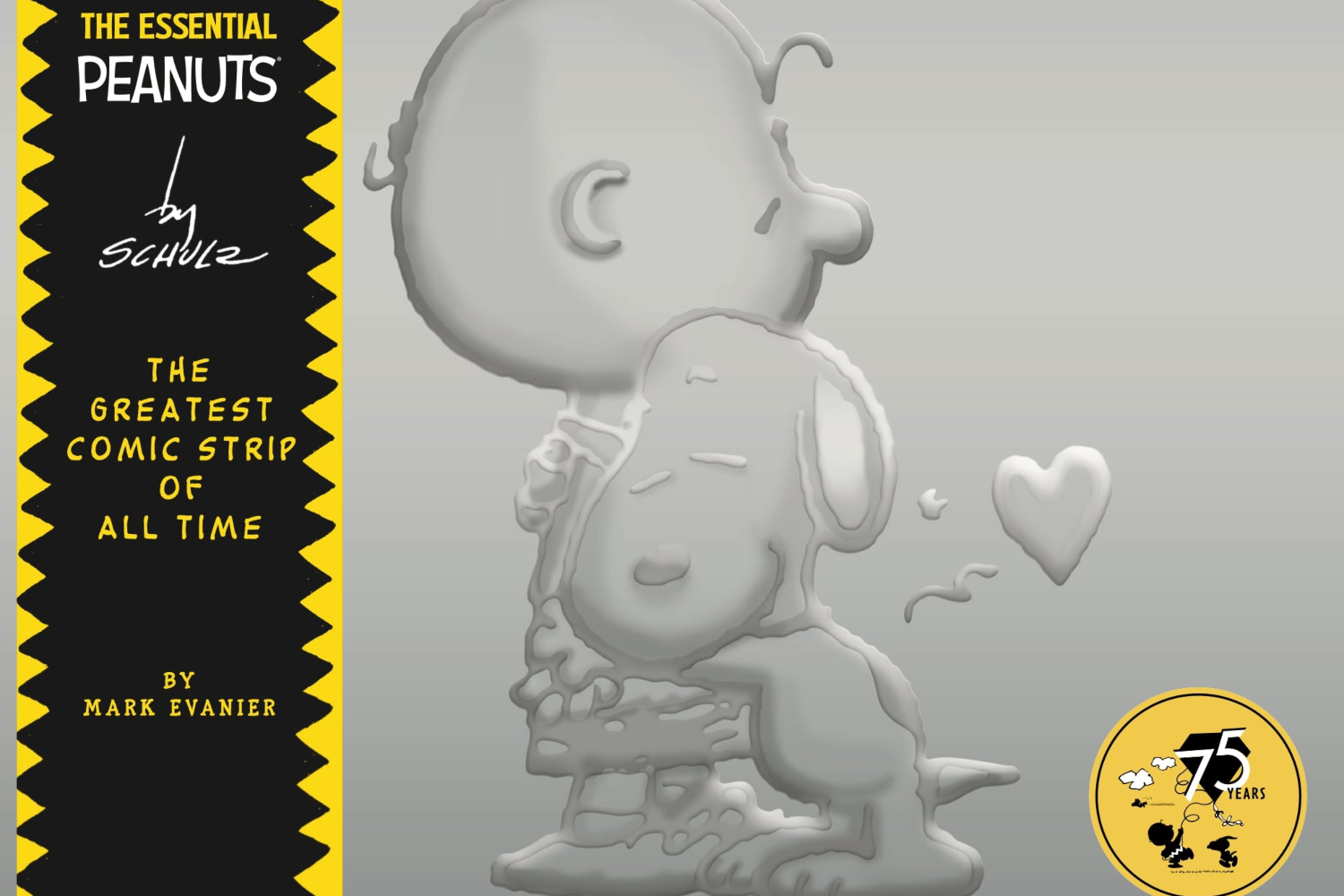

If you’re in need of feel-good comics magic right about now, then you’re in luck. This week (October 7), Abrams ComicArts is celebrating the 75th anniversary of Charles M. Schulz’s beloved Peanuts with The Essential Peanuts.
Written by award-winning comics writer/historian Mark Evanier, this deluxe coffee table collection gathers Schulz’s most iconic and influential strips, framing them with fresh historical and cultural commentary. (That includes an introduction by Patrick McDonnell, a foreword by Jean Schulz, and insights from 16 commentators.) The book offers not only timeless laughs but also a singular perspective on how Peanuts has resonated with fans of all ages across all decades.
And it ain’t half bad to look at, either. Designed by Chip Kidd, the collection comes packaged with a portfolio of collectible ephemera, including postcards, prints, stickers, an embroidered patch, and a facsimile comic. With so much rich history at your fingertips, The Essential Peanuts is both a celebration and a rediscovery of Schulz’s robust legacy.
Recently, I spoke with Evanier all about this celebration of all things Peanuts. That includes the challenges of selecting from such a vast body of work, why Peanuts still feels like family to so many readers, and what Schulz himself might have thought of this wondrous milestone.

Courtesy of Abrams.
AIPT: When you set out to choose which Peanuts strips belonged in The Essential Peanuts, what criteria guided your decisions? Were you aiming for the most famous moments, personal favorites, or strips that best highlight Schulz’s evolution as a cartoonist?
Mark Evanier: I didn’t pick out the strips by myself. The folks at the Charles M. Schulz Museum gathered up a committee of Peanut experts and we all contributed our thoughts. I don’t know about the others but my main considerations were (A) strips in which Schulz introduced something new that had a long, long life in the strip or (B) strips that made me laugh. A few strips, of course, fell into both categories.
AIPT: With such an expansive body of work to draw from, how did you balance including the “greatest hits” that fans expect with lesser-known strips that might surprise or delight readers?
ME: I think you have to approach a selection process like this with the knowledge that no matter what you pick, someone is going to descend on you in outrage shrieking, “How could you leave out…” and then they’ll tell you about their fave strip(s) of all time and suggest you’ve committed newspaper strip malpractice. Since I didn’t have the final say on this, I intend to tell everyone who complains, “You’re absolutely right,” and then I’ll blame everyone else involved. And they’ll probably be blaming me.

Courtesy of Abrams.
AIPT: Charles Schulz once said that true art speaks to succeeding generations. In your view, what is it about Peanuts that continues to resonate across decades and cultures?
ME: We just love those characters. That’s really all there is to it. They became an important part of our lives – in my case, when I was about eight or so. They’re so human and so interesting and often so funny that they’re like an extended family to some of us. And you never forget your family, even when they’re extended.
AIPT: This book doesn’t just present strips but also includes historical and cultural commentary. How important was it to you to place Schulz’s work in the broader context of its time — and what do you hope modern readers take away from that framing?
ME: Well, that was kind of the assignment – to place the strip in the broader context of its time. I don’t see the point of doing a book like this if you’re not going to do that, because obviously, we could have just filled the book with Peanuts strips and a lot of people would have been delighted. But the one thing the strips themselves can’t give you is that sweeping sense of perspective and the answers to the questions you just put to me.
I loved doing this book because it gave me an excuse to reread Schulz’s amazing body of work in sequence and then to spend a lot of time debating with myself as to the significance of it all. As with Charlie Brown, when I debate with myself, I usually lose, but I just hope I got enough of it right.

Courtesy of Abrams.
AIPT: The Essential Peanuts also features contributions from Patrick McDonnell, Jean Schulz, and 16 other commentators. How did their perspectives enhance or complement the vision you wanted for this project?
ME: I was going to say, “They filled up a lot of pages so I didn’t have to,” but the truth is that there’s no one right way to look at a body of work like this, and it was important that the book have points of view other than mine. It was interesting to see what it meant to them and how it became an important part of so many lives. When the book comes out, I look forward to hearing a lot of people tell me about the vitally different impacts that Mr. Schulz and his friend had on their lives.
AIPT: The anniversary edition includes ephemera like postcards, stickers, prints, and even a facsimile comic. What excites you most about these extras, and how do they deepen the reader’s experience of Schulz’s legacy?
ME: Schulz’s legacy is not just in the strip but in what the entire Peanuts franchise meant to so many lives. I remember hearing him say how proud he was when he saw someone wearing a Snoopy t-shirt or carrying a Linus notebook…or anything indicating that they considered his creations as part of their lives. The stickers, comic book, and other goodies represent that.

Courtesy of Abrams.
AIPT: As Peanuts celebrates 75 years, what do you think Schulz himself would make of this milestone and the ways his work is still being celebrated, rediscovered, and reinterpreted today?
ME: I think he’d modestly say – if it’s possible to say this modestly – “This is what I expected!” At least, I hope he knew that what he did would never be forgotten.
The Essential Peanuts is available in comic shops and book stores everywhere.



You must be logged in to post a comment.