

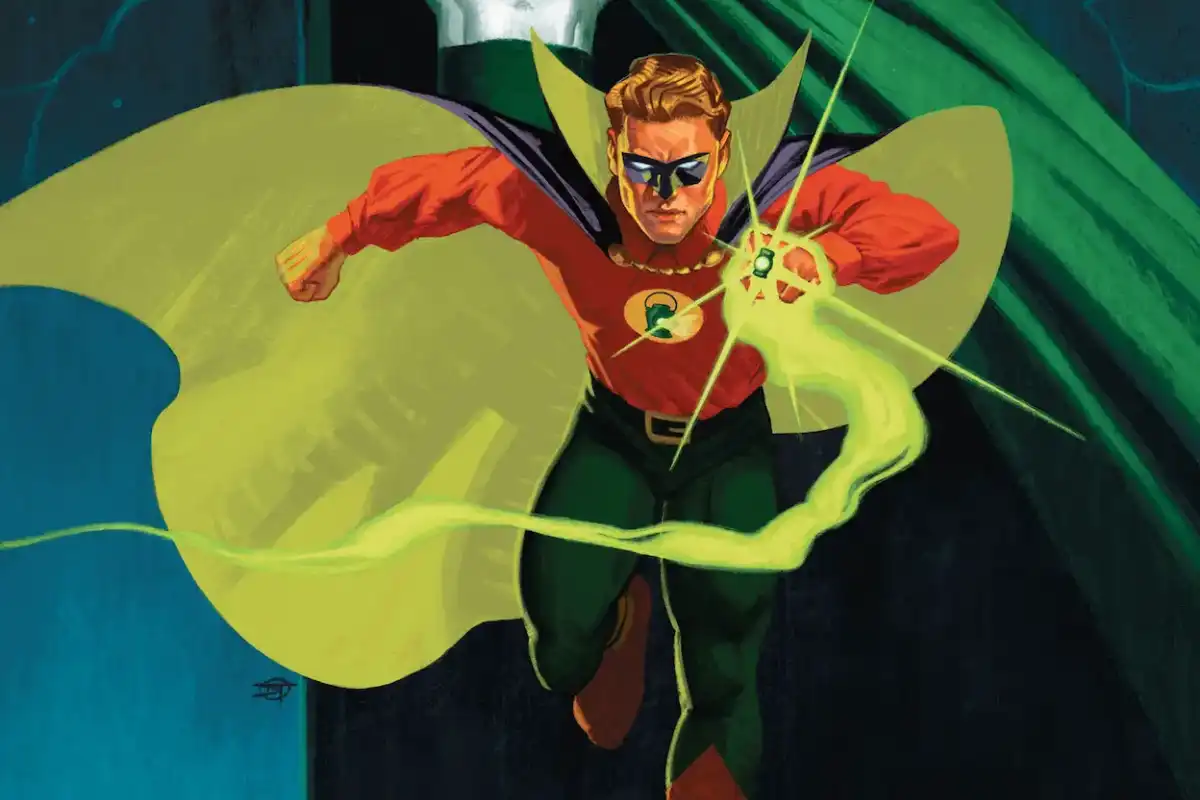

In any comic book, retcons present a complicated reality. On the one hand, decades of continuity establish one thing. On the other, a recent issue from five years ago decided that it would haphazardly thrust an entirely new element into a long-standing narrative. Future writers need to somehow mix both the original concept and the renewed one to create a fundamentally comprehensible work. Unsurprisingly, Alan Scott: The Green Lantern #3 manages that balance perfectly.
Alan Scott was not originally intended to be a gay character, and it was only in 2012 that DC decided that the character would officially be retconned. That change came decades after his first appearance in 1940. Tim Sheridan, Cian Tormey, Matt Herms, Chris Sotomayor, and Lucas Gattoni easily could have tripped in weaving this retcon into his backstory, but they continue to prove that Alan Scott: The Green Lantern is one of the best comics DC is publishing right now. They are genuinely the reason that this retcon works so well for Alan’s character.
Instead of leaving Alan to interact with the supporting cast from this series, he is instead given the chance to speak to Jay Garrick and the Spectre. Each somehow serves to represent Alan’s entire spectrum of interactions with the Justice Society — both before and after the retcon. There is resentment, isolation, and yet a feeling of genuine belonging and connection that appears to drive him to them again and again. If the original Green Lantern’s time with the Justice Society was ever baffling, given his solitary nature, Alan Scott: The Green Lantern #3 explains away those issues with ease.

DC Comics
While Jay plays an essential role, he gives the spotlight to Alan whenever he can. The Spectre, meanwhile, is another story entirely. He steals the show the moment he appears, and it can be easy to forget that this is Alan Scott: The Green Lantern and not Jim Corrigan: The Spectre.
That being said, it’s hard to say that the change is a disappointment. The Spectre’s interactions with Alan convey a deep-seated sense of empathy that makes Corrigan genuinely compelling. Still, it is a somewhat stark departure from other, much darker portrayals of the Spectre. The time period does help to explain that difference, but it is very much a jarring change.
Yet, while the Spectre does play a key role in Alan Scott: The Green Lantern, it all ties back into Alan’s story brilliantly. While the Green Lantern regularly stoops to well-justified cynicism, the Spectre adds a hint of realism to the narrative — despite the absurdity of realism coming from a man in a green cloak and briefs. He puts together the mystery in a way that Alan can’t. He is a detective, while Alan needs the story to be spelled out for him before he can act.
Characters as powerful as a Green Lantern need to have flaws. Alan’s inability to solve the mystery gives him a flaw much less absurd than a weakness to wood. It feels realistic and presents the idea that Alan may have other blind spots, such as his belief that the police are justified in prosecuting gay people simply for being gay. It’s a realistic way of developing a character in the period, and it’s a flaw that modern readers can recognize as tragic. It also explains why it took Alan so long to come out of the closet. In that way, it mixes the retcon with the original work in a fulfilling and completely believable way.

DC Comics
As for the twist at the end of the issue, it presents a major challenge for Alan going forward — and a challenge for Alan Scott: The Green Lantern as a whole. After all, as much as the Red Lantern’s identity reveal is compelling, it does feel somewhat derivative. After all, without revealing the twist, a long-dead character suddenly reappearing with a close connection to the Russians does feel a little too much like Marvel’s Winter Soldier reveal.
Still, the emotional undercurrent is what matters most. While not overwhelmingly predictable, it’s easy to see where this story will take Alan, and it’s a direction worth exploring. A book like Alan Scott: The Green Lantern can get away with some cliched elements, because the tension primarily lies in the character interactions. It’s the reason that Alan’s argument with Jay worked so well.
The art also helps to elevate the book, even without this issue having any major fight in it. Every character is subtly expressive, and the ebb and flow of light and darkness fits with Alan’s obsession with the concepts. There are some issues with the art, unfortunately, as some panels are unnecessarily reused and backgrounds are scrubbed away. Compared to Alan Scott: The Green Lantern #2, it just feels slightly more rushed. All the same, it works to effectively communicate both character emotions and motivations.
Alan Scott: The Green Lantern #3 is a case study in effectively retroactively integrating new continuity into an old narrative. While it never truly lives up to the impressive heights of Alan Scott: The Green Lantern #2, it effectively establishes Alan’s place in the world and in the DC universe. It also fills in holes left by other stories, while opening up new routes for Alan to take going forward. What more is there to ask for?




You must be logged in to post a comment Login