

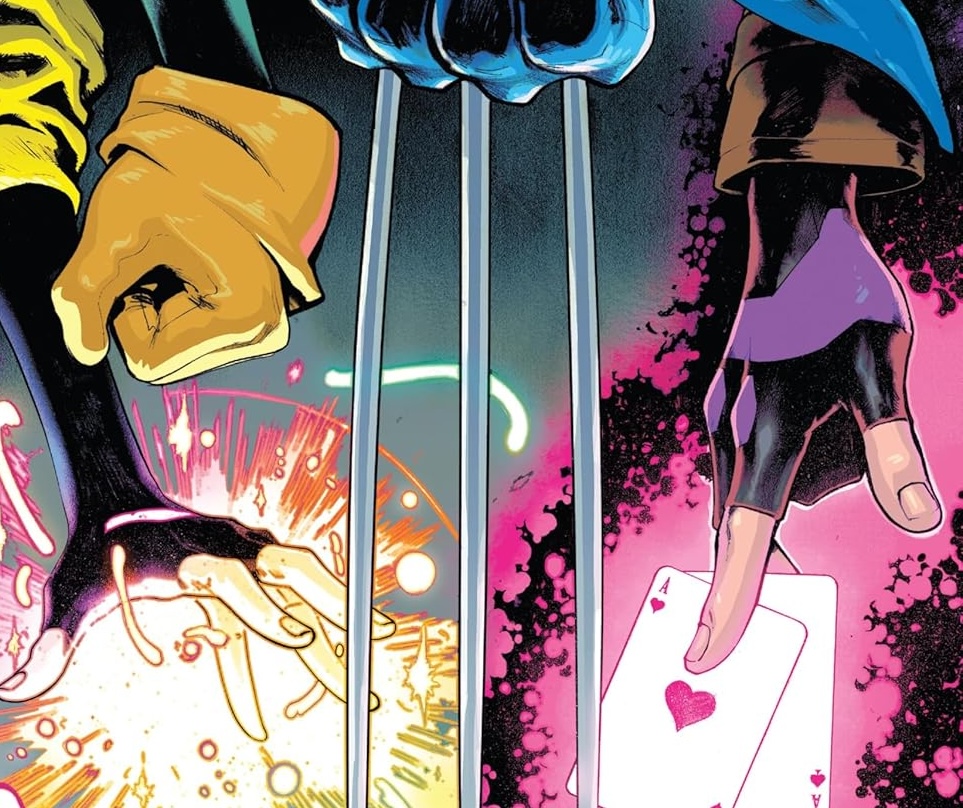

For some readers, the dust feels barely settled after X-Men #35/Uncanny X-Men #700‘s tumultuous finale to the First Krakoan Age. However, we find ourselves already knee-deep into the FROM THE ASHES relaunch: four titles have already crossed the starting line and today marks the debut of the second flagship X-Men book, Uncanny X-Men #1. Gail Simone, David Marquez, Matthew Wilson, VC’s Clayton Cowles, and Tom Brevoort are the creative team behind the strong opening issue, titled “Red Wave.”
The X-Men as a team or series of teams in the Marvel Universe have had countless leaders over the years. Most recently the role was filled by Synch and Talon, and in bygone eras, the likes of Cyclops, Jean Grey, Storm, Wolverine, Professor X, and Magneto have assumed the position, among others. More often than not, the leadership role is occupied by a mutant with particular mutant politics, be that of separatism, assimilation, etc. Out of all these criteria and context, Uncanny #1 lands on an unexpected contender for the new leader of the X-Men: Rogue. The real kicker is that it works, and does so quite well.
It would be disingenuous to act as if Rogue has never led a team of X-Men before, but such outings were not famous for their success in the field or sustainability as a long-term squad. The iconic leaders of the X-Men lead out of some need, either internal or external to themselves. Scott Summers leads the X-Men because he needs to fill the role he was raised to play. Ororo Munroe takes the reins because she sees that Scott and Charles’ egos are hampering the team’s effectiveness. So why does Anna Marie LeBeau need to lead the X-Men? Simone and co.’s answer: the X-Men is all Rogue has left.
From bombastic battles with Sadurang the God-Snake to tender moments with a Children’s Hospital hospice patient, Simone injects Rogue with an abiding sense of insecurity. Hyperaware of nonverbal cues from Logan, Gambit, and Nightcrawler, and wracked with existential questions about life after losing Krakoa, Rogue may be doing her best to stay calm and collected, but she’s deeply unwell. Despite being her foremost followers, Remy and Logan tug on this thread, suggesting to her that maybe they just need to be for a while, not be an X-Man. Having spent nearly her entire adult life as an X-Man, Rogue’s tragic irony here is understandable. She doesn’t know how to be anything else than an X-Man, even though being an X-Man is what has brought her to this place of nothingness.

wooimbouttamakeanameformyselfere
Credit: Marvel Comics
Where other mutant ideologies form out of praxis, theory, or capital, Rogue’s politics come from a place of passion, and compassion to be even more specific. Uncanny #1 fleshes this out deliberately; “because of the kid. Because of Harvey,” the reality that mutant children are still suffering is why Rogue cannot give up on living, and the only way she knows how to address that drive is by being an X-Man.
The majority of Rogue’s stories do not take time to reflect on her political bent. Her most seismic shift in ideology was defecting from the Brotherhood’s mutant terrorism to the X-Men over forty years ago. She’s morally flexible and not someone who enjoys debate, so approaching Rogue from the heart first is a deft move. In the issue’s afterword, Simone notes that her thesis for Rogue positions her across from Cyclops as the heirs to the spectrum between Xavier and Magneto. Of course, Jed MacKay’s Scott Summers is not seeking militant separatism, rather applied actions for mutant liberation and dismantling humanist supremacy. In the same way, Rogue is not calling for the assimilation of mutantkind, but rather seems to be a sort of superhero social worker for mutants. Summers and LeBeau are evolving on what came before, and the conflict that may arise will be fascinating to watch.
Simone’s writing is married perfectly with Marquez and Wilson’s art. Marquez is so skilled at capturing small nuances in emotion for heartfelt character beats, yet he also soars at big creature-feature action: feathered serpent Sadurang atop Teotihuacan? *chef’s kiss*. Wilson’s colors add warmth and light to the issue, as well as a texture that makes the setting and characters feel real and tactile. Marquez and Wilson also get to tease a motherly monster and introduce this book’s new class of young mutants, and both scenes are a treat. The entire creative team is a wealth of talent, and they’re making sure that readers get their money’s worth.
There’s not much in the way of flaws here, as long as you know what you’re in for: a character-focused issue from Rogue’s POV as she goes about defining what it is to be an X-Man after Krakoa. If you’re looking for a grand reintroduction to the franchise and set stakes for the successes and failures of mutantkind en masse, then this is not the book for you. It’s still good, just not what you’re looking for. It is a bit silly to see Logan join up with Remy and Rogue after giving Scott the whole “I can’t start over from zero again” spiel, but it is not a failing of the issue per se.
For the X-Men fans burned by the loss of Krakoa, you’re not alone. Rogue is just as hurt by it (if not more since she got to live there). It may seem silly from the outside, but it is a comfort to see our heroes grapple with the same sense of loss rather than be played for laughs; this theme is prominent throughout FROM THE ASHES books so far, but none so clearly as here in Uncanny X-Men #1. If that’s not enough for you, Gambit’s victory over the God-Snake is wily and fun, and there are ominous new threats–human and nonhuman–on the horizon that may pique your interest.




1 Comment
You must be logged in to post a comment Login