

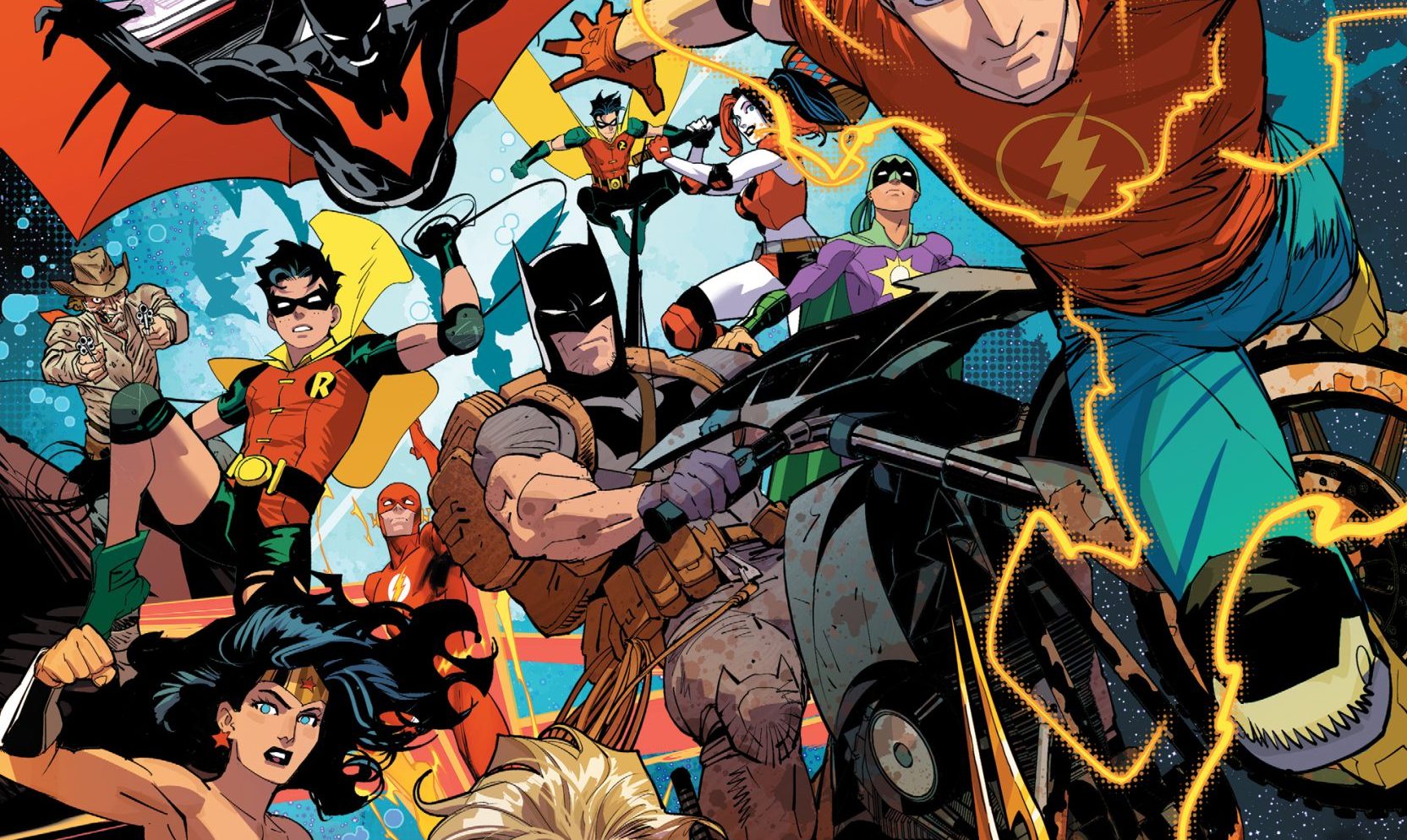

“Who are these lackwits, you ask? Champions drawn here from other eras by Air Wave, believing themselves to be the cavalry. If the heroes of our world have one common characteristic, after all, it is inopportune timing.”
With the first crossover of DC’s All In initiative drawing to a close, we’re treated to a literal battle of the ages as heroes from all the heroic eras make landfall to fight the Legion of Doom and stop Gorilla Grodd’s master plan. Though the crossover has had some issues with pacing, this issue gets right to the point of the matter with nonstop action and unlimited heroes on the page. And though it’s a satisfying conclusion to a somewhat convoluted story, we can’t help but wonder what purpose it served in the grander scheme of things.

DC
With the modern leaguers scattered across the timestream, a ragtag group of heroes gathered by Air Wave enters the fray, including but not limited to: Batman Beyond, Zero Year Batman, Barry Allen in his first year as the Flash, ’90s era Wally West and Aquaman, New 52 Harley Quinn, Jonah Hex, and Superman’s forgotten sidekick Boy Thunder, himself a Waid/Mora creation from World’s Finest. Hero mashups are always fun, and this one is no exception. Though however entertaining it is, it is also rather hectic and occasionally wooden in execution.
Despite Waid’s efforts, the script feels a bit narrow. In the most simple terms, it is heroes versus villains, the classic charade and all. However, much of the dialogue and action feels like the creators are just playing with their action figures. For an event conclusion, it leaves much to be desired, and often rings hollow until the final pages actually give the reader something to look forward to for All In’s future. But sadly, the rest of it, as gorgeously as Mora draws it, is mostly just Waid and his toys. It’s like watching a Robert Rodriguez movie, stuff just happens but at least you’re having a good time.
And to that effect, we must once again highlight the work of Mora and Bonvillain, who illustrate the hell out of these characters. These old designs are perfectly adapted, retaining the precise feel of the eras they represent without losing visual sync with the contemporary setting. Regrettably, it should be noted that the panelling in this series is far more traditional than the art team has previously done in World’s Finest, which is more free with its blocking. Though this works for what is essentially the flagship DC action book, we think the series could benefit from taking such queues from its spiritual predecessor, especially to accentuate the unique visuals from each era for each hero.

DC
The most consistent arc of this crossover was Air Wave, who was teased as a major player at the very beginning of this series, and that has been delivered upon just half a year later. His retribution with the League after having been duped by Grodd is a touching focal point for a story that plays with so many characters and eras. For a book that emphasizes its massive cast of popular characters, it makes sure to present them through the eyes of the team’s greenest underdog, who happens to be the main vehicle of the story. Though it’s easy to lose track of the cast, the emotional core is strong enough to make up for it.
With all of this said, Justice League Unlimited #8 is a convoluted conclusion to an equally convoluted crossover. It certainly has its saving graces and its heart, even if it can get lost in the superheroes versus supervillains of it all. One of those graces is in its final page, which gets the ball rolling for the next exciting chapter of the All In saga. Comics can often get stale if all you’re waiting for is the next big thing, but for all its flaws, the event does end up justifying its existence as the overarching time travel story gradually becomes more apparent. Perhaps it’s time for a different kind of DC crisis.




You must be logged in to post a comment.