

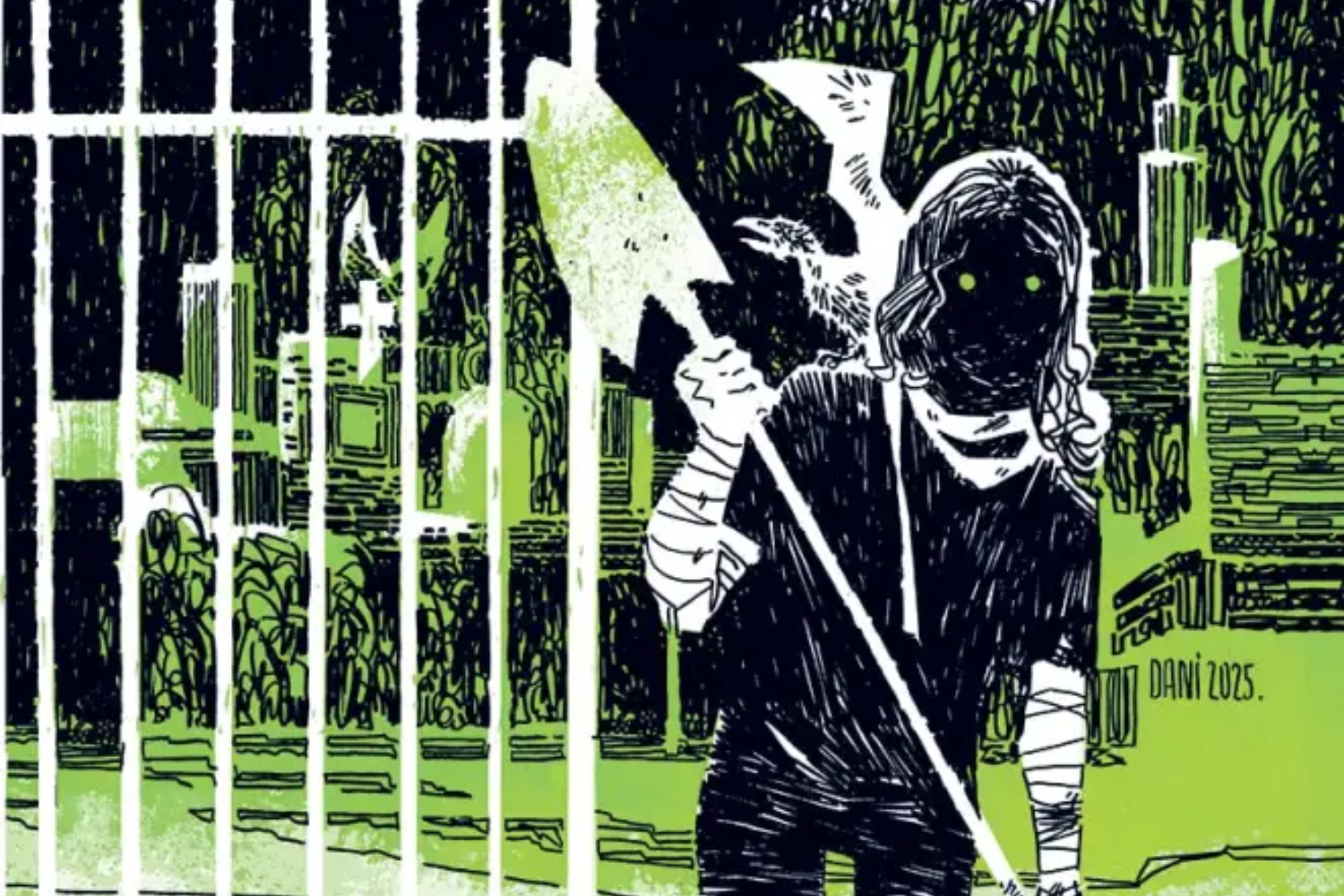

What happens when heroes die, and where’s that leave the rest of us?
That’s one of many key questions raised by ATHANASIA, a brand-new graphic novel we happily announced back in June. Here, writer Daniel Kraus and artist Dani introduce us to Forrest Molson, a newly sober graduate forced to work at the family business. But this ain’t no cobbler or sandwich shop — the Molsons serve as groundskeepers at Athanasia Cemetery, where Venture City’s greatest superheroes (the Dynamic Guild) are interred. But one day, Forest discovers a mysterious chemical oozing from the cemetery grounds, and it will not only test her sobriety but give her bizarre powers that could bring Venture City to its very needs.
Described as a “superhero story seen through the darkest lens,” ATHANASIA is very much for fans of everything from Chronicle and Darkman to Kingdom Come and Black Hammer. It’s 256 pages that expertly combine massively personal storytelling with a through dissection of the superhero mythos, giving readers some intriguing insights into how ideas of power, legacy, and personal responsibility all swirl together. And while it never once pulls its punches (at all), ATHANASIA feels oddly hopeful as it lets us explore how we all play the heroes and villains in our own life, and what we can do to make our lives worse or fight for something else entirely. Bring a cape and a shovel if you’re really gonna get into this one.
ATHANASIA is due out next week (October 7) via Vault Comics. In the lead up to the release date, we spoke with both Kraus and Dani via email. There, we discussed the idea of spoofing or satirizing heroes, the book’s core influences, why the opted for an OGN over the single-issue format, the family dynamics at the book’s core, and their favorite moments, among other topics and tidbits.

Courtesy of Vault Comics.
AIPT: I want to start with the idea of spoofing or satirizing superheroes and how it’s been done so many times before. Did that fact almost deter you from this book, or did it make you more inspired to do something truly novel in this “genre”?
Daniel Kraus: I definitely wasn’t interested in spoofing in the sense of anything humorous. The truth is, I’m not especially interested in the superheroes of ATHANASIA at all! The superheroes here are like the shark in Jaws or the zombies in Night of the Living Dead — they are the catalyst for a human story that exists off in the margins. I remember being a little kid watching the Richard Donner Superman movies and getting worked up about the people who got caught up in the super-fights between Superman and Zod, and so forth. Humans like to tell stories of battles but usually from the perspective of the high-level people making the battle decisions. I’m far more invested in the people who get caught up in the crossfire. In a lot of ways, being caught in a crossfire is the pervading story of this era of human history.
Dani: I don’t believe that this book concentrates on superheroes that much. Sure, they are a big part of the story but they are never fully there, we just see their impact on the main characters and the world. When Daniel approached me with this project, his promise was that we would do a “superhero” book without superheroes and this excited me, it definitely added an extra point for me to choose to get involved in the book.

Courtesy of Vault Comics.
AIPT: Is there one satire of superheroes that influenced this book? Maybe some book/film/TV show/comic with which it shares DNA? I feel more Powers than, say, Watchmen.
DK: I haven’t read Powers or Watchmen. The content of superhero media didn’t affect me much in ATHANASIA because I haven’t seen or read most of it. It was more the omnipresence of superheroes in our modern culture that inspired the story, how it seems to overwhelm people’s attentions, sometimes at the expense of other things. The influences on ATHANASIA came from different directions — Stephen King’s Pet Sematary, the true story of Chernobyl, and so on.
AIPT: Dani, you approach the heroes here in a novel way — it feels very Silver Age but also very intense and dramatic (I kept thinking something akin to Sandman perhaps). What inspired you to depict the characters/heroes like that?
Dani: We agreed to show all superhero scenes in this classic comics style and give the reader the chance to read about them and their adventures as if they were in the book reading Forrest’s old issues. I usually navigate through the projects I work on by instinct depending on what feelings the script creates in me and then I just try to pass this feeling on to the reader through my art choices and this time is no exception. My favorite part is the tragic flashback of Naomi’s story where I copied my own style in a comic I had drawn back when I was a kid. Figured that it would be interesting to depict Forrest’s memories and trauma of that day through childish drawings, a way to make time stop at that moment.

Courtesy of Vault Comics.
AIPT: I think the both of you individually wouldn’t be the first names I’d throw out for a new superhero title. What does that “outsider status,” if you will, lend you when approaching this story? Do you have insights that maybe other creators might not?
DK: You can say that again! I am the least likely writer in the world to do a superhero story — which is precisely why I wrote one. You’re right that I’m hoping my outsider status leads to some originality or freshness, but that’s up to others to decide. All I know for sure is that I’m coming at them from a different space, having not grown up with comic books and having no nostalgic connection to them. It’s notable that I’m not really writing about living superheroes. I’m writing about their dead, rotting bodies. To someone like me who doesn’t follow superhero media, superheroes feel overbearing — they are everywhere! — which is exactly how Forrest feels in ATHANASIA.
Dani: I’ve worked on various genres in comics, including superhero but my origins as an artist are in horror and noir and most of the times this flows in my work no matter what project I’m working on. Feeling that this was a great match with Forrest’s story as it is a tragic and dark one.
AIPT: How would you describe Forrest in this book? Is she a good kid “gone bad,” or is it deeper than just that? Do you have a certain pity or affinity for her?
DK: I have great affection for Forrest! I wouldn’t say she’s gone bad any more than I’d say anyone battling with addiction has gone bad. She’s fighting — she’s a fighter — just a different kind of fighter than the ones who wear capes. A real truism in life is that absolute power corrupts absolutely, which seems very relevant to any story involving people with superpowers. Forrest’s reaction to having sudden powers is to get high on them, both in literal and metaphorical senses. She begins to think she can do no wrong, which is how I think it would go for most people. But even at Forrest’s worst, I’m rooting for her.

Courtesy of Vault Comics.
Dani: Forrest felt quite familiar right from the first pages of the script. She is a good kid, with good character qualities, she just feels like she’s going through everything on her own and that’s how she ends up reacting the way she reacts and getting into this vortex of addiction. And that is how addiction works really, it just fills in a gap.
AIPT: Why does this story work out better as a graphic novel as opposed to single issues? I keep thinking single issues are also a great way to satirize superhero comics.
DK: I always saw ATHANASIA as a story I wanted to present in a single movement. I took a very novelistic approach to writing it, which is a slightly different approach than writing issue-to-issue like I did with The Autumnal, where each issue needs to have certain mini-arcs, cliffhangers, etc. My instinct was to stretch out a little bit more. I also suspected there wasn’t going to be any colors in the early part of the story, yet I wanted readers to know that color was coming — a tease you can automatically achieve when idly flipping through the graphic novel.
Dani: I’m really not a fan of single issues and always wait up until the trade is out so I can read the full story on my rhythm and terms. ATHANASIA works better as a graphic novel because of the way it unfolds and, frankly, this book for me is not a satire of the superhero genre, the whole heroic part is just a thing to step on in order to narrate a family’s tragic story.
AIPT: Was the addiction “angle” always part of the story? Or, how did this “gimmick” of a superhero graveyard become this oasis for an addiction narrative?
DK: The graveyard came first: I thought it was an evocative setting. But it probably took five minutes for that setting to inspire the addiction idea. I’ve been obsessed with the Chernobyl disaster, and other toxic accidents, since I was a kid. So the idea of the ground itself being poisoned by decomposing superheroes felt pretty natural to me.

Courtesy of Vault Comics.
AIPT: Do you have a favorite moment from the story? Some page or panel that truly speaks to the heart of it all (and why that instance)?
DK: To me, the dark heart of the book is when Forrest uses one of her new powers to bring her baby sister back to life. It goes in a very ‘The Monkey’s Paw’ direction, which is to say it’s horrifying, but more than that, it’s heartbreaking. It’s the moment that breaks Forrest and pushes her into a kind of psychosis. I think it breaks the reader a bit, too.
AIPT: I keep thinking about the timeliness of this book — a character wants to break free from a system overseen by “elites” that traps them. Did you intend on that? Does that add a new dimension to Forrest’s experience?
DK: That’s probably a function of any story about class struggle. Forrest and her family are living paycheck to paycheck in a world where the superheroes — and the people who make money off them — live in literal towers that loom over the city’s forgotten neighborhoods. These citizens have been forgotten. So naturally they are angry.
Dani: I feel like this “elite/working” class dynamic definitely plays a major role in the story and adds to Forrest’s experience and struggles with the world since most of the Molson family’s problems stem from their financial situation. We can even notice it in the way Forrest’s father is coping with his health problems.
AIPT: In addition to Forrest, the book includes her dad and grandpa. What’s interesting about this larger family dynamic? And what does this intergenerational aspect/component add to the overarching story?
DK: One of the themes of the book is breaking cycles that are so old we barely feel them anymore. Forrest sees the injustice and unfairness of her family’s situation more acutely than her father, grandfather, and great-grandfather, who have been, to a certain extent, tricked into believing their job is an “honor” rather than worth a living wage. Being just in the vague orbit of superhero celebrities is its own addiction.
Dani: Forrest’s dad and grandpa play a major role in the book, not only as individual characters but also through the representation of different generations. Forrest is expected to continue the family tradition of tending for the cemetery and keeping its secrets and her rebelling against that feels like breaking a generational trauma.

Courtesy of Vault Comics.
AIPT: How real (if at all) is the desire to eventually spin this story off — maybe to tell the stories of the actual heroes? Or would that ruin the sweet, sweet satire here?
DK: I don’t intend to tell the story of the actual heroes. Except for in very stylized flashbacks, superhero faces are not shown in ATHANASIA, and that’s very much on purpose. The whole point is to show the people eking out a living in the superheroes’ shadows.
Dani: ATHANASIA is not about the superheroes in it. I feel like a spin-off focusing on their stories would eventually ruin the whole point of the book which is mostly about personal struggle and going through addiction.
AIPT: Let’s end this on a fun/dumb note. If you somehow made it into a superhero graveyard, what would end up on your tombstone?
DK: I’ve been told my superpower is being able to resist reading reviews of my work! Carve it into the stone.
Dani: Hmmm… I think it would be something like, “She had the power to put the images of her mind on paper and that is what killed her eventually!”


You must be logged in to post a comment.