

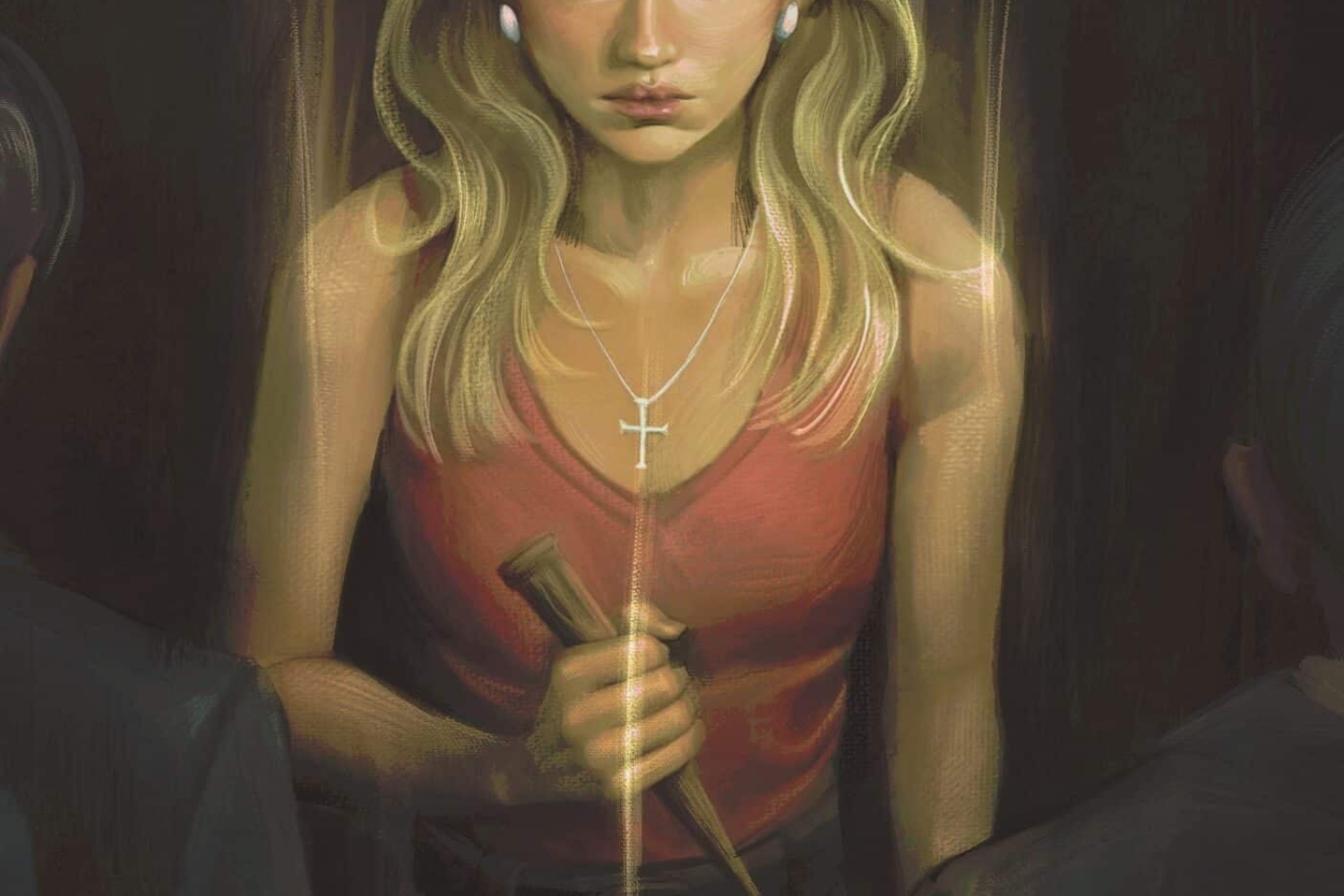

Recently, I got to catch up with Kelly Thompson to talk about an especially big and exciting project.
The only problem? We couldn’t actually talk about the story.
Seriously, even the solicitation is wildly vague: “And when she gave her life to save the world, the people who loved her couldn’t live with that. This is that story.”
Luckily, said project is Buffy the Vampire Slayer (from Dynamite), and even if she can’t talk about it as completely, Thompson has more than enough to say about everyone’s favorite vampire slayer to set the stage for a genuinely massive title.
“Bewitched, Bothered and Bewildered”

Main cover by David Nakayama. Courtesy of Dynamite.
Given that it’s Buffy, maybe we should start by affirming Thompson’s credibility. Not as a creator, mind you — her work on everything from Captain Marvel to Absolute Wonder Woman has solidified her voice as a generally unmatched writer. Rather, her cred in the realm of all things Buffy, where people need to see it for reasons both irksome and laudable. Fortunately, Thompson’s got it in spades.
“So I came in at sort of a weird moment, in that I don’t know what year it was, or whatever,” Thompson said of her foray into the Buffy fandom. “But I just know that it was the season finale of season one, which is a wild episode to start with. But you can see why it hooked me right away. There’s sort of everything encapsulated in that episode – horror, drama, romance, love, death. I think it’s a quite good finale for a pretty rough season. I think everyone would agree that season one is one of the weakest seasons.”
Admittedly, trash talking a supposedly “fundamental” show seems a wee bit counterintuitive. However, it’s just proof of that love and dedication Thompson feels toward the show, and how that hopefully connects back to her writing duties.
“The flaws of Buffy season one, when I look back on them, they’re almost sort of charming, right? It’s like, ‘Oh, they’re figuring it out,’” Thompson said. “And then when you get into season two, especially with the tragic romance between Buffy and Angel, all that gets dialed up to 11. And you’re like, ‘Oh, OK, they know what they’re doing now.’ They’ve charted a course, and I’m not saying you don’t ever get bad episodes here and there – ‘Beer Bad’ still exists.”
But bad is still good, generally. It’s basically the DNA of all things Buffy.
“I think one of the things that helps Buffy be beloved, and this goes to part of your first question, is that the very nature of Buffy includes camp,” Thompson said. “Like, ‘Oh, we’re not supposed to be taking all of this so seriously.’ There’s also some proto-meta stuff. That’s not really the way we do meta today. I’m not saying [the show] invented it. But I think it was one of the things doing things like that early, which is all really interesting, and I think it’s a good reference point for the things we ingest now that are new.”
Added Thompson, “It’s literally called Buffy the Vampire Slayer. You don’t call something Buffy unless you’re like, ‘Listen, we’re doing something here.’ If it’s ‘Jenny the Vampire Slayer,’ it’s a completely different thing.”
That certainly explains some of Thompson’s faves from season like, including “Prophecy Girl” and “Witch.” Although few things can ever beat “The Puppet Show,” according to Thompson – it’s “a perfect mix of all those things they’re trying to do: the absurd with the true horror with this comedy element…and the Scoobies having to perform on stage.”
And Thompson has other similarly themed insights that prove Buffy‘s campy might. Like how “Beer Bad” actually sucks because it’s a “disconnect between concept and execution.” Or how season two’s premiere (“When She Was Bad”) abandons its tragic premise because “they execute it with Buffy being mean. It feels so wrong when she’s mean. It makes me really uncomfortable, actually.” Even the “twist” ending for “I Only Have Eyes for You,” and how it “gives us a tricky way to make [Buffy and Angel] rotate around each other again and give these fans what they want.”
Heck, like any great fan, Thompson even wrote Buffy fan fiction. Sort of.
“I wrote a book called Storykiller, and that is probably the most Buffy-coded thing I’ve ever done,” Thompson said. “I would say some people would say it’s too close – ‘Gee, I wonder what your influences are here.’”
“Band Candy”

Variant cover by Joshua “Sway” Swaby. Courtesy of Dynamite.
In all that ways that matter, Thompson has tried to carry that robust devotion over to developing and writing Buffy. Because even if we don’t know that much, there’s still some things Thompson can actually discuss. And even if they’re also somewhat nebulous, boy howdy is this fellow dweeb more excited than singing along to “Once More With Feeling.”
For one, Thompson hasn’t just written Buffy (alongside artist Stephen Byrne) — she’s also penned Angel (with artist Giulia Giacomino). It’s all seemingly part of some truly master plan.
“When Dynamite got the license, they said, ‘I can’t imagine you have time for this,'” Thompson said. “I said, ‘Well, I’ve got news for you: I have my Buffy idea. It’s been sitting in my pocket for years waiting for someone to get the rights and want me to do it.”
And given her sheer devotion to the franchise, Thompson banked just one idea and one idea only.
“I have to warn you, if you don’t like this pitch, that’s completely fine. But I’m not going to want to re-pitch this,” Thompson said of her conversations with Dynamite. “This is the shot I’ve got, and you guys can love it or you can hate it and I’m OK with either of those. But I’m not going to want to go back to the drawing board to come up with something else.”
Added Thompson, “I don’t always want to be that rigid. That’s not really a great way to be as a creator in general…I’m not saying it’s a revolutionary idea or anything, but I will say that everyone said yes, and that’s how we got here.”
So, just what is that idea? Well, it begins with a crossover event between Buffy and Angel. When I asked (thanks to someone else’s comments to me) if it was akin to House of X/Powers of X, Thompson mostly balked at the mere idea. But then she also sort of acquiesced.
“Those are some of the best X-Men comics I’ve read, so that’s a big swing,” Thompson said. “Yes, we’re starting the books with a crossover event, and that’s how House of X/Powers of X started their new status quo.”

Courtesy of Marvel.
And while she may not like the X-centric comparison, there’s no denying that it just plain fits.
“If you don’t read Buffy #1, then you’re going to have a hard time in Angel #1,” Thompson said. “But if you read Buffy #1, and you get all the crazy reveals that are coming from this series we’re doing, then when reading Angel #1, you get all the emotional fallout and the ramifications of that.”
Sure, there’s some downsides to the approach. One is that “nobody at Dynamite is excited from a sales perspective,” Thompson said, adding, “I really appreciate the faith of them backing me up and letting us do this.” The other is that “for the first arc it means that the DNA of the Angel show is less present, and it is for the first five issues of Angel.”
Luckily, there’s something of a flipside — one that actually helps the Angel book.
“I think Angel #1 script is better than the Buffy #1 script,” Thompson said. “I don’t think that means that issues are better than other, but I just think the Angel #1 script is not weighted down by all those obligations that the Buffy #1 has because they’re intended to be read together. I’m talking about them as a two-part pilot.”
But, as Thompson noted, the idea at the core of this crossover “affects most of these people, so they all need to be on the board and I’m going to need the panel time to execute it properly.”
Added Thompson, “So, what’s a thing comics can do that a show cannot do? Smash all these characters together. Once we had a spinoff show, those characters almost never interacted. You want to see Angel and Willow develop their own relationship, and what kinds of friends they’ll be? Maybe they get to spend time together now because they’re sharing this book together.”
(As a bonus, Thompson said the “teams aren’t split cleanly on Angel–Buffy lines for plot reasons” but rather for how Thompson “wants to see these characters get to interact.”)
Finally, as an added wrinkle, the timelines across both Buffy and Angel are deliberately left unclear.
“I’m not pinning it down,” Thompson said. “I do think that anyone who’s paying attention to the sketches and stuff that have been out, Fred is in one sketch, and Dawn is there, too. So these things suggest it has to be at least a certain point. It’s a terrific non-ness.”
Oh, and just wait till you see the “vamp-wires.” Oh boy.
“Doomed”

Variant cover by Arthur Adams. Courtesy of Dynamite.
OK, now what exactly happens in these books that demands such a level of complexity and secrecy? Well, again, we don’t know, but we promise it’s a doozy unlike any other.
“In some ways, yes, it’s changing the face of Buffy as you know it,” Thompson said. “And it’s one of those things where the change is an atom bomb, but then the ripple effects are more nuanced and more of a recontextualization. It makes you rethink some of these relationships and scenarios.”
In some ways, it’s a story device that plays into both Thompson’s core strengths as well as creative shortcomings.
“Plot is not my strong suit – character and dialogue is a strong suit, and also the emotional interiority of said characters,” Thompson said. “You do need a plot to hang everything on. And you want a plot that ideally leans into their strengths and weaknesses and that will push them. It’s great if you can get some revelations and some real change to come from that.”
Added Thompson, “But even within that, I just want the plot to work as a framework, and then I want all the character stuff to create the complexity within that. To me, the plot here is the line. I can’t say to you guys what this is about and what we do. Then everything that comes after is just how the characters are responding and interacting with this new status quo they find themselves in.”
It’s not just dialogue doing all the heavy lifting, though. As a writer, Thompson said she has the regular tendency to “bite off more than I can chew and then not having the page real estate to do things justice on the page.” Fortunately, she tries to open the page up a bit whenever possible, and let a collaborator like Byrne really sing.
“I don’t really think of myself as a decompressed writer, and I suppose I certainly am compared to classic comics where you’re just layered with word balloons,” Thompson said. “I do really love dialogue, but I’m also really interested in letting the art breathe on the page. Sometimes a moment, even though you’ve got the perfect lines for it, letting the artist draw that moment is more powerful.”
Still, the whole “atom bomb” approach is really apropos here. Because rather than come in with a knife to carve things up, the whole bomb imagery hints at this idea of the totality of these changes, and the sheer scope and magnitude. It means we won’t all get what we want entirely, and that includes Thompson.
“I said in another interview that I really like Spike and Buffy together,” Thompson said. “But I don’t want anyone to be like, ‘Oh, damn, that means she’s doing Spike and Buffy together.’ Yes, there’s an atom bomb at the beginning of this, and there are a lot of ripples about how this changes things for everyone. My interest is in genuinely exploring that in an organic way. I know these characters. So if you do this, if you place this atom bomb here, what are going to be the real effects? And not what do I wish would happen.”
“New Moon Rising”

Variant cover by Juliet Nneka. Courtesy of Dynamite.
Because Thompson has learned to never make this about her and her wishes as a creator.
“When I was doing Rogue & Gambit, part of me wanted to roll up my sleeves and delete everything from canon I didn’t like,” Thompson said. “Rogue and Gambit are so f**king messy. Like, ‘I’m going to run through this and destroy everything that’s bad.’
Added Thompson, “That was fan instinct, not a creator instinct. A creator instinct is more about adding to things and leaving things in a place where other people can pick up on them. It’s about doing things that build a legacy as opposed to tearing parts of a legacy down that you don’t like.”
Because what she’s doing isn’t just “playing” with her own favorite series of all-time. She’s also adding to someone else’s favorite series of all-time, and that means being especially thoughtful and deliberate in her efforts.
“I realized that some of the shit I hated was some guy’s favorite thing he’d ever read, and it made me really recontextualize that for myself,” Thompson said. “There are a lot of people that think that’s the worst thing ever because they love this thing over here. You can’t treat it like an amusement park, where you’ve been given the keys and now you can just do whatever you want. It’s too destructive and it’s not helpful.”
Sure, enough of this approach is born out of balancing a huge cast (that’s something like 12 people strong, according to Thompson). But most of it comes out of this greater responsibility to telling stories that make sense and not delight your inner nerd. Take, for instance, Oz, Willow’s ex-boyfriend, Sunnyvale’s resident werewolf, and the coolest guy in town.
“One of the greatest things about Oz is that…it’s one of my favorite things in fiction: truth-telling characters. Buffy has some of the best,” Thompson said. “It was Cordelia for a while. Then she leaves the show, and I think everyone knew there’s a problem. Like, ‘We need some we need some oil to this water.’ So Spike is rolled back in, but all that time Oz is working as a truth-teller character. It’s just far less aggressive. He’s different than all those people around him, but it’s less the way that Cordelia and Spike is, right? He’s slightly outside the Scoobies, and that allows him this freedom to be a little different from them but it’s rolled into things in a more organic way.”
But while Thompson readily admitted that “Oz is definitely one of my favorite characters,” he simply can’t be a focus right now.
“My biggest criticism of the Buffy book I’m writing now is the diversity, which has nothing to do with me,” Thompson said. “It’s mostly white people, which I’m not wild about. But it does at least have one canon lesbian relationship, which is great. And so I’m much more inclined to lean into Willow and Tara than, you know, how does Oz fit in that? I’m interested in telling that story eventually, but I don’t think right out of the gate is where you want that story.”
So, yes, that means Tara will show up and have a presence. Thompson notes that the character “had an incredible hill to climb” not only as a queer character, but someone who invariably altered our perceptions and relationships with a beloved main cast member.
“I think it’s a shadow that hangs over Tara in the show forever,” Thompson said. “She’s in that horrible position where the writers desperately want you to like her, and so she’s not allowed to be bad. She’s not allowed to ever be a true character. She has to be the perfect girlfriend, and that’s hard and it’s ultimately not that interesting. It’s a thing you’re doing because you’re trying to build this thing…but it ultimately ends up being limited if there’s nowhere for her to go.”
Sure, Tara does eventually get some meatier parts in the show; in season six, when Buffy returns to Earth from “hell,” they have a connection that “helps them build their own relationship independent of Willow.” However, I wouldn’t exactly start making those “Team Tara” shirts anytime soon.
“I don’t want people to come and think they’re getting ‘The Tara Show.’ She’s a supporting character at best in this first arc,” Thompson said. “We’ve got to build to those things, especially with the big reveals that are in issue #1. Those things have big ramifications for everyone and a ripple effect, moving through all of those characters’ lives. We’ve got to grab hold of that in the right way. It’s very hard to do in the comic with a cast this big.”
“Blood Ties”

Variant cover by Amanda Cooper. Courtesy of Dynamite.
It’s not that Thompson’s take on Buffy‘s “supporting cast” is meant to be harsh; to me, it reads like someone embracing this challenge with clarity and intent, knowing they had to work smart to make this bad boy sing on the page.
It stems from big lessons she learned on the aforementioned, super great Absolute Wonder Woman.
“The biggest weakness of Absolute Wonder Woman is right now, I would say, we haven’t had enough time for the supporting cast. My fault, mea culpa,” Thompson said. “When she went in the maze, I didn’t leave enough space. I was so excited about so many things we were doing, and we had so much stuff we had to get through. I had left pages aside to help build the supporting cast a little bit. We ended up eating up all of that page time. We got barely any cutaways to those guys. So we’ve done a better job since then, but it’s still very minor.”
Sure, it’d be easy for Thompson to then really lean into Absolute Wonder Woman to improve Buffy‘s odds. And she absolutely is (in a roundabout way, of course).
“I do hope, and I’m sure Dynamite hopes it too, that my profile being raised to the degree that it’s been raised, thanks to Absolute Wonder Woman, will bring in curious people. I hope that those people will stay,” Thompson said. “Maybe that means all the people who are mad that Barbara Minerva hasn’t gotten enough panel time, they should come over here and they’ll be like, ‘Great, Willow is getting a lot of panel time.’”
But she’s also trying to respect the books for their lack of connection, adding that “there’s certainly a lot of magic and supernatural stuff, but they’re very different books.” Instead, she thinks about not if someone’s a Buffy fan, but if they’re a “Kelly Thompson fan or a Stephen Byrne fan and a comics fan. Can we bring that person into the Buffy fold, and then they become a person who now wants to watch the TV show?”

From Absolute Wonder Woman #20. Courtesy of DC Comics.
It’s an interesting approach to take, and something that Thompson is fully aware given her long-running career in this rather specific realm of comics. Sometimes history is important, and other times it’s a real curse.
“When you’re working at Marvel and DC Comics…big publishers have a lot of continuity history,” Thompson said. “There’s a lot of discussion in those rooms about do we want to reference, like, ‘You can find this in Uncanny X-Men #300’ or whatever? Or is it better for it to feel lighter for the readers?”
Added Thompson, “And it’s an argument that I think is valid, because everyone who’s making comics is just trying their best to make good things to make more people read comics. So it’s a valid conversation to have, but it never makes that much sense to me. And maybe it’s because I’m completely fine with discovering one of my favorite things of all time in the season finale episode of season one.”
In keeping in that very vein, you don’t really need much of a connection with Buffy to begin with before issue #1. It’s a little wild, sure, but it’s also a darn good idea.
“I would say for people who are interested in trying our comic, the good news is you don’t have to know anything about any comics,” Thompson said. “You don’t even technically have to know the show because we go to rather extreme pains in issue #1 to try to bring people gently into the fold.”
Even the connection to other Buffy comics proves somewhat tenuous. Thompson said that while she’s read and enjoyed “the reboots and Fray,” some of them are “less incredible, but I have respect for all of them. It’s pretty hard to bring something over from television and find that audience and really dial into it.”
“Lessons”

Main cover by David Nakayama. Courtesy of Dynamite.
To a huge extent, a lot of Buffy can already be explained when you realize there’s something else Thompson is attempting (even perhaps inadvertently?) Yes, it’s about tapping into the existing stories, but it’s also getting at something that was essential about Buffy when it debuted way, way back in March 1997.
“A first season was often pretty rocky, where they were like figuring things out, bringing in new characters and seeing what works,” Thompson said. “I feel like TV isn’t like that these days; it’s a very different model. When you see Pluribus season one or whatever, that is pure art. They’ve perfectly edited every inch of that thing before it releases. It’s just almost like a whole different world.”
Because it’s never about fan service or being the most explosive or wild or even deliberate and careful. No, it’s about having a mission and following through on that objective.
“For all their faults in that first season, they still knew what they were going for. They still knew what their North Star was,” Thompson said. “And it was just them trying to figure out how to do that. I guess that’s why I’m always hopeful that you can hook someone into something all-new, even if there’s a lot of history to it. If you can just tell a story that intrigues them and makes them curious about what else there is, I feel like that’s a lot of the fight, you know?”
The latest Buffy comic is – in some decidedly odd, wholly unintended way – a response to how TV has changed, and what shows like Buffy got correct that simply isn’t an option for modern projects.
“We don’t have these big, long, 22-episode series anymore. It’s less common,” Thompson said. “Great television tends to come in these smaller, bite-sized pieces. But you do lose that meandering exploration that a show like Buffy got to have. Some of [the episodes] are the best thing you’ve ever seen, and some of them have a real problem.”
But it’s also about something else entirely. This idea that ups and downs, good and bad are part of any genuinely worthwhile story. That it takes time for a narrative to hum, and through her work, maybe Thompson will have the time to “do a long run and to dig into stuff.”
It’s always about the long-term, even if you don’t always seem to like it all that much.
“The first season of Silo, I was just riveted. And when they came to season two, man, I just hated it so much,” Thompson said. “There were a couple good episodes, but everything else is a problem. It made me hyper-aware of…the way we ingest media now, or maybe it’s just because I’m a professional creator. And that makes me think of these things differently. But I realized that even though I still don’t advocate for this [second] Silo season, it’s still pretty good.”
“Chosen”
Thompson is at least partially familiar with a similar dynamic in at least one of her ongoing books. Because even the biggest aficionados have to learn to suffer sometimes.
“Listen, we’re headed into this thing with Absolute Wonder Woman right now,” Thompson said. “She took a really big loss and a lot of things have happened. Now we’re headed into a really dark summer that has not been very fun to write but it’s necessary. As creators, you just try your best to make that engaging and worth it even when it’s not ‘fun.’”
A lot of it goes back to her early assessments of Buffy (and especially those first seasons). Both Buffy and Angel did some stuff that seemed odd, painful, complicated, etc. And yet the end result was still decidedly magical. Like season seven and the Potential Slayers that many fans found irksome or irritating.
“They didn’t really have the episode time to develop any of those characters in organic and engaging ways,” Thompson said. “Every time they’re on screen, it feels like they’re stealing from the characters. Narratively, it’s very strong. It’s a great ending for the show thematically, and you can’t do any of that without spending time with those Potentials. It’s one of those hard things about being a creator. You have to get somewhere narratively, but you know that it’s not super enjoyable to get there. You try to make it as enjoyable as you can, but there are going to be these hang-ups.”
Same goes for Caleb, the serial-killing ex-priest who served as a thorn in the side of Buffy and the Potentials.
“The aggressive misogyny and everything, I think, for a modern audience reads really clunky,” Thompson said. “But you have to remember this was 2002, 2003 – you weren’t seeing a lot of things like that. If you throw a rock now, you could hit a really cool female superhero in a TV show or even a movie or certainly a comic book. It was a bit shocking for him to just say that girls were dirty and he hated that stuff.”
Thompson even has a really great view on Angel‘s finale (another instance where some die-hard fans felt short-changed or downright angry).
“I guess it’s why it’s one of the many reasons why season five is the coolest and most interesting to me is because it both feels like it breaks free of being a ‘junior Buffy‘ and it really embraces being darker and more adult, but it also brings in a lot of really wild stuff that feels more at home on Buffy,” Thompson said. “Like when Angel gets turned into a puppet – one of the greatest episodes of all time. You can just feel the ‘fuck it’ in that season.’ They didn’t have another season to wrap up those stories. I think it made them be a little more tight and smart and clever about how to execute some of that.”
It’s this stuff that I believe really makes Thompson the absolute best choice for Buffy and also Angel. (Also, in part because of her three favorite episodes: “Hush,” “Tabula Rasa,” and “Once More With Feeling.”) She has the credibility and devotion needed to tackle this nerdy hornet’s nest. The “atom bomb” idea is vague but hugely promising enough for its emotionality and emphasis on character dynamics. Plus, Byrne’s initial work captures the campy charm of the TV series. In short, Thompson told us everything we need to be sure that Buffy (and Angel to boot) will be the right kind of adaptations: thoughtful, inventive, and gripping.
And if you somehow need just one more shred of evidence, I offer a final promise from Thompson herself:
“Let me tell you what – you will never f**king see Kennedy.”
Buffy #1 is due out July 22. (The FOC is Monday, June 29.) Angel #1 drops on August 19.



You must be logged in to post a comment.