

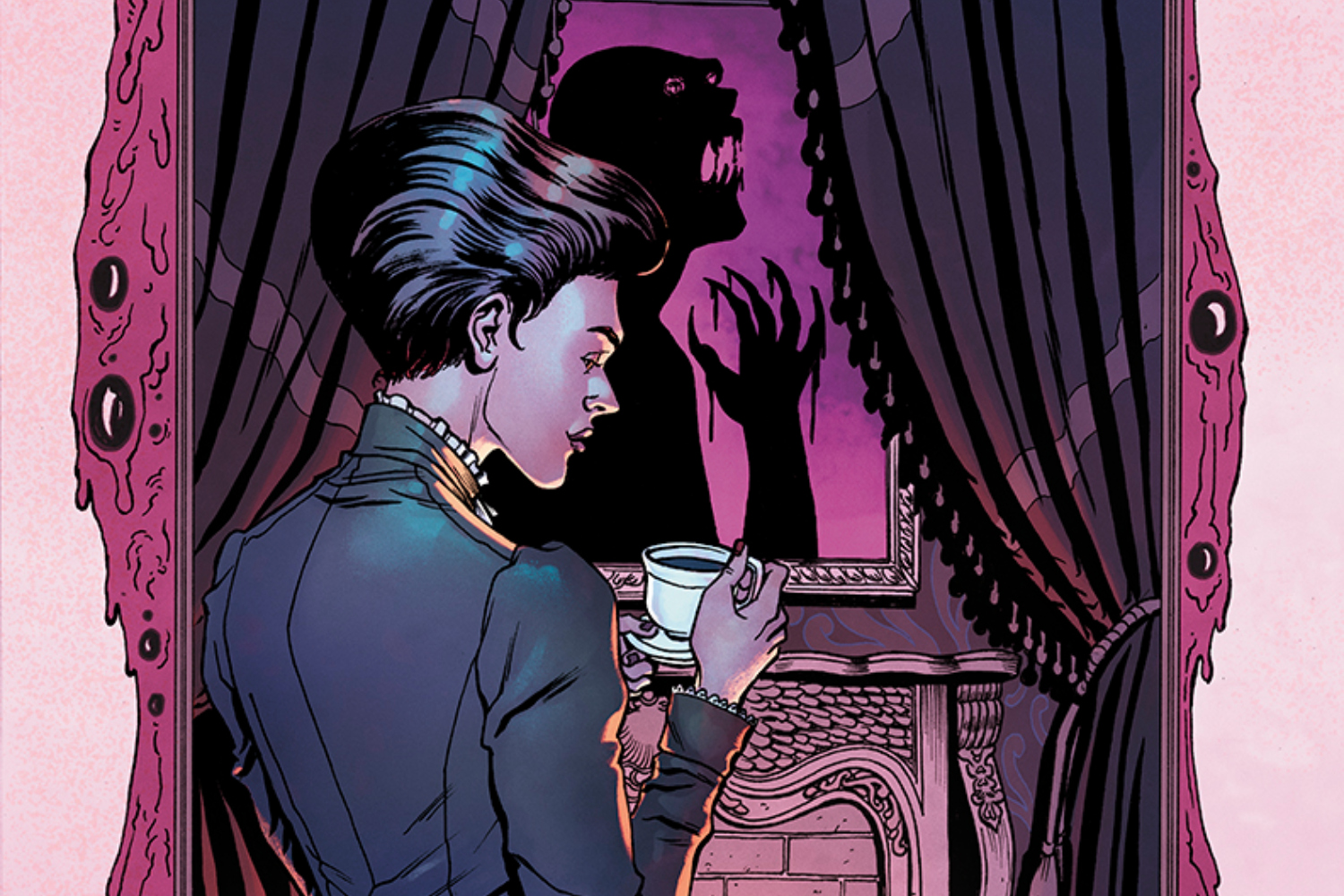

Sometimes the most important stories take the longest to tell.
That’s certainly the case for MADAM, from writer Joey Esposito (The Pedestrian) and artist Pandamusk, Per the duo, the story had been percolating for some 10 years following a conversation at a comic con. And that initial convo resulted in a tight and compelling premise: “Black magic Mary Poppins.” Yet MADAM‘s magic goes so much deeper still.
In the story, we follow Madam McQuileen, who poses as as nanny to steal the life force of vulnerable families. But after years of freely ruining loves, Madam McQuileen will come to deal with a man “obsessed…with her trail of bloody crimes,” and whether this means a new family (The Wades) will suffer a similar fate as so many others or if Madam McQuileen’s reign of terror will finally be put to bed.
Tapping into the essence/spirit of old-school, psychologically-abusive horror stories, MADAM is a true test of the reader’s mettle, patience, and humanity. It deftly explores ideas of trauma, family bonds, and human development with both a brutal honesty and an equally disarming level of intensity. Slow and steady when it needs to be, but also capable of fostering great shocks, MADAM is a story well worth your time — even if it won’t pick up the bill for your next psych appointment.
The 164-page MADAM is set to begin its Kickstarter campaign this week (October 14) — head here to pledge your support and browse the rewards tiers. (There’s some primo pin-ups and variant covers from the likes of Richard Pace, Yorgos Cotronis, and Richard Clark.) Ahead of the launch, the MADAM team were kind enough to field some questions via email. That includes the book’s long development process, more on their cinematic inspirations, and the role of horror stories in 2025.
Minor spoilers ahead for MADAM.

AIPT: What’s it been like to work on this for so many years? How has the story grown or evolved over that extended time period?
Joey Esposito: It’s weird, because in a lot of ways MADAM reflects a past version of myself. It’s a reflection of a very dark time that I’ve thankfully moved on from, so I guess it’s a nice reminder of how far I’ve come since we started talking about this book. The story itself has remained consistent, but I think it’s notably meaner and more cynical than I might make today, which maybe makes it right for our current moment.
Pandamusk: We started this project with no clear deadline [and] with the aim to work on it in between other projects. This was my first full-length comic book, and I came into it with pretty basic sequential art skills. With the length of time that passed between issues, I found my art style changed a lot between issues. I also didn’t know the story until I received the scripts and I found what worked for issue #1 didn’t necessarily work visually for subsequent issues. In the end, I decided to let the art evolve as I got to know the characters and I think the visual storytelling benefited. It is definitely hard for me to look back at some of the art without cringing, but at the same time it functions as a timeline of my artistic journey in comic books.
AIPT: Why opt for Kickstarter as well as the full OGN approach? What about this project almost demanded that?
JE: Mostly because of the timeline in making this book, it went through so many iterations over the years that page counts were wonky and the only way it made sense was to do it as a graphic novel. It was originally going to be a thing we just put out for free, so chapter one is 38 pages. But then there was some publisher interest around 2016 or so, so we changed to more standard length serialized issues. That fell through, and so we made the last couple of chapters longer. It just kind of continued on however we felt like it. I think we definitely could have benefited from an editor over the years, but I look at it as a learning experience.
Pandamusk: All the points Joey raised were relevant in our decision-making. When the story was finally finished, it made sense to get it out there in its current form and launch a Kickstarter.

A variant cover by Yorgos Cotronis.
AIPT: Where did the idea for “black magic Mary Poppins” come from? What about that deeply familiar character feels like it’s worth dissecting in this specific way?
JE: I’ve always had a major crush on Mary Poppins, so I guess it probably started there (HAHA). But for me, this was a way to process some personal things that were happening to me at the time, which included a deep-cutting, non-repairable betrayal by someone I trusted innately. So taking that and using it to build a horror tale about false faces and the lies we tell to the people we love seemed therapeutic. I think playing on the imagery of a nanny, whether it’s Mary Poppins or another figure like her, presents this idea of letting someone into the most private aspects of your life. And giving someone access to you in a familial way can be dangerous when their intentions are sinister.
Pandamusk: “Evil Mary Poppins” was Joey’s original pitch to me and what attracted me to the project. Mary Poppins is a beloved story about a character who cares, inspires, and protects her charges. I like the idea that we were going to subvert those roles. The scenario also allows evil to be openly invited into the lives of this family and gives a predator like McQuillen unfettered access to new victims.
AIPT: There’s almost “dueling” protagonists here, Jack and the Wade family. Do you gravitate toward one over the other emotionally? How do you balance two very different but familiar horror protagonists?
JE: Well, I’m not sure I’d call Jack a protagonist given his (spoiler) untimely end at McQuillen’s hand in chapter one, but it definitely kicks things off for what is definitely a parallel narrative between the Wades and Detective Harris, a cop assigned to the aftermath of what happens to Jack. I tend to gravitate toward the Wade children because I love their sibling dynamic. But I enjoy checking in with Harris and watching his descent into obsession at the cost of literally everything else in his life, imagining how things could have been different for him if he had better work/life balance.
Pandamusk: I loved Jack as a character. Brash and charged with the confidence of youth, he gives the reader the first glimpse of McQuillen’s evil. He is alone and completely helpless against her. On the other hand, the Wades, while dysfunctional, are still a family and so should have that additional inherent layer of safety. Unfortunately, just like Jack, Kelly (the big sister) has to face off against McQuillen alone without any real parental support from her mother. This is where the character of Detective Gil Harris comes in. He should fill in that protective role of the adult, but his own failings and distance from the Wade family keeps him falling short. The parallel story and shifting POV between the Wades and Harris, keeps up that tension and anticipation.

AIPT: There’s mentions of some key references, including David Cronenberg’s The Brood or William Friedkin’s The Exorcist. How do those filter into both the narrative and the art style/design?
JE: I think more than anything it’s the slower burn pacing, intimate domestic setting, and sudden shocks of violence. I love that style of 1970s horror. It trusts the viewer to settle into the world and become invested in its characters before descending into hell. Also, one of my sisters made me watch The Brood when I was far too young — also about motherhood and mother figures, not coincidentally — and the terror of that experience is seared into my brain.
Pandamusk: The Exorcist really messed me up as a kid and was formative in my personal definition of horror. (There’s a definite nod to a famous moment, at the beginning of issue #4.) The supernatural aspects of the movie tapped into innate Catholic fears and there was this pervasive oppression and powerlessness you felt as a viewer, facing off against a greater evil. McQuillen represents that.
While the first issue is dark and heavily shadowed and more in style with most horror, I pulled back in later issues to keep the domestic scenes lighter and fun. This helped contrast with later scenes of gore and horror, while avoiding telegraphing some of the visual jump scares.
AIPT: I love the way the book effortlessly hops between time periods. Is that process hard to manage, and what do you think it adds to the story “experience”?
JE: Really, I’m just a sucker for interconnected or intertwining narratives. I think it’s always fun to see how one thing impacts the other, or how you can build tension between what we as readers know that the characters do not. It can be difficult to plot out for sure, making sure the timelines make sense and all that. I hate constructing plot logistics, it is my least favorite part of writing because it is the hardest. And yet I always find a way to make it even harder for myself.
Pandamusk: For me it was a pleasure to draw fresh new characters outside the Wade family. It fleshes out the story and expands on the mythology behind McQuillen. What seems like an isolated danger to one family, suddenly broadens to a larger, pervasive threat. It was also fun to show the effect of time on some of the characters.

AIPT: Madam McQuillen is obviously meant to be a villain. But is there something relatable/charming/humanizing to her that complicates our relationship?
JE: Honestly, I don’t think so. I think her exploitation of our innate desire to have a nurturing figure in our lives makes her irredeemable. She’s earning people’s trust, only to subject them to the most depraved things you can imagine. She shed her humanity a long time ago, if she had it to begin with. Even with her Coven, she has these people whom she presents as family, but you look at their circumstances and how they came to be aligned with her, and you realize it’s just another way in which she’s manipulated the most marginalized and susceptible of society into becoming her lackeys, essentially. The way in which she uses these people is just as sinister as what she does to the families she destroys.
Pandamusk: Joey is right, her motives and actions are pure evil. Visually, however, it was important for me to humanize her so she doesn’t come across as an open threat. In the way she acts around the Wade children, or the earnest expressions she wears when she is with Monica. I want the reader to relate to her like the characters do — surely she has redeemable characteristics? I’d like to think there’s good in everyone, but that’s not the story that we are telling.
AIPT: How easy is it to filter your own childhoods into this story? Or is that something you actively tried to avoid?
Pandamusk: All art is filtered through personal life experiences. I pulled characters’ behavior and appearances from people I’ve met or know. The siblings’ interactions mirror my own childhood experiences. Kenneth and Michael’s bedroom is basically what mine looked like.
JE: Exactly this. Even if you try to avoid it, I think it seeps in anyway. There are definitely elements of my personal experiences as a kid in here, though I can’t say I ever had a babysitter who wanted to torture me, at least to my knowledge.

AIPT: In this day and age, what does horror provide for you as both creators and fans? There’s something almost warm and inviting about MADAM, and that’s certainly my kind of horror story.
JE: Horror is the place to unleash your darkest feelings and thoughts about the world around you and be safe doing it. Horror is malleable and universal. Nobody wants to confront their greatest fears or the darkest parts of themselves, but horror forces that experience on you. As a fan, I love to feel unmoored from my surroundings and completely engulfed in the terror around me. As a creator, it’s like performing an exorcism on myself.
Pandamusk: I think with the horror genre you have the opportunity for greater emotional swings. The quieter moments heighten the horrific ones. From an art point of view, it was an opportunity to draw really gross, sadistic and gruesome art without coming across as a psychopath.
AIPT: Thematically, I get the idea the book is about, with or without a witch, that there are no “good old days” and growing up is as wondrous as it is a nightmare. How close am I, or are there “thematic tentpoles” you were going for instead?
JE: That’s part of it, for sure. I think ultimately a major theme here is how the previous generations have fucked things up for the ones after them. Unequivocally. I think by the end of the book, that becomes pretty prevalent. It’s not subtle. But on a smaller, more personal scale, I think the book is also about the illusion of childhood, that the adults around you want to protect you and always have your best interests at heart. When we grow up we learn that isn’t always true, that our parents are flawed people just like us and have their own shit going on.
Pandamusk: That illusion breaking is a sad part of coming of age. Suffering can lead to more suffering, and McQuillen represents that notion. She has the power to help but instead takes advantage of people’s frailties, insecurities all while smiling and misleading them. Pure evil.

AIPT: Do you have a favorite moment or page/panel from the story – something that speaks to something about the story?
JE: There’s a moment in the final chapter where McQuillen reveals her true nature, and that’s the moment the whole story really grew from. She is an elemental evil that is unkillable, unbeatable. Nothing anyone can do will ever stop her, and I think that’s the ultimate moral here. There is no defeating evil, there is only surviving it.
Pandamusk: The last page of issue/ chapter three. Horrific to draw. And the notes I left for our colorist still make me laugh. Ed Ryzowski did an amazing job. (LOL; sorry again, Ed!)
AIPT: Is there anything else we should know about MADAM, comics, murderous nannies, black magic, etc.?
JE: Just that I hope people will consider giving the Kickstarter campaign a look. There’s a lot of incredible art featured by friends and people I admire, including an alternate cover by Yorgos Cotronis that’s stunning, and original pieces by Valeria Burzo, Richard P. Clark, Eamon Winkle, and Richard Pace.
Also, it’s harder than ever to put something new into the world that isn’t already tied to some larger franchise. But I think people are hungry for it, particularly in horror. Look at the box office for things like Sinners or Weapons — these are original takes that stand on their own and audiences flocked to them. And they were also very good, which is important.
Pandamusk: This project has been with us for more than 10 years and it is both sad and fulfilling to be so close to the end. I think it’s important that people continue to craft and create art, and learn from their experiences. That journey is what makes us humans and [is] the point of life. I hope people who read the book get a sense of what that was like for Joey and myself in creating this. And I hope they enjoy it!
Support the MADAM Kickstarter.



You must be logged in to post a comment.