


A good ending is like running into a wall.
Which is to say, it may be a little shocking and abrupt, but you also can intuit that, given you were likely running through your own house/a familiar space, this sort of thing was bound to happen. And it’s like you’re almost stuck — between the shock and the familiarity, and in that narrow space maybe you feel something different.
And not just that nasty bump forming on your chin.
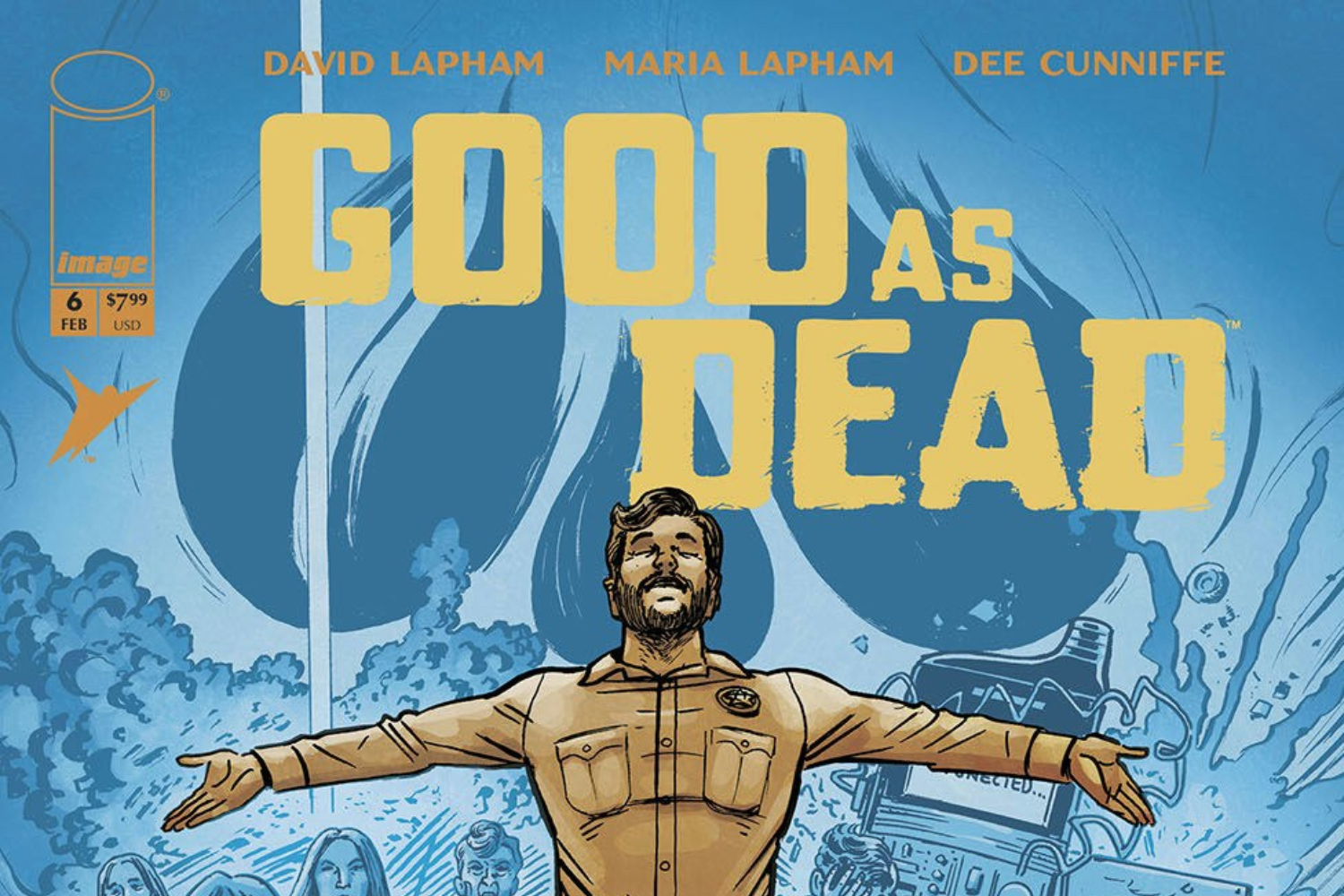
That’s the best way I can describe Good As Dead #6. After five issues exploring Port Linden in the aftermath of an exploding bridge (and way, way more bonkers stuff to boot), we’ve reached the eagerly anticipated finale. While the book took some time for me to really get it into (odd considering creators David and Maria Lapham always spun instant gold with Stray Bullets), the duo (alongside colorist Dee Cunniffe) built this post-modern crime caper about the weirdness of small town life. But I always suspected that, whatever issues or complaints I had with Good As Dead, the end would either be the saving grace or the final word on this failed experiment.
And I’m happy to report it’s not just the bridge that was eventually blown away.
Here’s what you need to know coming into Good As Dead #6: Having been ruled by the dueling families of the Calhouns and Valades for years, Linden is rocked by the explosion of an important commerce bridge. The resulting saga gripped the town with fear and grief as they contended with a new, extra bloody chapter from the Valade-Calhoun clash, a resulting FBI investigation, the threat of aliens and otherworldly entities, and a conspiracy more all-consuming than anyone could ever truly consider. (That last one involved the death and newly-discovered diaries of Dr. Yao, and the secrets inside that could make or break the town.) In short, a crime story with teeth and claws to spare, and that felt like the Laphams were really swinging for the fences.
Which isn’t to say Good As Dead was entirely perfect. I found Sheriff David Calhoun a little lacking — even as he spent the whole issue trying to solve his own poisoning. I wanted more from other cast members (like Deputy Lenore Hunter and Bobby Calhoun, the sheriff’s insane, totally badass sister). And I couldn’t shake the sense that some of the otherworldly tendencies were either a red herring of sorts or instead a needless distraction. None of this made me want to necessarily drop Good As Dead, but it informed this tension I felt reading this book — this minor “unease” that, perhaps with more focus and clarity, we could have something truly great.
And that’s what this ending offered up. Despite the many threads/moving parts, the creative team managed to pretty much settle everything with true power and efficiency. It wrapped it all up in a neat little package, and most of what we got felt quite satisfying. Maybe not in a “This person got exactly what I wanted,” but in a way that was more like “The team made clear decisions and I can respect those for their finality and overall level of interest/effectiveness.”

Courtesy of Image Comics/Skybound.
Given how busy (in a rather good way) this finale proved to be, maybe it’s best if we bust out the bullet points (and some minor-ish spoilers):
- David Calhoun: As mentioned, I was slightly underwhelmed by the good sheriff. They kept inferring that this was his story, but I couldn’t see it. But as he dies in this issue, I now 1) recognize how he serves as an entry point to the larger ideas of community and legacy at the book’s core and 2) his “death scene” really plays out like this bonkers, Coen Brothers-esque spike of magical realism that finally lets this book execute that part of the vision in a way where its intentions are fully clear.
- Lenore Hunter: Unlike the sheriff, I instantly felt like the deputy was the star of the show. And through some effective reveals, as well as the book’s explosive ending, she managed to achieve that destiny while also coming off heaps more complicated. Her whole arc was deeply, deeply satisfying, and she emerges in the end as this robust figure who showed a complicated morality (for a complicated world), and ultimately brought home the book’s community focus in a really impactful way. I was right about Lenore, but also quite wrong, and damn is that satisfying.
- Bobby Calhoun: I was always right about Bobby — but only because I instantly pegged her as the gun-toting badass who would likely play a major role in the final confrontation. She absolutely does, but not necessarily in the way you think. That pivot, if you will, doesn’t take away from her badassery (she’s still a huge driving force in the book’s conflict), but there’s something else here. That surge of humanity, and a “grounding” of her peculiarities, managed to A) make her feel all the more real and organic when it mattered and B) connect her to her brother to further this book’s theme of questioning reality and the stories we tell to get by/survive.
- Becca: From the start, Becca’s whole arc felt a tad forced — she had friends/family killed during the bridge collapse, and so she launched a mission of fiery, half-cocked vengeance. That’s not to say she didn’t play an important role; rather, she seemed a little one-dimensional. But she learns a really powerful lesson in issue #6, and while it’s not obviously satisfying, it is something that will guide this character forward long beyond this story. And that matters even if we’ll never see it.
- Aly and Sam Calhoun: The sheriff’s family felt like plot devices far too often. But Good As Dead #6 lets them understand similar ideas of legacy and community, and in that way, they feel truly alive. And if you hadn’t picked up on that by now, that seemed to be an important theme across this conclusion (and that’s got to count for plenty as everything coalesced in its final shape).
Now, all of this growth isn’t to say that this specific issue was perfect. The Valade clan felt needlessly absent, and it would have been nice to see them play more of a role in addition to the “main” cast. Similarly, J.P. Valade does get a minor role here, but even then he’s regarded as more of a plot device (and in service of the Calhoun family legacy, really). It sort of made the family feud at this book feel a little flimsy/unfulfilled, but then maybe this was the Calhouns’ story all along.
Which, if you hadn’t guessed by now, I’m totes fine with just such a “development.” Endings aren’t just about reaching your destination, but the resulting clarity and value. And whether you hit a wall or come to some new space/clearing, you still have to grapple with what it all truly meant. And in the case of Good As Dead, it meant a lot of things.
It meant a story about what family has always meant and how (if at all) that definition or value has changed. It meant exploring the ways we try and get by, and whether we play the hero or villain or opt for more of a supporting role in this wacky play we call life. It meant death and destruction will always came to pass, but so too can decency and humanity in ways that actually matter. It meant a recognition that life is so much more dark and unsettling that we could ever imagine, but that we can survive it together. Mostly, though, it meant something that was as unpredictable as it was familiar, and in that space is where life really happens.
This ending may have smarted our nose/forehead, but damn if it also wasn’t so utterly life-affirming.




You must be logged in to post a comment.