


Some books tell you exactly what to expect within their pages.
Death Fight Forever does not.
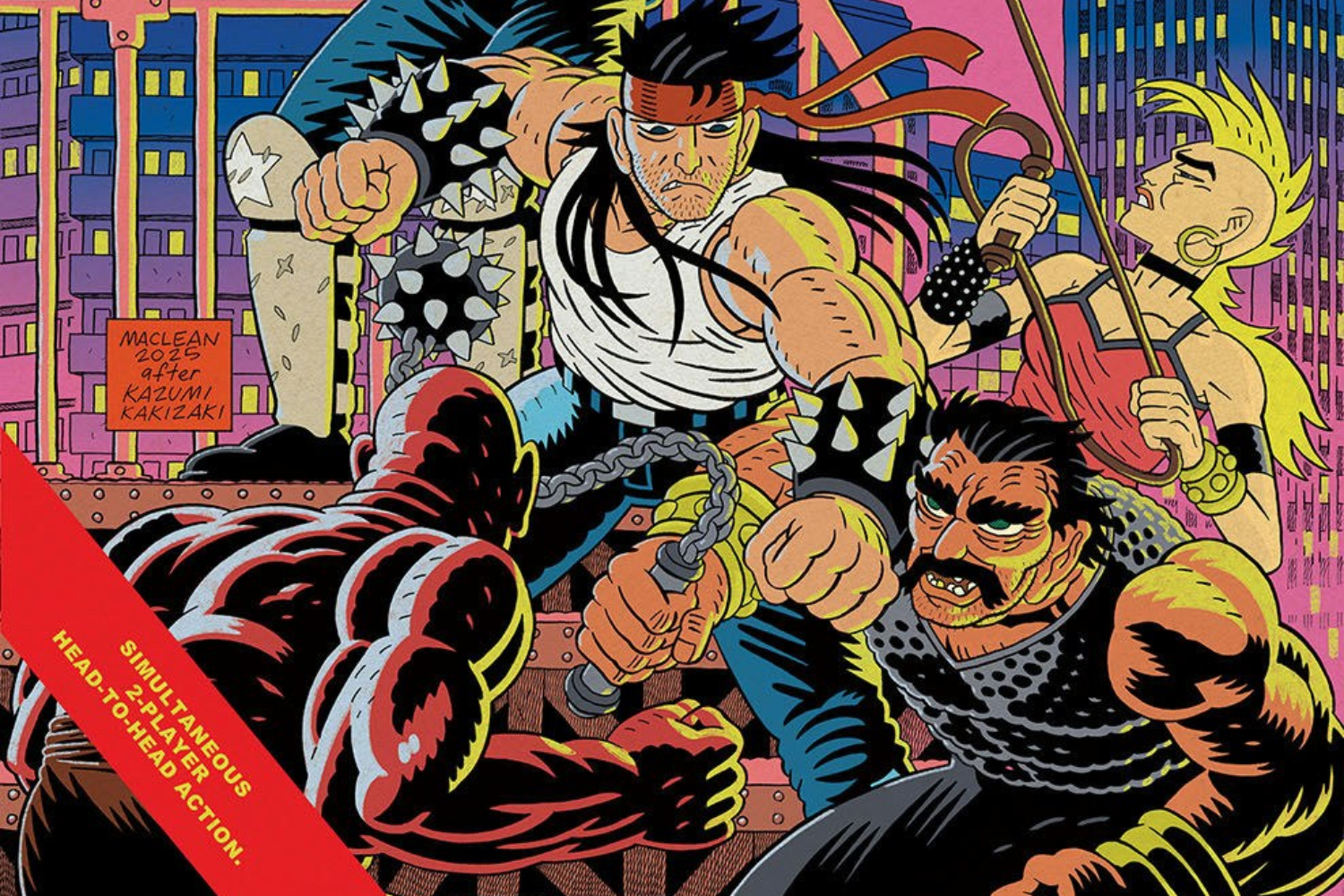
OK, that’s a wee bit unfair. Because writer Andrew MacLean and artist Alexis Ziritt do actually use this book to pay homage to late ’80s action films and video games. That’s why we get the Biggle brothers (Crash and Bash) battling “inter-dimensional crime boss Lord Slyther” like Double Dragon meets Contra meets Blood Dragon. You know, that tale as old as time.
But almost immediately (and without spoiling too much), MacLean and Ziritt quickly show us that this is not what Death Fight Forever is actually about. Instead, it’s about one of the brothers and Marla Mendoza (aka the head of the COPZ gang and “Slyther’s most formidable loyalist.”) In that way, they quickly buck expectations in such a way (and with maximum efficiency) that we’re left to 1) wonder what else might alter the scope of this story and 2) who does this story actual belong to in the end?

Courtesy of Image Comics.
Mostly, though, it feels like a neat commentary on action films themselves. Not in a way that feels intellectually challenging, but rather commenting on our connection to these stories. What value do they hold when they can be so easily altered or manipulated? Can you have a tale of revenge/vengeance between a guy and a girl, or does that automatically mean romance is inevitable? (And should we care either way as media consumers?) And if we actually know how this tale winds up, does that ruin the journey, and can these kinds of action-heavy stories maintain their shape without our (often overtly expressed) innocence and uncertainty?
It’s less like playing Contra and more like a second run-through of Braid: You know what’s waiting for you, so can you find the same sort of joy this time around? In that way, Death Fight Forever also feels like an extension of MacLean’s own Head Lopper. That series felt like an obvious enough homage to fantasy stories a la Conan, but it made certain editorial decisions to make us reconsider the roles of heroes and villains and what happens when, say, a mythical kingdom collapses. It’s not just blindly celebrating some thing you love, but earnestly dissecting and examining it to better understand it and why you loved it in the first place (and how, if at all, that admiration continues to develop/evolve).

Courtesy of Image Comics.
But I think more than any thematic interests, what Death Fight Forever ultimately does is allow MacLean to give Ziritt a platform. In an interview (also available for your reading pleasure this morning), MacLean told me that he’d intended Ziritt to do the whole book. When Ziritt eventually couldn’t do all five issues, the story was planned out to let him draw issues #1-3 (and leave a space to “pivot” stylistically for other artists across issues #4-5). That to me feels like very much in line with Death Fight Forever‘s exploration of/interest in relationships and collaboration.
And through that support (and probably just massive talent in general), Ziritt delivers something utterly bonkers. It feels like Beavis and Butt-Head or Heavy Metal — these things that felt a little “wrong” or out of my personal purview, and yet they instantly cracked my brain wide open. Both Contra and Blood Dragon are still the perfect reference points, and yet Ziritt takes it 1,000 steps further with those vivid color palettes (everything feels so alive and rich and yet also subtle and nostalgic in a perfect storm of aesthetic might); perfect character designs (the brothers are rugged and oddly alien, and again that narrow space feels thematically rich); and the right balance between grounded, gritty reality and otherworldly flourishes.

Courtesy of Image Comics.
Death Fight Forever‘s visuals may be the most obvious representation of this book’s interests and influences, but even that feels like you’re still missing out on so much context. Given that the narrative has so many objectives that may or may not be true/capable of being accomplished, we rely on the artwork to feel connected to the story. And while it does offer up that sense of brain-melting joy, it never merely satiates.
The design choices always feel as deliberately cool as they are a touch unsettling or otherwise left-of-center. Is that to “prepare” us for an uneven and lithe narrative experience? Maybe. If nothing else, though, it certainly augments mere nostalgia with something altogether more complicated. And in that way, Death Fight Forever is what it is and isn’t that at all with this unwavering brashness and confidence.
I’d normally say that I don’t know where this story is headed. Except, as mentioned above, we generally know the ending already. And whether that’s a good thing or not (or if there’s still more surprises to come?), it just speaks to what I’ve been saying this entire time: Death Fight Forever feels like the right kinds of novel and different without disconnecting itself from a level of fan service (albeit for folks with specific enough interests). Whatever the steps between now and the finale, I already know Death Fight Forever can more than meet its lofty goals of depicting tiger-man soldiers and deeper emotional stakes.




You must be logged in to post a comment.