


Over the last decade or so, Doug Wagner and Daniel Hillyard have forged a wholly effective creative partnership across comics. And it’s one predicated on a number of elements: a robust personal friendship and respect, a love of poignant storytelling, and an undeniable urge to connect with others via their chosen medium.
But mostly it’s that the pair are weirder than a pigeon on mescaline.
“We’re still early in the relationship then, so we’re not quite as great mates as we are now,” said Wagner recounting their “early days” during a recent Zoom call. “But I pitched him a couple of things, and Plastic was one of them. And he goes, ‘Hey, I think I want to do this Plastic thing.’ And I did not pick him for a Plastic guy. He was giggling at the same twisted, disturbing things.”
Plastic is, of course, the story of the serial murdering Edwin who keeps his mother’s head in a jar. From there, they pair moved on to, in no discernible order, cannibalistic Furries (Plush); a serial killer battling a cult of “all-female sunflower farmers” (Vinyl); and a tale of the most intense art student ever (I Was A Fashion School Serial Killer).
“We both have found this spot where we just love the same kind of crazy stuff,” Hillyard said during the same call. “We naturally gravitate towards these kinds of things. Sometimes I hear stories of some nightmare collaborations and creators having real trouble with each other. Me and Doug working together, it’s like breathing.”
But after years of truly insane stories, the team of Wagner and Hillyard are trying something new with Narco – and it may be their most crazy experiment to date.
Fargo by Way of Dark Souls?

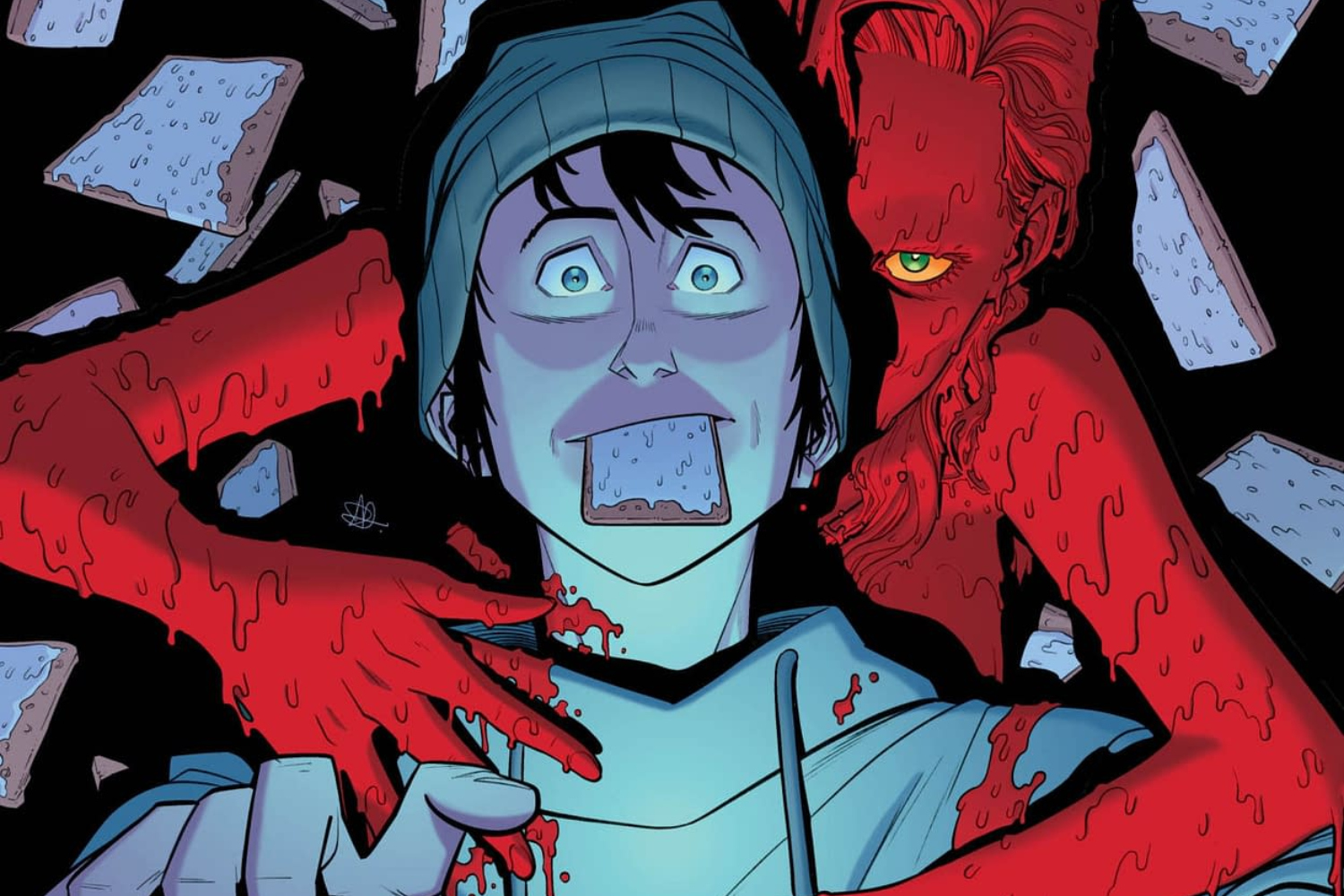
Variant cover by Daniel Hillyard. Courtesy of Image Comics.
In the five-issue Narco, we meet Marcus Wesphal, a young man with a “rare forfim of narcolepsy”: if his heart rate becomes elevated, he suddenly passes out. After years of living with the condition (often being homebound for days at a time), Marcus finds a bit of hope when he becomes “infatuated” with the girl next door.
Until she’s murdered, and Marcus instantly becomes “suspect No. 1.”
And, sure, it wouldn’t be a Wagner-Hillyard title without a little twist and some blood and guts. At the same time, Narco is very much a reaction to their larger bibliography. A keen understanding of what they’ve done right, what they can do better (or at least different), and what they’re actually building toward.
Because they could have easily kept telling the “same” kind of story, but then that wouldn’t be in the true spirit of their collaboration.
“We can talk about stuff and go, ‘Hey, I’m not sure this page is working. What do you think if we did this?’ It’s all about the book,” Wagner said. “It’s not about us. It’s about what’s the best page or the best story we can tell. What’s fun about it is one of us will have an idea. And you’ll go, ‘Wait a minute, what if we did this?’ Or, ‘What if we took it to this level?’ And it’s more like two friends daydreaming about how crazy we can make this scene versus it being competitive.”
They also want to tell decidedly standalone stories, and while that’s true of their entire output, Narco is the one that at least feels the most singular given its themes, main character, and general vibes.
“I don’t want anybody to have to read Plastic to understand Narco or vice versa,” Wagner said. “And so that’s always been a big thing for both of us – let’s make sure these are standalone stories, but yet it’s all encompassed in the same universe.”
At the same time, Narco does still connect in some key ways to their “Murder-verse” (my term, not theirs). Just only in the ways that actually seem to matter.
“It’s all about whether the story’s worth telling individually first, rather than thinking that we’re just trying to, like, make pieces to build this overall sort of jigsaw puzzle,” Hillyard said. “If you have read any other books, we put enough little Easter eggs in there. They’re not things that are important to the overall plot or character development in that story.”
Hillyard added that it’s “like a Dark Souls game – you can still just enjoy the story if you like, But then if you want to jump in and scan through all the inferred stuff and get this grander idea of how everything fits in together, like this character’s doing this at the same time that this character’s doing that, then you could jump in and do that.” Wagner added that it’s like “Fargo the TV show,” which offers a bit of context to the Wagner-Hillyard pairing.
But while Narco fits with their past works in a number of ways, it’s still very much Wagner and Hillyard doing something new. It’s an attempt to accomplish something these gents have never done before: demonstrate genuine restraint.
“It was a new ground for us in the sense of we’ve just been doing all this stuff where we’ve been going more visually shocking and that kind of thing,” Hillyard said. “And then we were trying to rein it back into this psychological horror thriller format and trying to come up with a way that was…more psychologically tense than a shock-and-awe kind of thing.”
Through The Rear Window

Courtesy of Image Comics.
Part of that “cerebral” focus is inherent with the “premise” of Narco. Wagner says the idea, “gifted” to them by Keven Gardner of 12 Gauge Comics, puzzled the duo from the very onset.
“And, at first, Daniel and I were like, ‘Well, I don’t know how that works,’ Wagner said. “Like, how do you do a comic book with action scenes when the main character passes out every time something like that happens.”
Luckily, there was already inspiration built into Wagner’s own semi-regular media consumption.
“So we bounced around ideas, and I watch Rear Window once a year just because I love that film,” Wagner said. “And when I watched it, it gave me an idea of, ‘Oh, wait a minute, we can do something that doesn’t necessarily have to have action scenes if we went more psychological and thriller and anxiety-driven.”
Added Wagner, “A lot of times we lean on spectacle for some of the action scenes and stuff. That was appealing, and I didn’t know how this was going to turn out, but I wanted to give it a shot.”
For his part, Hillyard thought that Marcus’ condition wouldn’t just affect the young man physically, but it would be felt in all aspects of his life.
“Because he can pass out any minute, his environment is potentially dangerous to him. You see in his apartment, and everything has round edges,” Hillyard said. “He exercises, and when he’s on a treadmill, he’s wearing protective gear and a football helmet. He has to wear this watch that beeps when it tells him his heart rate’s going too high. Everything is done to try and protect him.”
Added Hillyard, “When we were looking at trying to experiment with how to do these blackout scenes, the world then becomes a dangerous element. That’s what everything starts to warp in and it overtakes him.”
And while neither man has had to deal with the same kind of affliction as Marcus, Wagner very much understood what the young dude went through with the threat of passing out looming perpetually overhead.
“Well, you know, back about a decade ago, I started having really bad anxiety and panic issues,” Wagner said. “People that suffer from that will understand that, a lot of times, you feel like you’re about to pass out. I think I leaned into that a little bit with Narco, where you see him in that first scene and he’s like, ‘Hey, I realize I’m going down. Let me lay down and just surrender to it.’ And that’s what I learned to do. I knew when I’d start hyper-ventilating…to lay down and let that happen.”
Hillyard, meanwhile, likened it to “training jiu-jitsu” and getting choked out, adding, “It feels like everything’s fine and then everything just kind of goes. You kind of wake up and everybody’s just staring at you.” It was about realism for not only the characters but the readers’ own ongoing immersion.
“We didn’t want it to just be like a light switch,” Hillyard said. “The panel just turns black, and then the next page, he’s up. So then that’s when it started to become this warping element. And then, in later progressions of the story, we see as he tries to struggle through his actions at the time those things happen.”
The Opposite of Invincible

Courtesy of Image Comics.
But Narco‘s depictions of realism go so much deeper still. As Wagner also pointed out, “this is the first time we’ve ever written a character that we didn’t think could kick some ass.” Even the variant covers depict a decidedly helpless Marcus.
“Dan and Dave Stewart did the Invincible variant for the first issue,” Wagner said. “But it’s Marcus, and he doesn’t do action. And so pouring pop tarts on top of Invincible, it’s his way of fighting. So having a character that doesn’t really do anything action wise, or having a character that can’t defend themselves really, was totally rare. I’m not even sure I’ve read a comic book where a character couldn’t defend themselves.”
And while Wagner thought the challenge was “fresh and novel and fun,” it also allows Narco new storytelling opportunities. Unlike Sprout or Edwin, Marcus can’t shoot/stab his way through his problems, and so he’s had to find other ways to survive.
“Because he’s so helpless, we wanted to make it so that he had adapted to that and made a livable life for himself,” Wagner said. “So it wasn’t completely pathetic. I think if we went the other direction, it would have been too far and he wouldn’t have been as quite likeable.”
On the one hand, it meant more of adapting his environment to his condition, including “putting tennis balls on the doorknob,” Wagner said. However, Marcus also benefited hugely from living in a very specific time, and he’s very much of this specific point in time.
“He’s figured out how to live his life. And luckily, in our current society, he could,” Wagner said. “You can get your groceries through DoorDash. There’s all these ways you can get around things. And then he surrounded himself with really good friends who accepted him for who he was. So he’s got a really good life. And we wanted to add that so when we rip him out of it, it’s even worse.”
Hillyard offered up one analogy to explain the dynamic Marcus experiences as the story progresses: “Imagine trying to perform a task, like pouring a cup of water as you’re passing out, but you’re still really desperate to do it. You’re losing your grasp on everything.”
But it wasn’t just about making Marcus feel uncomfortable as he’s both potentially framed for murder and responsible for acting as his own unofficial private eye. Wagner said it’s about having “a purpose; it can help you focus and walk through the fire.” Gone is the safety net, and our sleepy little bird must learn to fly on the way down.
“This is his opportunity to shine. He’s still got to struggle with the fact that he’s walking out into a world he’s never been in before,” Wagner said. “But we’re hoping that people will relate to that. Like, ‘Hey, wait a minute. I’ve been ripped out of my comfort zone.’ And that can be something as easy as losing a job, right? And you’re like, ‘Oh my God,’ but it gives you a purpose. And you’re like, ‘Well, I’m going to go interview for jobs, and I’m not comfortable doing this, but I’m going to do it.’ And you can become a better person through it.”
Not Quite Extremely Wicked, Shockingly Evil, and Vile

Courtesy of Image Comics.
Still, this wouldn’t be a Wagner-Hillyard production if there wasn’t murder and/or serial killers. Before he finds himself accused of some heinous crimes himself, Marcus spends much of his ample time indoors obsessed with true crime and conspiracy theories.
“When I was doing the research, a lot of the stuff that you read in that opening scene is based on truth,” Wagner said of the intro where Marcus is scrolling boards/penning posts. “Yes, we found tons of serial killers. They suspect there’s 10 times more that have never been captured and they’re running around now. And so then you lean into that, and go, ‘This is kind of spooky.’ And then we wanted to set the tone right out of the gate with Narco mentioning that going, ‘The world’s scarier than we think, and there’s a lot more serial killers out there than we possibly know.’ And now we’re about to introduce you to a new one.”
However, it’s not just about celebrating the macabre. Given the journey Narco focuses on, the “inclusion” of serial killers and true crime is also about how they react and respond to these kinds of sudden, violent things.
Take, for instance, the kinds of people that find themselves either obsessed with or even perpetrating these heinous crimes.
“There’s the type A and type B personalities,” Hillyard said. “One of them is very neat and controlled and they need everything to be a certain way. And then another is a little bit more chaotic and they just enjoy the mess and like the fluidity of stuff. Marcus is definitely of a similar personality type in that regard.”
Wagner then expanded that frame of thinking: There’s something about these killer types that demand a certain skillset. And in recognizing and exploring that, we can see how Narco might test Marcus and the sorts of obstacles he might face upon leaving his lil ‘nest.
“Like, how do they hide in plain sight if there’s so many of them,” Wagner said. “You read stuff about Ed Gein and Ted Bundy and you’re like, ‘How did these guys get away with this stuff?’ They were doing it almost in broad daylight. Jeffrey Dahmer, he’s eating kids in his apartment. But think about the people that would be cleverer than that. That’s the scary ones. That’s always been my theory – we don’t find as many female serial killers because they’re clearly smarter than men. It’s much easier for them to get away with it, I think.”
In turn, that allows the creators of Narco a chance to build on that promise of “less guts, more drama.” It’s ultimately about drawing things out and augmenting them to maximize the eventual shock, awe, etc.
“It’s definitely more about the tension and the atmosphere than a big, shock moment,” Hillyard said. “There’s still those moments in there, but they’re definitely played more to the tension of the character rather than something massive going on. Instead of blood and guts flying everywhere, it’s more about the situation and the tension in it and how he responds to it. And I hope we balance that off with… the opposite of ‘tense’ scenes. Like, where he’s hanging out in the park feeding an opossum.”

You even see that same “motif” play out in more long, drawn-out scenes where the “camera” really hovers over a moment.
“We took our time there and were like, ‘Instead of doing just two pages here, we’re going to do six,'” Hillyard said. “Because we wanted to slow it down and go, ‘OK, let’s take all the tension out of the scene before we ramp it back up again.'”
And that tension isn’t just delicious for us as readers. It’s also about stripping people of their power and better understanding an event/moment, and seeing what really happens. As Wagner put it, “It’s fun to throw in those variables and then see how characters react.”
Wagner said that Marcus will “get stronger and stronger from each interaction. But you still want to keep pushing him to his limit every chance we get. You’ve got to keep escalating the tension a little bit more.”
Again, part of that’s for an entertaining show, as we place our own hopes and doubts into Marcus’ misadventures – or, as Wagner put it, “We’ve got to push him and make it tense and make the reader feel the anxiety.” But it’s also about making him a better person; Marcus’ own lot in life isn’t just to suffer, but to perhaps overcome his “deficits.”
There’s a theme across the first issue where Marcus tracks his own heart rate. Anything less than 200, and he’s as right as rain. And as the debut goes along, you see him enjoy the little victories when, say, he reaches 205 and is still mostly OK. It’s Marcus realizing he’s made of sturdier stock, and perhaps he has more control than he previously thought. And that is, once again, something the rest of us can relate to in a major way.
“You’re hitting on like one of the themes I wanted to touch on – the illusion of control,” Wagner said. “All of us think we have everything under control, and then a little thing comes along to ruin your day. And you think, ‘I don’t have as much control as I think I have.’ You think you have life one way, and then just to show you how unpredictable it is, this happens.”
But it can also be a good thing (especially if you look at it the way Marcus does across #1).
“But then it can also happen in really positive ways as well,” Wagner said. “You end up bumping into something, into a circumstance or someone, and you’re like, ‘How does that even happen?’ Life can be so crazy sometimes.'”
Not Plastic, But of Sturdier Stuff

So, does that mean Narco is a decidedly positive, uplifting story (that’s also about death and suffering)? Sure. In fact, most of the tales from Wagner and Hillyard tend toward the decidedly positive and life-affirming.
“I had this discussion the other day, and somebody came and said, ‘I’ve read all your books and they’re just love stories.’ And I go, ‘Yeah, that’s it,’ Wagner said. “Everything’s about love and acceptance – acceptance for who you are.”
Wagner added, “Plastic is still a male-female kind of love, but in Vinyl, it’s about best friends and who you love as a friend. And then in Plush, it’s about family, and who do you accept and who do you pick as your family versus who you were born as part of your family.”
And while the central question of Narco is “how can we tell a different love story,” according to Wagner, the book still connects to the duo’s larger “canon.” Because even if you pass out a lot and are accused of murder, you still need someone to rely on.
“In Narco, I think you’re going to see the same kind as Klik Klik Boom. It’s Serena and Sprout meeting together for the first time and becoming the best of friends,” Wagner said. “I think that’s [also] the nail in the head for I Was A Fashion School Serial Killer. Again, it’s another kind of love in friendship, but it’s an unexpected one. It’s not something that [Rennie ] was looking for, and so she’s tenuous.”
Added Hillyard, “I don’t want to steal Doug’s thunder, but he says the story is about how we all have that thing that we would fight for.”
It’s also about one more thing, according to Wagner: “Don’t judge a book by its cover. We really want to drive that home.” That means in ways that might even save your life.
“Edwin was the first one – here’s this skinny older guy that doesn’t look like much,” Wagner said. “And then people try to take advantage of him, and the second you go past that line, you’re like, ‘Oh my God, this might be the most dangerous person on the planet.'”
It also means in ways that could actually enhance your daily life.
“But on the flipside, then you got Sophie from Fashion School Serial Killer, who when you first see her, you might think, ‘Oh, this is just another fashionista student,'” Wagner said. “Or, ‘She’s just a shallow, semi-vagrant girl who completely defies expectations.’ But when she falls in love with you, it’s forever.”

Courtesy of Image Comics.
Yet as I’ve tried to make clear throughout this piece, Narco is still very much its own thing. The overt emphasis on tension, the skills and scope of our lead, and the general feel and pacing – even on down to the very conclusion, Narco is a singular beast.
“I’ve always enjoyed our finales,” Wagner said. “So the finale in this one’s so different because it’s not the typical Fashion School Serial Killer ‘killing people with an umbrella scene.’ I really enjoyed this one, and the intensity of it and how it all comes together. So it’s disturbing in our way, but totally different than anything we’ve ever done before.”
If there’s anything that does make Narco 1,000% like everything that’s come before this stale, it’s the continuation of Wagner and Hillyard’s relationship. Whether they’re busting out the same gallons of blood and guts, or trying to surprise us another way, the pair always leave us questioning ourselves and the story itself. And you better believe that’s going to happen with Narco.
“My favorite moment’s our first red herring moment,’” Hillyard said. “Anytime you watch anything that’s serialized like [Murder, She Wrote], they always throw in a red herring. There’s something that makes you go, ‘Oh, it’s definitely that person.’ And then the next time the story starts, it switches up and it shows you why it can’t be that person.”
Hillyard added, “For me, it’s the moment where we get that first look at somebody, and you look and go, ‘Oh wait, they might not be so nice. There might be something there about them that’s a little bit sinister.’ Then, of course, there are loads more that get thrown up and then eventually you don’t know where to look.”
Narco #1 is due out this week (March 4) via Image Comics.



You must be logged in to post a comment.